
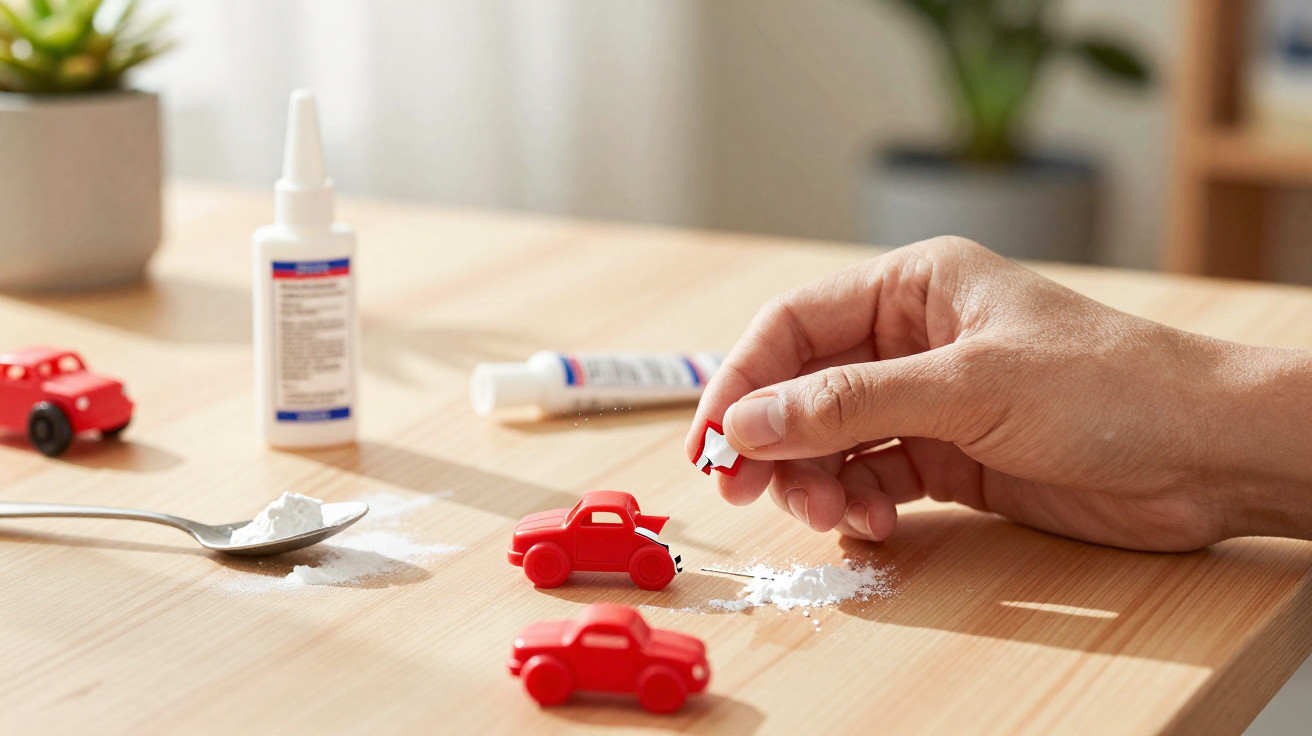
A chair leg splitting just before guests arrive, a drawer handle left in your hand, a small plastic item you assumed belonged in the bin: everyone knows how a minor repair can ruin an entire day. In my grandfather’s workshop, an old box of bicarbonate of soda always sat beside a tube of glue. At first glance, there was nothing particularly remarkable about it. Yet this understated pairing is now reappearing in garages, DIY forums and even on the kitchen worktops of busy households. It is no substitute for a new part or a craftsperson’s expertise, but it can rescue plenty of small items. The outcome is often surprisingly effective.
The overlooked combination that gives objects a second life
The idea relies on an almost ordinary pairing: cyanoacrylate glue, commonly known as “super glue”, and bicarbonate of soda. When brought together, the powder speeds up the glue’s setting time and forms a hard material that can fill a crack or rebuild a small missing section. Initially it looks like white dust, but within seconds it turns into a type of solid resin. The process seems almost too straightforward to work. That simplicity is precisely why it has returned: you do not need a large workbench or expensive equipment to rescue an everyday object.
A neighbour recently described repairing the broken mounting bracket for his electric gate remote using this method. The thin black plastic part had cracked around the screw hole, the sort of damage that makes an item unusable even though everything else still works. He aligned the edges, added a drop of glue and then sprinkled over a pinch of bicarbonate of soda. After building up several very thin layers, he sanded away the excess. The repair has held for more than a year despite daily handling. A replacement part would have cost nearly €30, excluding delivery.
There is nothing magical about the reaction, although it may look that way. The bicarbonate acts as a filler and speeds up the glue’s hardening, while the glue works its way into the surface’s tiny irregularities. The repaired area then becomes very rigid, at times more rigid than the surrounding plastic. This makes it useful for small brackets, chipped corners, worn screw threads and decorative objects. Let us be honest: hardly anyone does this every day. But when a casing lug snaps or a toy loses a small peg, this tip can prevent a needless purchase.
Using super glue and bicarbonate of soda: thin layers and patience
For the neatest result, prepare the surface before opening the tube. Clean and dry the object, remove any crumbly material, then position the parts to be joined. Apply a very small amount of glue along the crack or inside the gap, then add a light dusting of bicarbonate of soda. Wait a few seconds, tap off the surplus and repeat if a deep gap needs filling. It is better to build up the repair in thin layers than create a large lump that is difficult to sand back. A fine file or fine-grit abrasive paper can then restore a cleaner shape.
The most common mistake is rushing in with a large drop of glue and a whole spoonful of powder. The mixture heats up, can sometimes release an unpleasant smell, and may become grainy or brittle. It is best to work near an open window, protect the work surface and keep your face well away. Do not use this approach to repair an item intended to touch food, a toy that a child puts in their mouth, a damaged electrical cable, or a component involved in vehicle safety. A home repair has limits, and recognising them prevents a great deal of trouble.
For items subject to only light stress, my grandfather’s rule remains remarkably relevant: do not try to save everything; reinforce what can genuinely be reinforced. Precision matters more than quantity. Wear safety glasses and avoid cotton gloves, as cyanoacrylate glue can react with the fibres and become extremely hot.
“A successful repair is not always noticeable: it simply makes the object useful again.”
- Clean and thoroughly dry the cracked area.
- Use a small pinch of bicarbonate of soda, never a large heap.
- Apply the glue in thin layers and allow it to harden between each application.
- Sand gently once the material is completely hard.
- Keep this technique for non-critical parts that do not need much flexibility.
Repairing small things means viewing what you own differently
There is something reassuring about this small repair: it slows the instinct to throw something away as soon as it shows a weakness. A box, handle, frame, appliance foot or the corner of a toy can sometimes be put back into service with ten minutes of attention. It is not only about saving money, although that matters when expenses mount up. It is also a way of regaining a little control over ordinary possessions. Repairing is not cut-price DIY: it means deciding that an object deserves another chance.
Glue and bicarbonate of soda will never replace welding, suitable fixings or a professional’s work. Some materials remain too flexible, some breaks are too wide, and objects exposed to heat or high loads require another solution. But this tip recalls a simple truth that previous generations understood well: before replacing something, it can be worth taking a closer look. Where is the weak point? Can the part be strengthened? Even an imperfect attempt suggests a different relationship with the home and what it contains.
Perhaps you have an item at home that everyone has been avoiding for weeks: a wobbly coat hook, a cracked battery cover or a small furniture component put aside “for later”. Taking it out of the cupboard and seeing it differently can sometimes be the start of a very simple repair. The next time a plastic part appears beyond saving, that forgotten white powder at the back of the cupboard may change what happens next. The best tips are often the ones shared over a coffee, without much fuss.
| Key point | Detail | Added value for the reader |
|---|---|---|
| The glue-and-bicarbonate pairing | Bicarbonate of soda speeds up cyanoacrylate glue setting and helps fill small gaps. | Quickly repair small cracks or broken lugs. |
| The thin-layer technique | A small amount of glue followed by a light dusting of powder produces a neater, stronger finish. | Reduce excess thickness, heat and sanding. |
| Limits to observe | Do not use for food-related, electrical, medical or safety-related purposes. | Use this tip without taking unnecessary risks. |




Comments
No comments yet. Be the first to comment!
Leave a Comment