
Sometimes, a single detail is enough to spoil a room you otherwise really like. The sofa is positioned perfectly, the television is at the right height, and the lamp casts that soft evening glow… then your eye lands on a nest of black cables winding across the floor. Chargers, broadband router, extension lead and lamp cable: everything appears to have started a life of its own. We all know the moment when we shove a cable behind a piece of furniture, promising to deal with it “this weekend”. Let’s be honest: nobody actually does that every day. Yet one very simple trick can turn this visual clutter around in minutes, without drilling into the wall or redoing the entire set-up. The result is often surprisingly effective.
Adhesive cable trunking: the small detail that changes everything
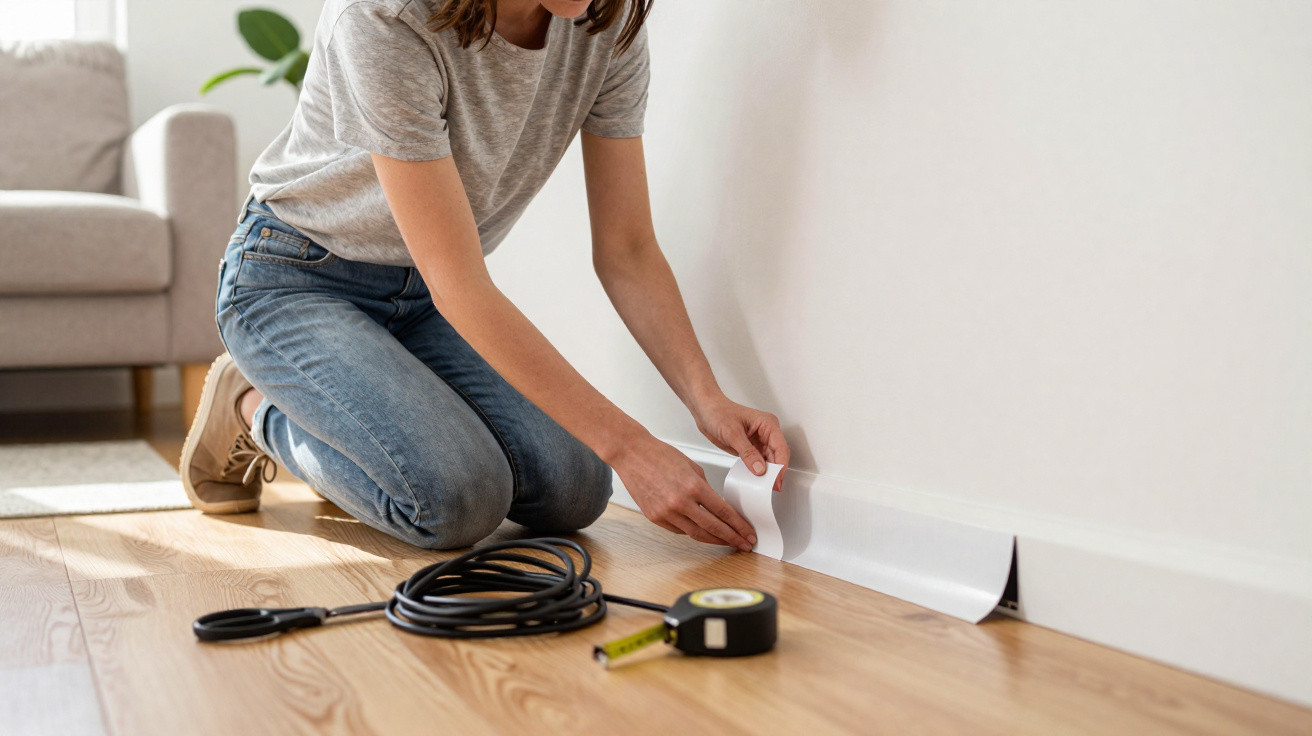
The most effective approach is to use flexible or rigid adhesive cable trunking, selected to match the wall, skirting board or furniture. It sticks in place within seconds and encloses the wires in a discreet narrow channel that no longer draws the eye. The cable has not truly vanished, but it no longer dominates the space. That visual illusion is what makes all the difference.
In a living room, the clearest example is a wall-mounted television. Cables running down towards the TV unit catch the eye, even in a carefully styled space. White trunking fitted on a pale wall can make them almost instantly disappear; on a coloured wall, some versions can be painted with the same paint used in the room. Five minutes is often enough to measure the length, hand-cut a slim model and attach its adhesive backing.
This option is popular because it avoids major work and needless expense. Rather than recessing cables into the wall-a job requiring equipment, time and sometimes a landlord’s permission-you simply bring order to what is in view. A home feels calmer when minor messes no longer demand attention. It is almost a decorating principle, but above all it is an everyday reality.
A quick method for a neat finish in under five minutes
First, unplug the relevant appliances, then gather together the wires that follow the same route. Wipe the skirting board, wall or rear of the furniture with a dry cloth: adhesive does not hold well on a dusty or greasy surface. Next, fit the trunking without pulling on the cables, leaving a little slack near the sockets. The right approach is to conceal the route, rather than stretching the wires tight like cords.
A common mistake is choosing trunking that is too large “just in case”. It can end up being as noticeable as the cables it was meant to conceal, particularly beside a television or desk. It is better to choose a slim option, even if that means fitting two separate small channels when there are many wires. If you rent, opt for removable adhesive strips: they reduce unpleasant surprises when it is time to hand back the keys.
Before closing the cable cover, simply check that nothing is overheating and that the sockets remain accessible. As an electrician often points out:
“A tidied cable must remain inspectable, without being crushed, pinched or trapped behind furniture that is too heavy.”
A few guidelines will stop a good decorating idea becoming risky DIY:
- do not overload a concealed extension lead;
- allow power adapters room to breathe;
- keep electrical cables separate from delicate wires where possible;
- make sure switches and sockets are easy to reach.
When cable organisation becomes a genuine decorating touch
Once the wires are hidden, the room rarely looks “different” at first glance. Instead, it feels tidier and more restful, as though something has finally been put back where it belongs. It is the sort of subtle change guests may not always be able to identify, but they notice it nonetheless. Behind a desk, along a skirting board or beside a bedside table, this minor adjustment also frees up space to live, work or simply vacuum without sighing.
Adhesive cable trunking is not just for immaculate magazine-style living rooms. It works in a child’s bedroom with a nightlight, in a hallway where the broadband router takes centre stage, or in a kitchen where the food processor, kettle and phone charger compete for the socket. The aim is not to conceal every sign of life. It is simply to decide what you want to keep visible and what you would rather forget about.
There is another very practical satisfaction: this small task needs no drill, no dust and no call for someone to come to the rescue. Some people add braided sleeving to group wires beneath a desk; others use adhesive clips to guide a charger along a table. Every home creates its own route, according to its sockets, furniture and routines. The most useful solution is often the simplest one: see cables as part of the décor rather than an inevitability.
| Key point | Detail | Added value for the reader |
|---|---|---|
| Adhesive cable trunking | A slim channel that can be attached to a skirting board, wall or behind furniture. It is available in white, black, light wood and paintable versions. | Quickly conceals visible wires without drilling, for a far more discreet finish than simply pushing a cable behind furniture. |
| Quick preparation | Unplug appliances, remove dust from the surface, group the cables, then fit the trunking without placing excessive strain on the wires. | A neater installation that lasts better and remains easy to alter when moving home or changing furniture. |
| Everyday safety | Avoid pinched cables, overloaded extension leads and transformers enclosed in an unventilated space. | A more orderly home without sacrificing access to sockets or the proper operation of electrical appliances. |




Comments
No comments yet. Be the first to comment!
Leave a Comment