
An old sideboard in the sitting room shifts as soon as a stack of plates is placed on its top. The small kitchen table, meanwhile, appears to dance across the tiled floor at the slightest knock from an elbow. Before considering the tip or an expensive replacement, a few straightforward steps can often restore a piece of furniture to its original stability.
We all know that slightly irritating moment: you sit down for dinner, cut your bread, and the table starts shaking as though it has something to say. In my case, it was a beech chair inherited from an aunt-apparently sturdy, yet incapable of staying quiet for more than two minutes. The first thought is usually that the wood is “finished”. Very often, it is nothing of the sort. Over time, it has simply moved, endured being relocated, humidity, minor impacts and the everyday use that gradually loosens everything without warning. Wobbly furniture is not necessarily beyond saving. Sometimes, it only needs a little care, a few everyday tools and an honest assessment. The answer is often closer than you think.
Find the cause of the wobble before reaching for the glue
An unstable piece of furniture rarely gives particularly graceful clues. It creaks, leans, catches slightly on the floor, or its feet never seem to touch the tiles at the same time. Hold it with both hands and gently move it in several directions: where the movement occurs already tells much of the story. If the entire piece rocks while none of its joints move, the floor or the leg lengths may be responsible. If one corner opens up, inspect the tenons, rails and screws. A minute of observation prevents random repairs.
In an older flat, a coffee table can look warped when the real culprit is slightly sunken floorboards. One simple test is enough: place the furniture on a flatter surface, such as a large board or elsewhere in the room. If the wobble disappears, there is no need to dismantle anything. Conversely, if a chair continues drumming with its feet even on a level floor, a joint is probably loose. A difference of only 2 or 3 millimetres can create remarkably frustrating instability in daily use.
Wood is not a fixed material. It swells when the air is damp, contracts when the heating is on, then settles into a balance that is never quite the same as the previous year’s. Old glues may also become brittle, while screws gradually enlarge their holes through repeated strain. The good news is that this wear is often confined to one area. The aim is not to make furniture look brand new at all costs, but to restore a sound structure. Repair starts with an accurate diagnosis, not an emergency squeeze of glue.
Simple ways to restore stability to wooden furniture
First, empty the furniture and turn it over carefully, ideally onto a thick blanket. Tighten every accessible screw using a suitable screwdriver: damaging a screw head with a bit that is too small happens quickly. If a screw spins freely, remove it, insert a few wooden cocktail sticks coated with wood glue into the hole, allow the glue to set, then screw it back in without forcing it. This small trick works particularly well on common pine, beech or plywood furniture. Always wait until everything is fully dry before putting weight back on the item.
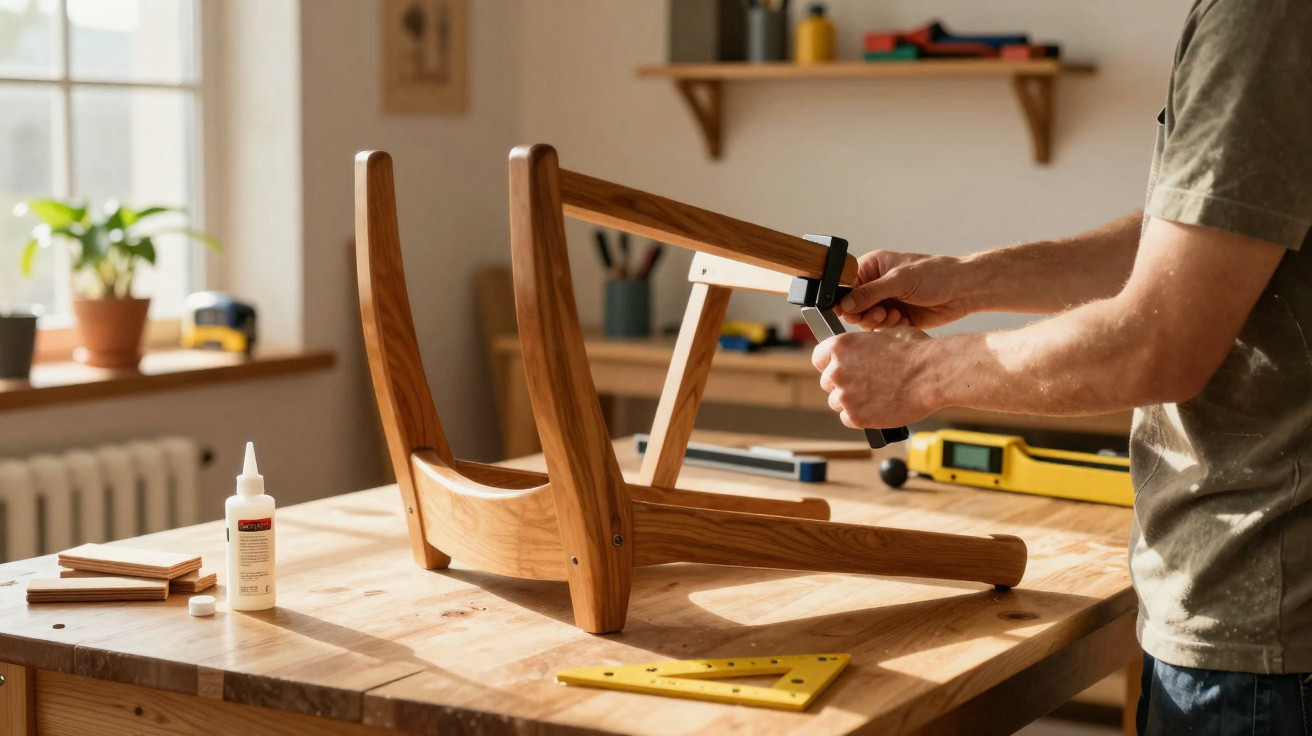
When the movement comes from a glued joint, the task calls for a little more patience. Gently open the joint if it separates naturally, remove dust and old glue residue with a fine blade or light sandpaper, then apply a vinyl wood glue. Clamp the joint, protecting the surface with wooden blocks or cardboard. Let us be honest: nobody really does this every day. Taking your time is better than clamping too tightly and permanently marking a leg or rail.
Furniture that twists diagonally sometimes lacks a supporting element rather than glue. A small, unobtrusive metal angle bracket fitted inside a corner can transform a sideboard or desk. On a chair, a low stretcher or a triangular wooden brace is often neater and longer-lasting.
“A successful repair does not try to hide the passing of time: it simply stops the furniture from suffering further.”
- Check first that the floor is level.
- Tighten screws before taking joints apart.
- Use a glue suitable for indoor or outdoor wood.
- Fit pads beneath the feet once the repair is complete.
Reinforce the structure instead of hiding the issue
Felt pads, plastic shims and pieces of cardboard slipped beneath a foot can provide a fix for one evening, but they do not always address the underlying problem. If the structure moves every time it is used, the furniture becomes more fatigued and cracks widen. A well-considered reinforcement, fitted where the wood is under strain, is preferable to an invisible but temporary solution. On a table, a bracket beneath the top is often concealed. On a chest of drawers, a screwed rail at the back can stop a gradual warp from taking hold.
It is also worth accepting that antique furniture should not be repaired like a flat-pack shelf. A family china cabinet assembled with wooden dowels deserves gentler handling than furniture made from chipboard panels. If in doubt, photograph every stage before removing a part, especially when several components appear fragile. Complete dismantling is rarely necessary and can make a simple repair more complicated. A limited, tidy and reversible intervention will often better preserve the object, its usefulness and even its sentimental value.
Some signs mean it is wise to seek the advice of a cabinetmaker: a leg split along its entire length, a severely twisted top, evidence of active insects, or a structure that separates despite being tightened. This is not giving up; it avoids the seemingly good idea that breaks a difficult-to-replace component. In most other cases, a screwdriver, glue, clamps and a quiet hour will often be enough. Repairing furniture is also a way of slowing down a little in a home where everything seems replaceable. The result will not always be perfect, but it will be dependable-and that is often all that is needed.
| Key point | Detail | Added value for the reader |
|---|---|---|
| Identify the source of the wobble | Test the furniture on a level floor and locate the moving joint | Avoids unnecessary repairs and needless expense |
| Repair worn fixings | Tighten screws, fill enlarged holes and reglue open joints | Restores lasting stability with little equipment |
| Reinforce without altering the character | Use discreet brackets, rails or suitable pads | Extends the furniture’s life while preserving its appearance |

Comments
Продвижение сайтов по России: конкуренция в регионах https://proffseo.ru/prodvizhenie-sajtov-po-rf
В среднем, продвижение по нескольким регионам сразу в компании «Пиксель Плюс» начинается от 60 000 рублей в месяц (если в списке городов имеется Москва) и от 40 000, если продвижение по 2 регионам без Москвы https://proffseo.ru/prodvizhenie-zarubezhnykh-sajtov
+ Получите:
Региональное продвижение позволяет охватить новую целевую аудиторию, осуществлять развитие и экспансию в город, в котором заинтересован бизнес: компания, бренд, интернет-магазин https://proffseo.ru/prodvizhenie-angloyazychnykh-sajtov
Для продвижения компании и сайта по конкретному городу, области или региону России, нужна специальная «региональная» SEO-оптимизация сайта https://proffseo.ru/prodvizhenie-angloyazychnykh-sajtov
по версии Рейтинга Рунета 2021 https://proffseo.ru/prodvizhenie-angloyazychnykh-sajtov
Время «мастеров на все руки» давно прошло https://proffseo.ru/
Только слаженная командная работа специалистов своего дела приведет к максимальным результатам https://proffseo.ru/prodvizhenie-zarubezhnykh-sajtov
Leave a Comment