
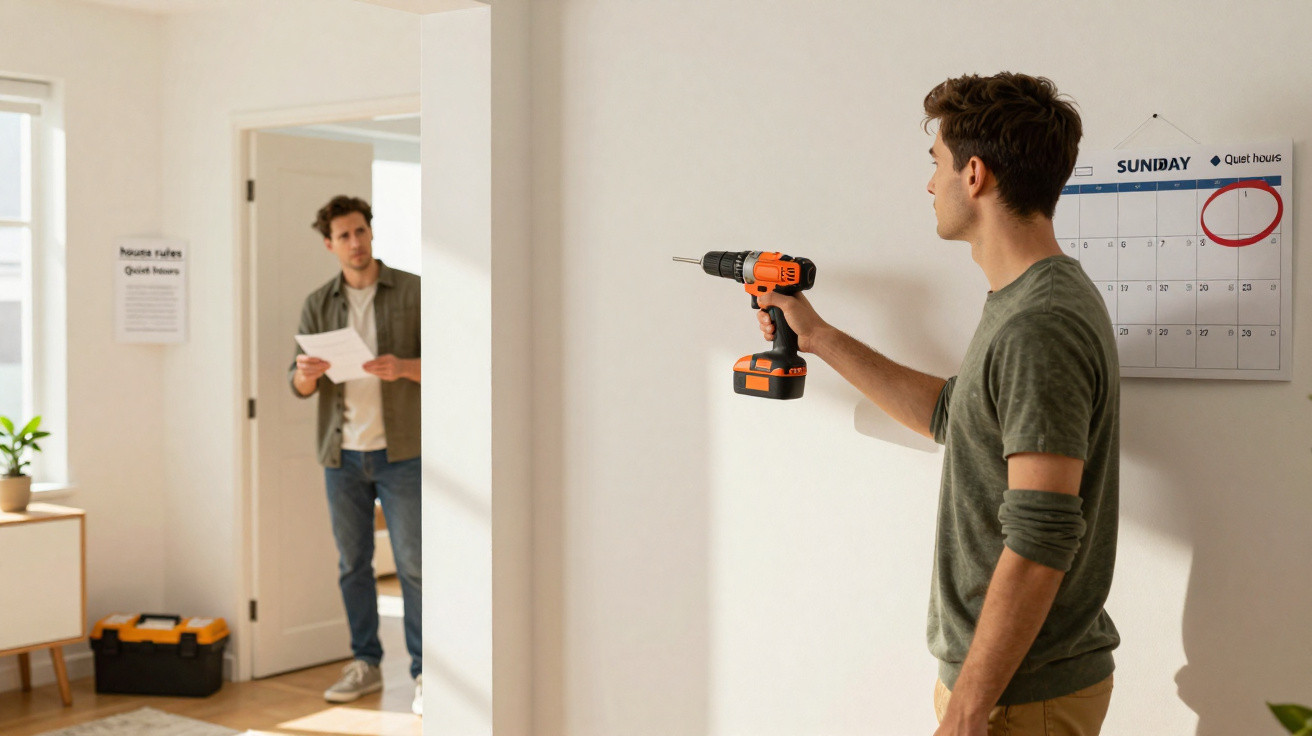
It is 10.17 am on a Sunday, and the drill is waiting on the living-room floor. The curtain rail has finally arrived, the wall has been measured three times and the wall plugs are ready. Yet a familiar doubt lingers behind the door: is this really the right time to drill two holes? Some people in the building are still asleep, others are already having lunch with their families, and the downstairs neighbour may have worked overnight. Sunday DIY often feels like a minor emergency, but it can rapidly become a lasting source of friction. Drilling, sanding, sawing or using an angle grinder is not automatically prohibited. It depends on the time, the setting and local rules. Getting the details wrong can prove costly.
Sunday DIY is not permitted all day
Whether in blocks of flats or housing estates, the noise of a drill travels through walls far more easily than good intentions do. Sunday is treated differently: most local authorities allow noisy work only during a restricted period, often in the morning, to protect residents' rest. One rule appears regularly in local orders: noisy DIY or gardening equipment is allowed from 10 am to 12 noon.
This 10 am-to-noon period is not a fixed national law. It is a widely used timetable drawn from numerous prefectural or municipal orders, but some towns impose tighter limits and others set slightly different times. The rules may therefore differ in Paris, Lyon, a tourist village or a rural municipality. The right approach starts before you take out the drill.
The Public Health Code does not set one universal hour for drilling holes in a wall. Instead, it penalises noise that disturbs neighbours because of its duration, repetition or intensity. In other words, ten minutes of quiet DIY during authorised hours does not have the same impact as running an electric sander for two hours with the windows open. Let us be honest: hardly anyone does that every day, but one noisy Sunday can leave a strong impression.
Times to check before drilling or sanding
Before you begin, look for the municipal order on your town hall's website, call the local authority reception desk or check information boards in your area. Leasehold building regulations may also impose more specific restrictions, particularly in newer developments where noise disturbance is closely monitored. In many departments, the generally accepted times look like this: weekdays, 9 am–12 noon and 2 pm–7 pm; Saturday, longer periods; Sunday, often only a morning slot.
A common mistake is assuming that small jobs are exempt because they take “only five minutes”. An impact drill, orbital sander or jigsaw can create sharp, repetitive noise that is especially audible in an older flat. Let your nearest neighbour know if several fixings need to be drilled: a simple message can prevent considerable irritation. Courtesy does not replace the rules, but it often stops the situation from escalating.
If a neighbour complains, switch off the tool, check the local times and offer to continue later rather than allowing tempers to rise in the corridor. The law addresses genuine disturbance, rather than the mere act of living in your own home, as the relevant provision makes clear.
“No particular noise must, by its duration, repetition or intensity, undermine the peace of the neighbourhood or human health.” - Article R. 1336-5 of the Public Health Code
- On Sundays: check whether your municipality permits DIY work, often between 10 am and 12 noon.
- For a sander, saw or drill: choose the shortest and least sensitive time slot.
- In a leasehold building: read the regulations again and notify neighbours if the work will take a little while.
Fines and neighbour disputes: what you could actually face
Noisy DIY outside the permitted times may be deemed a neighbourhood disturbance, even in the middle of the day. Contrary to a persistent belief, daytime noise nuisance does exist: the racket does not have to occur at night to be penalised. A municipal police officer, police officer or gendarme may record the disturbance and issue a penalty, particularly when the noise is obvious, prolonged or repeated despite requests to stop.
A fixed penalty for neighbourhood noise can be 68 euros, usually rising to 180 euros if payment is late. For a third-class offence, the maximum amount can reach 450 euros before a judge. In the most strained situations, a neighbour may also bring civil proceedings and seek compensation if they can demonstrate an abnormal neighbourhood disturbance. A drilled wall can be filled; a damaged relationship with a neighbour, far less easily.
The best method is a practical one: prepare the measurements, wall plugs and tools before the authorised slot, then make the noise in one short session. When assembling furniture, cutting the pieces on Saturday or using felt pads, clamps and a manual screwdriver on Sunday can transform the atmosphere. This is not about tiptoeing through life, but about recognising that other people's rest is also part of communal living.
| Key point | Detail | Benefit for the reader |
|---|---|---|
| Sunday times | Often permitted in the morning, frequently from 10 am to 12 noon, depending on the local order | Avoid doing DIY at a prohibited time in your municipality |
| Legal rule | Noise may be penalised because of its duration, repetition or intensity | Understand that noise nuisance can exist even during the day |
| Financial risk | A fixed penalty of 68 euros, which may increase in the event of late payment or proceedings | Assess the consequences of excessively noisy DIY |





Comments
No comments yet. Be the first to comment!
Leave a Comment