
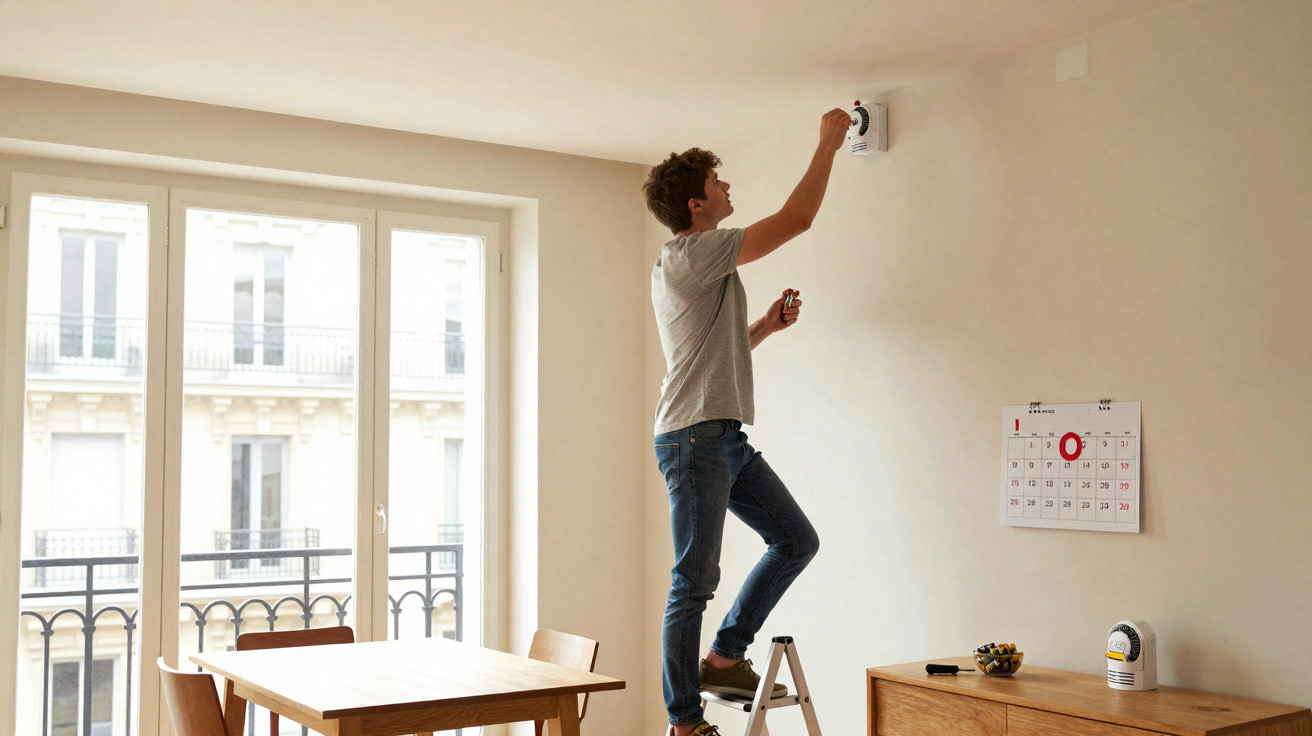
In many homes, smoke alarms remain fixed to the ceiling… with flat batteries. In the United States, firefighters are sounding the alarm.
An article from a US news website focused on consumer issues and home safety, subsequently picked up by several local media outlets, has brought a highly practical question back into focus: when should smoke alarm batteries be changed, and why do so many households still overlook this straightforward task? Drawing on data from US emergency services and advice from fire-prevention experts, specialists set out a clear timetable… one that many families fail to follow.
A required device that is too often overlooked
In the article circulated by the US outlet, firefighters stress that a smoke alarm remains the first line of defence between the start of a fire and a tragedy. In the United States, as in France, this device has become essential in homes.
Yet US figures reveal a worrying blind spot: a significant proportion of fitted alarms do not work when a fire breaks out. The most common reason comes down to one tiny item: the battery.
“In many home fires, emergency services find either no smoke alarm at all or a device with a flat or removed battery.”
US firefighters point out that a properly working smoke alarm greatly reduces the risk of death in a house fire. That protection, however, is only effective when the device has power and is properly maintained.
When to change the battery: the recommended schedule
The article outlines a simple guideline widely promoted by fire services in the United States: link battery replacement to a recurring date in the year so it is not forgotten.
The crucial moment: one fixed annual date
The experts interviewed explain that most older smoke alarms use standard batteries, which should be replaced roughly once a year. To prevent this task being overlooked, US emergency services advise people to:
- pick a set date each year, such as a clock change, anniversary or the start of a season;
- replace the battery as a matter of course on that date, even if the alarm has not indicated that it is running low;
- use the opportunity to test the alarm manually.
This approach is intended to overcome the biggest enemy of home safety: procrastination. Waiting for an alarm to chirp because its battery is low often means putting off the replacement… and then forgetting it altogether.
“Fire-prevention specialists insist that a battery which still has some charge must not be kept in a smoke alarm to ‘use up’ the rest of its life.”
Long-life battery smoke alarms: a false sense of security
The article also refers to newer models fitted with sealed batteries claimed to last ten years. US experts consider this an improvement, but warn that the promise should not lead people to neglect maintenance.
Even with these models, it remains necessary to:
- test the alarm regularly using its designated button;
- check the manufacturing date or expiry date shown on the casing;
- replace the entire smoke alarm, including its battery, once the stated lifespan has ended.
Firefighters note that electronics age, dust can build up, and components become less reliable over time, even where the battery still appears to be working.
Why so many households miss this vital date
The US article examines at length the reasons why thousands of households each year live with non-functioning smoke alarms, sometimes without realising it.
Forgetfulness, noise nuisance and misplaced confidence
Three factors recur regularly in accounts collected by emergency services:
- Simple forgetfulness: once fitted, a smoke alarm fades into the background. Positioned high up, it receives no attention unless it sounds.
- The nuisance of chirping: some residents remove the battery when the alarm is triggered by cooking fumes or bathroom steam… and never put it back.
- Underestimating the danger: some households consider themselves “careful” and believe they would smell smoke in time, especially at night, a belief firefighters reject.
“Fire services remind people that smoke puts occupants to sleep long before flames become visible. Without an alarm, escape very quickly becomes impossible.”
A task tied to no routine
The experts interviewed highlight a psychological factor: replacing a smoke alarm battery is not established as a social or cultural ritual, unlike other seasonal tasks, such as putting away end-of-year decorations or switching the heating back on.
Without a clear prompt, maintenance gets lost in everyday routines. That is why US campaigns seek to link this task to clearly identifiable calendar events, repeatedly reinforced by the media or public authorities.
What to do at home: smoke alarm habits to adopt
The article sets out several straightforward steps to use at home to make an installation safer, whatever type of smoke alarm is fitted.
Check, test, replace: three essential actions
- Visual check: make sure every smoke alarm is securely attached, that no tape or paint is blocking its openings, and that its indicator light is working.
- Monthly test: press the test button to ensure the siren sounds. If it is very quiet or silent, action is needed immediately.
- Battery replacement: on models with replaceable batteries, fit a new battery at least once a year, even if no audible warning has been given.
Firefighters also stress that an inconvenient alarm should never be disabled in a kitchen or noisy room: it is better to reposition it slightly further away than to remove the battery.
Choosing the right location and number of smoke alarms
The article stresses that the battery is only one part of the issue. The alarm must also be audible to every occupant, particularly at night.
Emergency services generally recommend:
- at least one smoke alarm on every storey of the home;
- an alarm close to bedrooms, in the hallway or on the landing;
- an unobstructed position away from direct ventilation grilles, to prevent air currents from dispersing smoke.
“A correctly positioned smoke alarm powered by a recent battery greatly improves the chances of being woken in time to get out.”
What this means for households in France
In France, fitting at least one smoke alarm in every home is compulsory. Regulations require the device to be present, but do not specify a particular type of battery. In practice, the same types of devices are found as in the United States: alarms with conventional replaceable batteries and models with sealed long-life batteries.
French firefighters deliver a message very similar to that reported by the US outlet. They emphasise:
- the need to test the smoke alarm regularly using its designated button;
- replacing the whole device after around ten years;
- changing the battery at least once a year for non-sealed models.
In France too, fire call-outs still reveal homes fitted with inoperative smoke alarms, often because the battery was removed after unwanted activations or was never replaced.
When should this be done in a French home?
French authorities do not impose a specific day for changing batteries, but recommend associating the task with a recurring event, as in the model described in the US article. The principle remains the same: create an annual habit that every household member can recognise.
Some social landlords, property management companies and local councils also organise collective reminders through posters or information messages, encouraging residents to check their alarms on fixed dates.
Understanding how a smoke alarm battery works
The US article also touches on the question of battery reliability over time. In a smoke alarm, the battery does more than power the siren. It must retain the ability to provide sufficient energy, even after long periods on standby.
Conventional alkaline batteries gradually lose their charge over the months, even if the alarm is never triggered. Long-life lithium batteries, by contrast, retain power better over time, which explains their widespread use in sealed models.
“Even with batteries advertised as lasting ten years, manufacturers and firefighters advise not exceeding the lifespan stated on the smoke alarm casing.”
Another point that is rarely known by the public concerns temperature: a very cold loft or a ceiling beneath an uninsulated roof can speed up battery discharge or interfere with the device’s correct operation. Experts therefore advise fitting smoke alarms in circulation areas with more stable temperatures.
One small task, major consequences
Ultimately, the US article restates a reality that emergency services repeat on both sides of the Atlantic: the difference between tragedy and a successful escape often comes down to a few seconds gained. A smoke alarm that is correctly powered and maintained provides that vital head start.
For a French household, the message is clear: taking a few minutes each year to change the battery or check an alarm’s date is far from insignificant. This quiet appointment in the family calendar can determine whether everyone is able to leave their home in the event of a night-time fire.





Comments
No comments yet. Be the first to comment!
Leave a Comment