
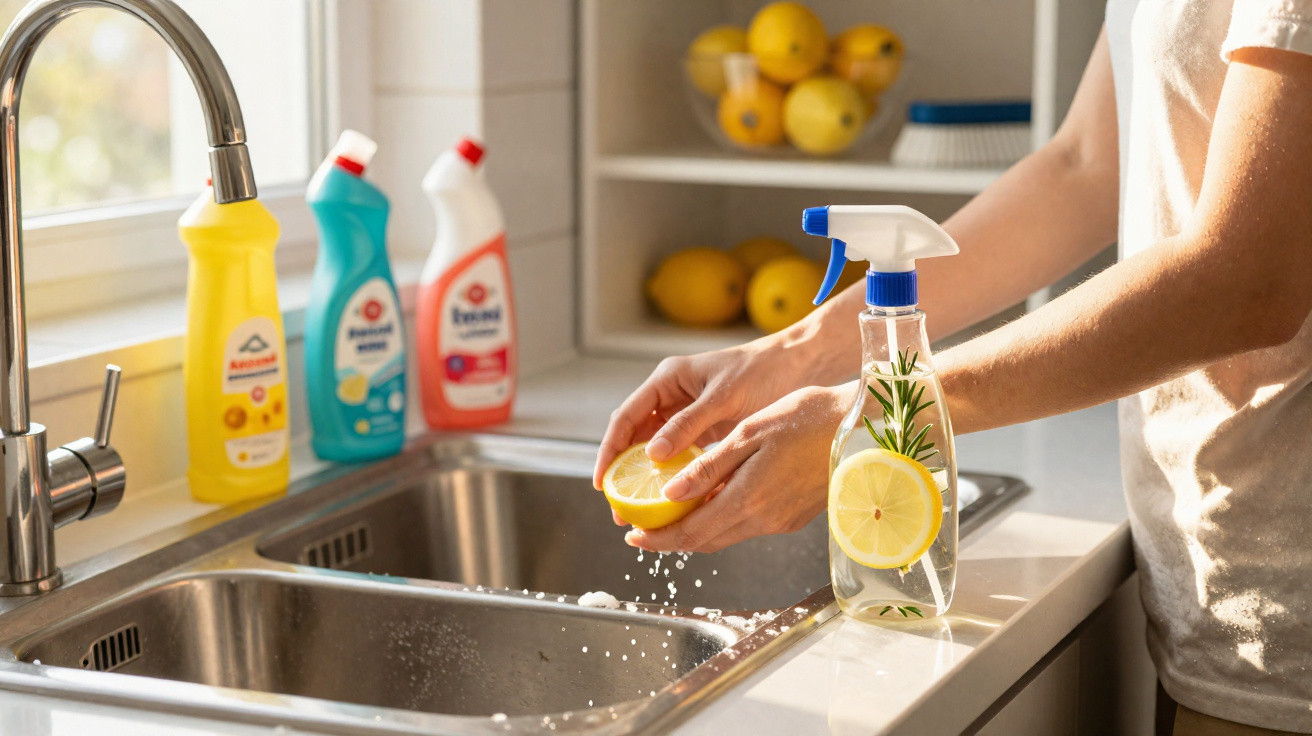
Beside it sat a half-empty bottle of glass cleaner, a greasy hob and a sink marked with water spots. It was one of those evenings when the kitchen looked more like “long day” than “Pinterest”. Out of sheer convenience, I cut open a lemon to squeeze into my water. Juice splashed onto the stainless-steel sink – and suddenly left a lighter streak. I rubbed the area once with the leftover lemon half. The mark disappeared. No foam, no cloud of chemicals, no plastic spray trigger. Just this small yellow fruit, capable of far more than brightening up our tea. At that point, a quiet, almost cheeky question arose.
Why a lemon of all things?
Anyone who sees a lemon only as decoration in a water jug is missing its secret role as a cleaning expert. Its modest peel contains a remarkably effective combination of acid, essential oils and odour-fighting properties. In many homes, colourful bottles pile up: one for limescale, one for grease, one for unpleasant smells. Meanwhile, a lone lemon is often sitting in the middle of it all, waiting patiently for its turn. We all know that moment of standing in front of the cleaning cupboard and wondering briefly: which of these eight sprays was for the taps again?
Instead, an increasing number of kitchens feature a small still life of bicarbonate of soda, vinegar and a sliced lemon ready for use. An Allensbach survey showed a few years ago that almost one third of Germans feel “overwhelmed” by the selection of household cleaners. The same pattern kept coming up in conversations with friends: people buy specialist products, use them twice, then forget about them. One acquaintance told me that when she moved house, she had to throw away five different cleaning bottles – all half full and all out of date. Yet she buys lemons fresh every week.
There is a simple truth in that: Many everyday cleaning problems are less complicated than supermarket shelves would have us believe. Citric acid dissolves limescale, breaks down grease and neutralises familiar kitchen odours from onions, garlic and fish. Of course, it is not a disinfectant in the medical sense. But for ordinary daily use, its power is often enough to replace three cupboard staples: limescale remover, degreasing kitchen cleaner and air freshener. It also offers something no plastic spray bottle can: the quiet sense that you are managing with fewer chemicals.
How one lemon replaces three cleaning products
The most straightforward method is to cut a lemon in half and use one half like a natural sponge. For removing limescale in the bathroom, rub the cut side over taps, the shower head and the basin fittings. Leave it briefly, rinse with clean water and buff dry. The acid loosens white marks without you having to breathe in harsh fumes. For stubborn patches, sprinkle a little salt onto the cut surface. It provides mild abrasion – rather like a gentle exfoliant for metal.
In the kitchen, lemon can stand in for your degreasing cleaner. The method is simple: squeeze a few drops of lemon juice straight onto the greasy hob, leave it for a moment, then wipe it with a damp cloth. This works particularly well on dried-on splatters from frying fat. If you wish, combine lemon juice with a little warm water and a tiny drop of washing-up liquid in a small bowl. Use it to wipe cupboard fronts, clean handles and even freshen the microwave. Heat a bowl of water with lemon slices for a few minutes, wait briefly, then wipe it out. The inside will smell as fresh as new.
Its third job is as a natural odour stopper. Slice the lemon and place one or two pieces in the fridge or in a small bowl beside the sink. If chopping boards smell unpleasant, rub them thoroughly with the cut side, let it soak in for a short time, then rinse. For the bin, a squeezed lemon remnant is enough: place it on a piece of kitchen roll and set it on top of the rubbish. Many people who try this once say that the feeling in the room changes: less stale smell, more freshness without an artificial floral fragrance. Let’s be honest: nobody genuinely sprays air freshener every day just because the kitchen smells of onions.
What to remember so your lemon really shines
A small routine is often enough to create a kind of “basic lemon cleaning kit”. Keep one or two lemons not only in the fruit bowl, but somewhere visible near the sink. Whenever you cook, cut one open and make deliberate use of what remains. First, squeeze some juice onto the tap; then rub the peel briefly over the hob; finally, use it on the chopping board. This turns the lemon from an ingredient into a small cleaning ritual. Anyone who wants to can pour a blend of water and lemon juice into a glass spray bottle and use it as a mild all-purpose cleaner.
There are a few traps that nearly everyone falls into at first. Some people enthusiastically rub lemon over everything – including delicate natural-stone worktops or unsealed marble. In those cases, the acid can do more harm than good. Testing a small, hidden area first provides reassurance. Others leave the lemon on for too long, so the limescale comes away but dull patches remain. Then there is the matter of time: anyone expecting lemon to rescue the oven “in no time at all” is often disappointed. Burnt-on layers that have built up over years still require more than one fruit and a clear conscience.
At the same time, people who clean with lemon regularly often describe a kind of mental relief. Fewer bottles, fewer labels and fewer warning symbols. More clarity, and more of a freshly cleaned kitchen scent rather than a “chemical laboratory” smell. One reader once wrote to me:
“Since I started using lemon as a little tool, cleaning feels less like a chore and more like a quick reset for my kitchen.”
It is useful to keep the fruit’s multiple roles in mind:
- As a limescale remover for taps, sinks and shower heads
- As a grease breaker for hobs, microwaves and kitchen fronts
- As an odour neutraliser for fridges, bins and chopping boards
What changes when a lemon tidies the cleaning cupboard
Anyone who takes an honest look through their cleaning cupboard will usually find not an organisational triumph, but a small museum. There are bottles with old logos, specialist products for situations long forgotten, and partly used sprays whose original purpose is no longer clear. Once you start using lemon intentionally, a subtle shift in perspective often follows: the question of what you genuinely need – and what you merely keep carrying out of habit – becomes harder to ignore. Lemon almost forces you to observe again: how does the tap respond? How does the kitchen smell afterwards? How many products could actually be removed?
This small change also has an unexpectedly social side. When visitors are coming over, people are often self-conscious: the kitchen is not perfect, there are water marks somewhere, and the bin is half full. Then someone asks, “What smells so fresh in here?”, and you reply, “Just a bit of lemon in the sink.” It creates a different kind of conversation. Suddenly, it is about simple tricks, everyday life and the quiet wish for home to feel a little easier. Perhaps that is the fruit’s secret charm: it is so ordinary that nobody feels lectured by it.
A lemon will not turn your home into a glossy magazine set. It will not work miracles where years of “I’ll do it later” have accumulated. But it can provide a small counterweight to the overwhelm of shelves filled with colourful promises. A yellow spot in your line of sight that says: start small. Use what is already there. Turn a leftover into something useful. Anyone who has seen a single lemon replace three bottles often reconsiders not only their cleaning cupboard, but other routines too. Perhaps your next lemon will tell you more about your home than you expect.
| Key point | Detail | Benefit for the reader |
|---|---|---|
| Lemon as a limescale cleaner | Citric acid removes limescale from taps, sinks and shower heads when applied with the cut surface | Saves buying specialist bathroom cleaner and reduces everyday chemical use |
| Lemon as a degreaser | Used directly on the hob or in a water-and-lemon blend for surfaces | Replaces degreasing kitchen cleaner and makes use of food leftovers already on hand |
| Lemon as an odour fighter | Slices in the fridge, in the bin or rubbed over chopping boards | Fresher air without artificial fragrances and less need for air fresheners |
FAQ:
- Can lemon really replace all chemical cleaners? No, it mainly replaces mild cleaners for limescale, grease and odours, rather than strong disinfectants or specialist products.
- Which surfaces should I not use lemon on? Delicate natural stones such as marble, limestone and unsealed concrete are sensitive to acid and can become dull.
- How long can lemon juice be left to work? Usually only a few minutes on metal and ceramic; it is better to apply it briefly several times than leave it on once for too long.
- Can I keep leftover lemons for several days? Store them in a container in the fridge for one to two days; after that, they shrivel and lose effectiveness.
- Is cleaning with lemon cheaper than conventional cleaning products? In many households, yes, because one regularly purchased lemon can partly replace several specialist products and is less likely to sit unused in the cupboard.

Comments
No comments yet. Be the first to comment!
Leave a Comment