
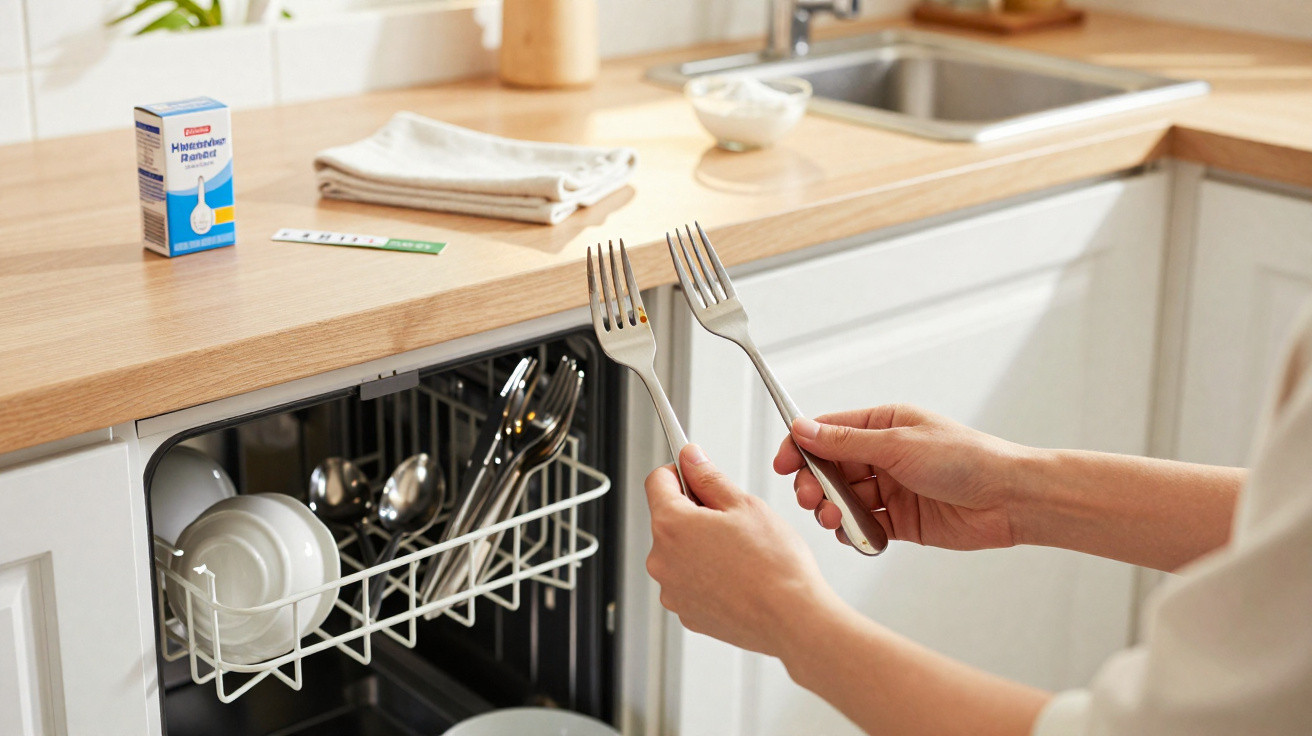
The same scene plays out in countless kitchens: you open the dishwasher, briefly pleased by the sparkling glasses, only to be disappointed. Knives, forks and spoons are marked by brown-orange spots or a grey-black film. Instead of stainless-steel shine, there is frustration and the assumption that either the dishwasher or the cutlery is simply rubbish. Yet these rust marks result from a very specific combination of metallurgy, water chemistry and a few everyday mistakes – and the answer is often simpler than expected.
What is actually happening to your cutlery
Many people rely on the term “stainless steel” and assume it cannot rust at all. That is only partly true. Stainless steel is not indestructible: depending on its alloy, the metal reacts very differently to heat, moisture and detergents.
Manufacturers commonly use different grades of steel for cutlery:
- Forks and spoons are often made from 18/10 stainless steel (containing nickel), which is relatively resistant to corrosion.
- Knives frequently use steel with a higher carbon content so that the blade stays sharp.
Although that extra carbon helps knives retain their edge, it also reduces their resistance to rust. This is why knives are often the first items to rust in many homes, while the rest of the cutlery still looks flawless.
Rust on cutlery does not automatically mean poor quality – it is often simply a more sensitive steel alloy meeting unfavourable conditions in the dishwasher.
Rust or a black tarnish? The difference with silver
Solid silver and silver-plated cutlery behave very differently from stainless steel. They do not rust; instead, they tarnish. Their surface reacts with sulphur compounds in the air or in food, producing the familiar black colouring.
The key issue is that dishwashers are simply not a suitable environment for silver. Harsh detergents, which often contain chlorine, attack its surface. The result is not merely discolouration, but genuine corrosion and permanent damage.
A basic rule from restoration workshops: silver does not belong in the dishwasher. It should be washed by hand.
The main causes inside the dishwasher
Rust stains on stainless steel are rarely caused by “bad steel”. Much more often, they are the result of several factors acting together.
Moisture trapped in the dishwasher
The most common culprit is cutlery left in a closed dishwasher for hours after the programme has finished. The inside remains warm and humid, while condensation collects in small recesses, around handles and in grooves.
- Water cannot dry away properly.
- Detergent residues remain on the surface.
- The protective chromium oxide layer on stainless steel is weakened.
More sensitive knife blades in particular can develop small dots under these conditions, which quickly look like rust – and often are rust.
Too much salt or the wrong regeneration salt setting
Regeneration salt is intended to soften the water. However, if the softener setting does not match the actual water hardness, problems can arise:
- Too much salt: a higher salt concentration in the wash chamber attacks metal surfaces more aggressively.
- Too little salt in hard-water areas: limescale and minerals build up, making the surface rougher and more vulnerable.
When heat and harsh chemicals are added to the equation, brown spots can soon appear, especially along cutting edges and corners.
Contact with other metals and “flying rust”
Another often overlooked issue is metal components that are already corroding, such as:
- rusting wire baskets in the dishwasher
- cheap sheet-metal or iron utensils placed in the cutlery basket
- old clips, fasteners or tin openers that end up in the machine
When tiny particles of rust break free, they can settle on otherwise undamaged stainless steel. This so-called “flying rust” may appear harmless at first, but can become the starting point for corrosion spots of its own.
Habits that quietly ruin your cutlery
Leaving cutlery in the dishwasher for too long
A common everyday approach is: “I’ll empty the dishwasher later.” That is precisely what makes the rust problem worse. Every extra hour of moisture increases the likelihood of staining – particularly when a programme finishes overnight and the door remains shut until morning.
Mixing metals indiscriminately
Loading stainless steel, silver, cheap iron utensils and perhaps an aluminium item into the same basket is practically an invitation to electrochemical reactions. Different metals in direct contact encourage small voltage differences that accelerate corrosion.
Particularly problematic combinations include:
- silver cutlery together with stainless-steel cutlery
- cheap steel items beside high-quality blades
Such mixtures often lead to staining and dull surfaces, even on short programmes.
Practical steps that quickly slow rust
What to do immediately after a wash cycle
The most important measure costs nothing but a little discipline:
- Open the dishwasher door as soon as the programme ends.
- Ideally, leave it slightly ajar so that steam can escape.
- Unload the cutlery as soon as possible rather than leaving it overnight.
The shorter the damp period after the programme finishes, the lower the risk of rust stains.
Check regeneration salt and water hardness
Many people set the water hardness when they buy the appliance and never adjust it again. Anyone who has moved home, or has never checked the settings, should do so. The dishwasher manual explains how to alter the hardness range.
Rules of thumb:
- If the water is very hard and the salt reservoir regularly runs empty, metal surfaces face greater stress.
- If the machine is set too “strong”, excess salt may circulate through the system.
Separate metals – especially silver and stainless steel
Silver cutlery is best kept out of the dishwasher altogether. If it does go in, it should not sit directly beside stainless-steel items. Other metals should also be placed separately in different areas where possible, so that they do not affect one another.
How to rescue cutlery that is already affected
Light rust stains on stainless steel
As long as stains are only on the surface, much can be saved. Straightforward household remedies are effective:
- Mix bicarbonate of soda or traditional baking soda with a little water to form a paste.
- Apply it to the rust mark with a soft cloth and rub using gentle pressure.
- Rinse thoroughly under running water and dry immediately.
Clear household vinegar can also remove light rust traces. The important point is not to soak items indefinitely. A brief soak, followed by rinsing and drying with a cloth, is enough.
Restoring shine to blackened silver
Damage to silver can look dramatic, but it is often confined to the surface. A simple restorative bath can work wonders:
- Fill a bowl with hot water.
- Line the bottom with aluminium foil.
- Add one to two tablespoons of baking soda or bicarbonate of soda.
- Place the silver items in the water for several minutes.
A chemical reaction transfers the sulphur from the silver surface to the aluminium. The silver becomes visibly brighter; then rinse it well and polish it dry.
When cutlery is genuinely beyond saving
If brown-orange spots repeatedly return in exactly the same place despite proper care, the cause is often deeper damage. Small indentations that feel like craters indicate pitting corrosion.
The appearance of these areas can only be improved to a limited extent. It may be sensible to wash such pieces by hand from then on, or to replace them entirely if the damage is highly visible – particularly with knives whose blades have already become blunt.
How to prevent new damage over the long term
Once you understand why cutlery rusts in the dishwasher, you can make better choices when buying it. Higher-quality stainless-steel grades with clear markings, such as 18/10, are more resistant to corrosion. For knives, it is worth checking for statements such as “dishwasher safe” – reputable manufacturers often clearly state any limitations.
In areas with extremely hard water, an additional water filter or a local water softener in the kitchen may be worthwhile. This protects not only cutlery and crockery, but also household equipment generally, from the kettle to the washing machine.
For particularly delicate or expensive cutlery, hand washing remains the safest choice in the long run. A few minutes at the sink may prevent the need to buy an entire replacement set – and avoid the daily irritation of unattractive rust spots on the dining table.



Comments
No comments yet. Be the first to comment!
Leave a Comment