
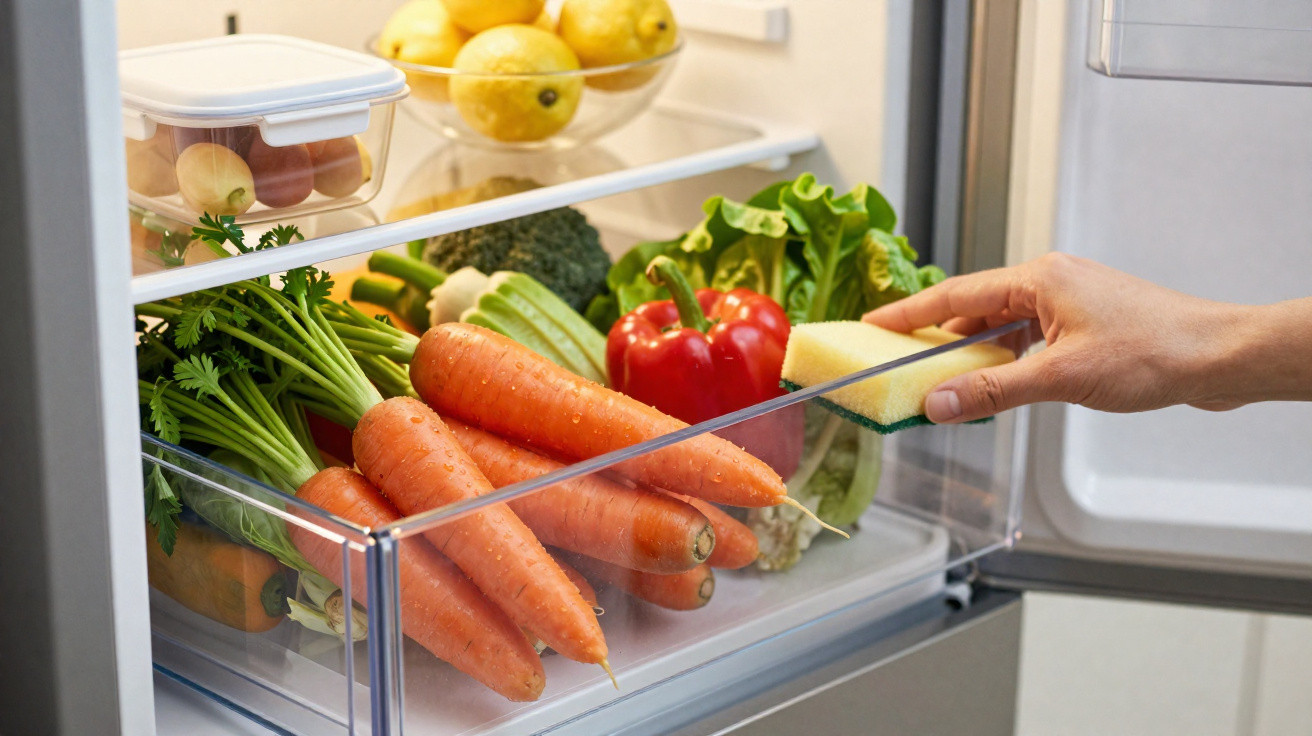
A refrigerator can develop a wet-sock smell well before any food has truly spoiled. The cause is not necessarily last week’s leftovers; it may be the hidden swamp taking shape in the crisper drawer. The surprisingly satisfying solution you may not have tested is a clean, dry kitchen sponge left inside to do… nothing. At least, nothing you can see. Even so, greens retain their crunch, berries leave fewer stains, and that lingering stale smell eases for weeks.
The lettuce drooped in one corner, strawberries turned misty, and condensation coated the drawer’s plastic sides like a gym mirror. A neighbour once suggested a trick so unglamorous that I nearly laughed: put a new sponge in the crisper and leave it there. It looks silly until you notice the difference.
The answer is simply a sponge. By Wednesday, the glass beneath the drawer was dry. The spinach still looked lively. That mild “old fridge” odour was no longer there to welcome me at breakfast. The sponge did not appear impressive; it merely sat there and subtly altered the conditions.
Why a dry sponge helps in a soggy crisper drawer
A crisper drawer creates its own miniature climate. Fruit and vegetables breathe, the air heats up whenever the fridge door opens, water condenses, and the process starts again. The plastic drawer walls hold on to humidity. That can be useful, up to a point. Excess moisture makes greens wilt, while too little leaves herbs dry and crisp around the edges. The ideal balance is narrow, and most kitchens do not reach it by accident.
Consider strawberries after a supermarket trip. They may look flawless at first, but after two days, a few become soft, one develops spots, and the entire punnet soon follows. A single spoiled berry gives off extra moisture and gases that encourage the others to deteriorate. In a drawer where damp air has nowhere to escape, decay wins battles you never witness. A dry sponge interrupts that cycle by absorbing the tiny pools of moisture you cannot see.
The principle is straightforward. Sponges are made to draw in water vapour and tiny beads of condensation from both the air and surfaces. This reduces the drawer’s overall humidity enough to slow mould and sogginess without drying out the produce. It also lessens moisture on packaging, where bacteria and yeasts first begin to thrive. Think of the shift as going from a rainforest to a meadow in the morning.
How to use a sponge in the crisper drawer
Choose a brand-new, fragrance-free, non-scratch kitchen sponge. Lay it flat in the rear corner of the crisper drawer rather than placing it on the greens. It needs to start dry. Replace it each week, or sooner if it becomes damp and heavy. If your refrigerator has two drawers, use one sponge in each. For decent airflow, keep the drawer around two-thirds full and leave any packaging vents open.
Everyone knows the moment when rocket goes dark around the edges and you decide not to notice. This modest trick gives you extra time. Pick a sponge that is neither antimicrobial-treated nor scented. Between uses, rinse it and allow it to dry completely, or alternate between two sponges so one can dry while the other is in use. Honestly, no one empties and cleans a crisper drawer every day. This method allows for that.
There are a few common mistakes to avoid. Some people put in a wet sponge, increasing humidity, while others push it beneath produce, where it absorbs juices and distributes them around the drawer. Keep the sponge dry and where you can see it.
“The goal isn’t zero moisture. It’s steady, gentle humidity with fewer peaks,” says a home economics instructor I called for sanity-checks.
- Use one dry, unscented sponge for each drawer.
- Replace it or dry it out every 5–7 days.
- Use it alongside a breathable container for greens rather than sealed plastic.
Small crisper drawer habits that save food and money
This tiny action can have disproportionately useful results. You spend less time throwing away slimy bags, spend less money making repeated lettuce trips, and are more likely to eat the food you purchase. A sponge cannot restore firmness to a peach that has been sitting for a week, but it extends the period when food is enjoyable rather than merely edible. That can change how your kitchen feels.
Your drawer becomes more dependable. You begin to trust your fridge again. That confidence helps you plan more effectively: shop once, cook twice, and serve meals with less pressure. A less damp crisper also helps prevent odours from building up throughout the refrigerator. There is less unexplained moisture, fewer sticky patches, and a gentle refresh of the air you notice whenever you open the door.
Minor improvements add up. Herbs make it through Thursday, carrots remain crunchy, and cheese is less likely to absorb a fruit-and-vegetable scent. The sponge will receive no praise, and it does not require any. What matters is having a drawer that quietly fits around your week instead of making you adapt to it.
Beyond the sponge: simple changes that strengthen the effect
Would you like the drawer to resemble a fresh market stall? Pair the sponge with a handful of easy adjustments. Move the humidity slider towards low for berries and greens that tend to sweat. Reserve the high setting for leafy herbs wrapped in a thin cloth. Keep apples and bananas out of the crisper because their ethylene speeds up ripening for everything else in that confined space.
Give greens containers that allow them to breathe. A salad spinner is ideal for the first day: spin the leaves, then place them in a vented container with one paper towel beneath the lid. Store mushrooms in their paper bag. Keep cut produce in sealed containers so its juices do not spread into the drawer’s air. Place fruit that ripens quickly in a separate container to slow the knock-on effect.
Create a small routine. On shopping day, add a fresh sponge. Halfway through the week, squeeze it out and leave it to dry on the worktop while you make coffee. Mark the drawer sliders with a strip of painter’s tape: “Low = berries/greens, High = herbs.” It requires almost no effort, and it makes the rest easier too.
The quiet satisfaction of a well-behaved fridge
Your kitchen is trying to help. The more small, sensible defaults you provide, the less it pushes back with wilted food and unpleasant smells. A sponge in the crisper may sound like the sort of tip you would quickly scroll past. But once you try it, the drawer stops resembling a swamp and begins working like a pantry with climate controls. It is not magic; it is design and habit meeting in the simplest possible form.
The enjoyable part comes next. You open the fridge, see bright greens and choose to cook rather than put it off. You spend less, waste less, and no longer blame yourself for the rapid spoilage that too many kitchens treat as normal. The adjustment is subtle. The feeling is not.
Try it for a week: one clean sponge and a small reset of the climate where your food is stored. The improvement creeps up on you, and then it lasts.
| Key point | Detail | Benefit for the reader |
|---|---|---|
| Moisture control | A dry sponge absorbs peaks of condensation inside the crisper drawer | Greens remain crisp, while berries develop mould less quickly |
| Airflow and placement | Place it in the back corner, keep the drawer two-thirds full and leave vents open | A stable microclimate without constant attention |
| Regular replacement | Change or dry the sponge every 5–7 days | Weeks of a fresher fridge with a 10-second habit |
FAQ:
- Should the sponge be dry or damp? Dry. A damp sponge increases humidity and defeats the purpose. Its role is to absorb ambient moisture, not introduce more of it.
- How often should I replace or clean it? Weekly is a sensible routine. Rinse it in hot water, squeeze it thoroughly, allow it to air-dry completely, and alternate it with a second clean sponge.
- Can paper towels do the same thing? They can help with moisture on surfaces, but a sponge holds more water and releases less back into the air. Many people use both: a towel in the container and a sponge in the drawer.
- Is it safe to put a sponge near food? Choose a brand-new, unscented sponge and keep it separate from washing-up use. Do not place produce directly on it. Colour-code it if that is helpful.
- What about ethylene from apples and bananas? Keep high-ethylene fruit out of the crisper or in a separate container. The sponge controls moisture, while separating those fruits controls ripening speed.


Comments
No comments yet. Be the first to comment!
Leave a Comment