
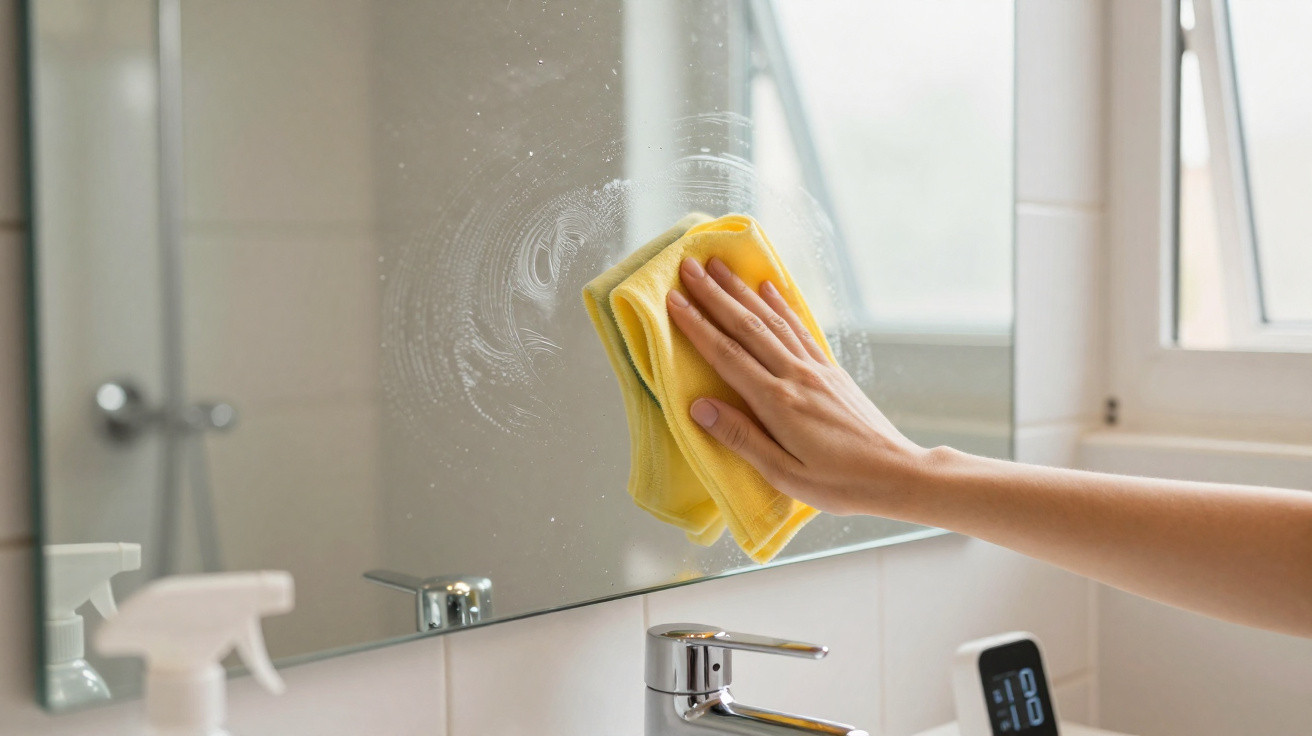
There is a small, mortifying bathroom moment that plays out everywhere. You have just cleaned the mirror, step back, tip your head slightly and, as the light changes, there they are: streaks. Tiny greasy reminders of toothpaste, fingerprints and a hurried morning. You exhale, fog the glass and rub at it with the hem of your T-shirt like a teenager, somehow leaving it even worse.
Then sunlight catches the window at exactly the wrong angle, and the mirror appears to have endured a downpour of soap and regret. You tell yourself you will “do a proper clean this weekend”, while knowing perfectly well that weekend-you forgets every promise made during the week.
There is, however, a simple trick that takes less than a minute and transforms the whole situation.
Once you have used it, you are unlikely to return to your old routine.
The embarrassing truth about bathroom mirrors
Most people assume mirror cleaning is simply spray, wipe and finished. Then daylight comes along and reveals every dried droplet and uneven mark, like an unforgiving before-and-after image of your hard work. The mirror turns into the room’s quiet critic, reflecting both your face and every shortcut you took.
That is the strange effect of a streaky mirror: it can make an entire bathroom seem slightly uncared for, even if you have tidied, folded the towels and lit a candle. The glass still seems to say, “Nice try.”
Fortunately, this does not mean you are lazy or hopeless at cleaning. More likely, you have been combining the wrong product, cloth and wiping technique.
A woman I interviewed was convinced she “couldn’t” make her mirrors come clean, regardless of what she used. Her usual choices were a standard glass spray, an old T-shirt and sometimes kitchen paper. In warm yellow lighting, the results always seemed acceptable. In bright morning sunshine, though, it looked as if somebody had brushed oily fog across the glass.
Out of frustration, she began timing the task: seven minutes, nine minutes and twelve on one particularly bad Saturday, when she tried newspaper, vinegar and half the cleaning aisle.
A friend eventually showed her a technique that required fifty seconds from the first spray to the final wipe. Her mirror suddenly resembled hotel glass. Not “good for home”. Truly clear.
The explanation is almost disappointingly straightforward. Glass does not require lots of product; it needs the correct texture and a movement that lifts grime rather than merely spreading it. Most streaks are not “stubborn dirt”. They are residue from using too much cleaner, fabric softener remaining in the cloth, microscopic lint or oils transferred from your hands.
When these are moved about in random circles, they are effectively smeared into visible patterns. That familiar cloudy finish is simply cleaner left on the surface without being buffed away.
Halve the amount of product, use the right cloth and change the motion, and the mirror behaves completely differently. It is not magic, although it can feel that way.
The under-a-minute mirror trick that actually works
For this fast method, take two cloths and the mildest cleaner you have. Keep one cloth slightly damp and the other entirely dry. Apply the cleaner to the damp cloth rather than spraying the mirror itself. Two light spritzes are enough.
Using the damp cloth, wipe the mirror in quick, straight lines from left to right, working from the top down. Do not overthink it: cover the entire surface once. Avoid circles and do not rub over the same patch repeatedly.
Immediately trace every line with the dry cloth, as though it were a shadow. Use the same movement and direction. By the time you reach the bottom edge, the glass should already be clear. Including reaching for the spray bottle, it takes under a minute.
People usually make two familiar errors. The first is soaking the mirror in product because more foam seems to mean more cleaning power. That is what creates streaks resembling river maps. The second is grabbing any cloth from the laundry pile, even though it may still contain fabric softener and lint. As a result, the mirror picks up invisible fibres and oils while you are attempting to remove them.
Realistically, nobody follows a perfect routine every day. You are not going to wash dedicated cloths after every clean or count sprays like a scientist.
The lasting solution is to make the process easier: keep one small bottle and two cloths in the bathroom, then turn the job into a ritual so quick that your brain has no reason to object.
“Once I stopped spraying the mirror directly and started spraying the cloth instead, the streaks disappeared,” says Léa, 34, who cleans hotel rooms for a living. “We don’t have time to baby every mirror, so our tricks have to be fast or we just don’t use them.”
- Choose flat, tightly woven microfibre cloths for both stages rather than a fluffy towel.
- Do not use fabric softener when laundering these cloths, as it leaves a film that can streak glass.
- Put the cleaner on the cloth rather than the mirror to prevent drips and excessive product.
- Wipe in straight top-to-bottom lines, following every damp pass with a dry one.
- To check the result, stand at an angle to the mirror and inspect it in natural light where possible.
When a clean mirror changes the whole room
The first time you use this method and step back, a subtle change becomes obvious. Instead of catching light in blotchy areas, the mirror becomes a calm, even surface. Your reflection appears sharper, while the frame, tiles and toothbrush left by the basin suddenly look more deliberate and less chaotic.
Everyone knows the feeling of a small, unexciting task unexpectedly improving their mood. At home, a mirror can quietly amplify that feeling: it reflects either clarity or low-level disorder.
After seeing a mirror become streak-free in under a minute, it is difficult not to notice the difference afterwards.
| Key point | Detail | Value for the reader |
|---|---|---|
| Use two cloths | One damp with cleaner, one dry, both tightly woven microfibre | Reduces streaks and cuts cleaning time to under a minute |
| Spray the cloth, not the mirror | Two light spritzes on the damp cloth instead of soaking the glass | Prevents drips, residue, and cloudy patches after drying |
| Straight-line motion | Clean top to bottom in fast, straight passes, following with the dry cloth | Leaves a hotel-like finish with less effort and no overthinking |
FAQ:
Question 1 Can I use regular kitchen paper instead of microfibre for this trick?
Kitchen paper can help in an emergency, but it often sheds lint and falls apart when wet, which may cause streaks to return. A flat microfibre cloth produces a smoother, clearer result and lasts far longer.
Question 2 Do I need a special glass cleaner, or will vinegar and water do?
For most mirrors, a basic mixture of water with a splash of white vinegar works well. Shop-bought glass cleaner is also suitable. The technique matters more than the brand.
Question 3 My bathroom has no window. Will this still look streak-free in bad light?
The method remains effective, but check the result once in daylight with the door open to “calibrate” your eye. Afterwards, you will be able to trust the technique even in artificial light.
Question 4 What if my mirror has old, hardened spots of toothpaste or hairspray?
Treat those areas first with a slightly wetter corner of the damp cloth and a small amount of cleaner. Then carry out the quick two-cloth pass across the full surface.
Question 5 How often should I clean the mirror to keep it this clear?
Once the mirror is properly clean, a 30–40 second touch-up every few days should be enough. A fast wipe while you are already in the bathroom often feels more manageable than a large weekly scrub.



Comments
No comments yet. Be the first to comment!
Leave a Comment