
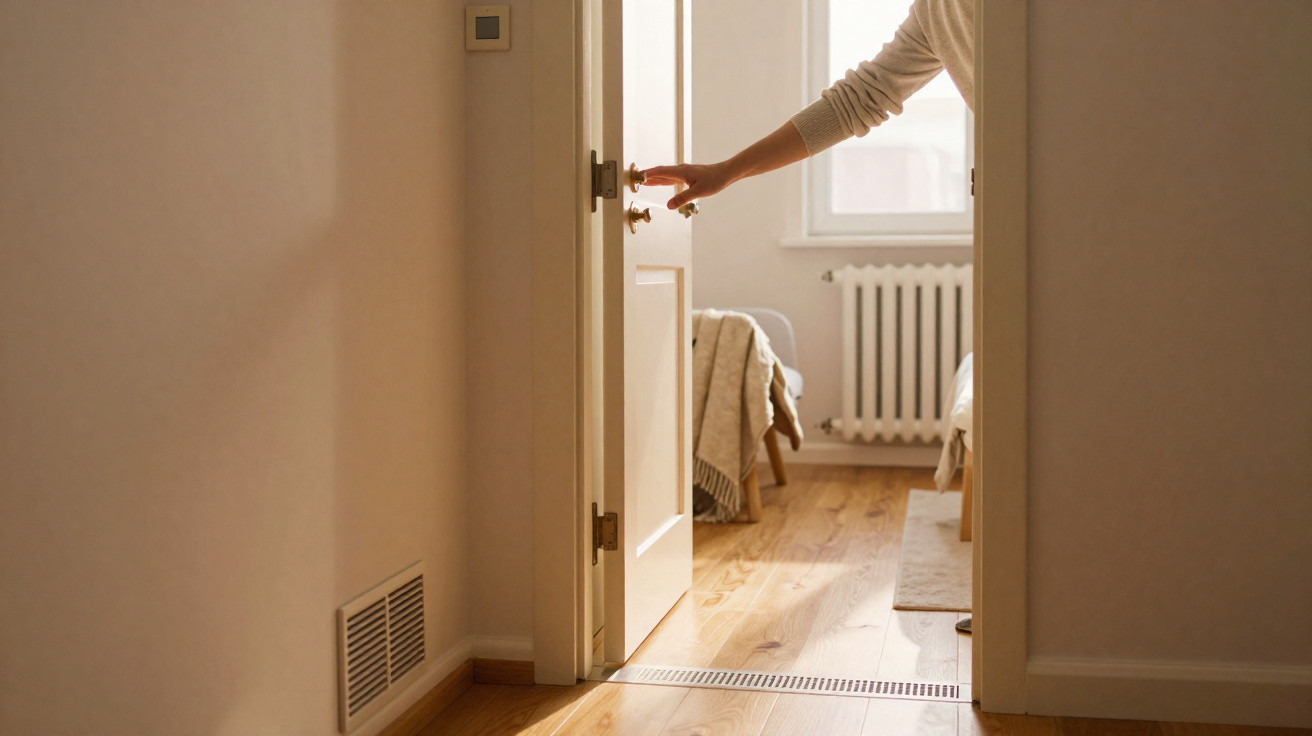
Even a door left ajar can make a difference.
Throughout the UK and US, households are turning up the thermostat, reaching for jumpers and asking a quiet but common question: is it better to leave internal doors open or closed to keep warm without sending energy costs soaring? The real answer depends far less on the time of year than on the way air circulates through your home.
Why home heating depends on air flow
Heating involves more than a boiler, furnace or heat pump producing warmth. It also relies on warm air moving around the property, blending with cooler air and returning to the system. Where circulation is restricted, certain rooms become stuffy while others remain cold, and the heating continues working in pursuit of an even temperature it cannot quite achieve.
Good heating is as much about air movement as it is about temperature settings.
Each property has its own air “personality”. An open-plan flat with a central corridor behaves differently from an older home divided into numerous smaller rooms. Radiators beneath windows distribute heat differently from ceiling vents or wall-mounted units. When doors enter the equation, they either allow air to move freely or hold it in places where it is of little benefit.
That is why the blanket advice to “always keep doors shut to keep heat in” may be unhelpful. Closed doors improve things in some properties. In others, they can quietly undermine the heating system, making it operate longer and harder without delivering any meaningful comfort benefit.
Central return vs room-by-room: understand your system first
Before choosing whether to open or close doors, establish how your heating and ventilation system works. Most modern arrangements fit into two main types.
Homes with a central return grille
Many UK and US homes with forced-air heating have a large return grille in the hallway or living area. Used air is drawn back through this grille, filtered and reheated. To complete that cycle efficiently, air from every room must be able to travel back to this central location.
With a central return, closed doors can trap air in rooms and starve the system of what it needs to work efficiently.
If bedroom or home-office doors remain closed for extended periods, there is no straightforward route for the supplied warm air to leave. Pressure rises slightly inside those spaces. Meanwhile, the hallway, which commonly contains the return grille, can receive too little air. This creates uneven temperatures and leaves the system running as it tries to reach a target temperature consistently.
In more serious situations, a fan working against these pressure imbalances may wear out sooner. Its components face added strain, while the system can short-cycle or run almost continuously during cold weather. The physics may go unnoticed, but the repair cost a few years later probably will not.
Homes with individual returns in each room
Certain properties, particularly newer or higher-specification homes, include return grilles in every heated room. Air then follows a smaller local circuit, entering and leaving each room without needing an open route to a central hallway.
This gives you greater flexibility. Shutting a bedroom door does not interrupt the system because every room can “breathe” independently. Whether to leave doors open or closed is therefore mainly a matter of comfort, privacy and noise reduction rather than a major energy-saving measure.
- If there is one large grille in the hallway: leaving doors mostly open while heating is on is generally preferable.
- If every room has both a supply and return: doors can remain closed with no major effect.
- If you are uncertain: identify where air is drawn in while the fan is operating.
Common mistakes that prevent your home heating properly
Heating engineers repeatedly see the same issue: supposedly “cold rooms” that do not lack heating capacity, but are poorly served by air movement. Closed doors contribute to the problem, although they are seldom the sole cause.
A lot of “cold room” complaints come down to blocked air paths, from doors to furniture to clogged filters.
These common problems can reduce comfort while increasing bills:
| Problem | What happens | Simple fix |
|---|---|---|
| Closed doors with central return | Rooms become too warm or stay cold, the hallway sensor gives an inaccurate reading, and the system runs for longer | Leave doors open while heating is running, particularly during lengthy heating cycles |
| Blocked vents or radiators | Sofas, curtains or beds hold heat against the walls | Keep a clear space in front of and above heat sources |
| Clogged filters | The fan has to work harder, less air reaches rooms and noise rises | Inspect and replace filters every 1–3 months in winter |
| Leaky windows and gaps | Warm air escapes more quickly than the system can replace it | Fit draught strips, use heavy curtains and repair visible gaps |
| Closed internal vents | People close off “unused” rooms, disrupting the system’s balance | Leave most vents open, and consult a professional before closing several |
Should you keep doors open or shut in winter?
If you use forced-air heating
In homes with a furnace or air-source heat pump and a central return, keeping doors at least partly open during heating periods will usually help the system operate as intended. This is especially relevant for rooms that consistently fail to match the hallway thermostat reading.
Doors do not have to be fully open. A gap of just 5–10 cm can provide a route for air to leave and return towards the return grille. Some households install undercut doors or unobtrusive transfer grilles above doorways, allowing air to pass even with the door shut.
If you rely on radiators or electric heaters
For UK homes heated by hot-water radiators without mechanical ventilation, the situation is slightly different. As there is no ducted return, doors have less influence on the system itself. The choice is instead a balance between retaining warmth and allowing it to circulate.
Open doors allow warmth to spread into cooler parts of the home, reducing cold spots but also distributing heat into rooms used less often. Closed doors can make one room feel cosier, particularly overnight, though hallways and neighbouring rooms may become noticeably colder.
With radiators, closing a door can create a cosy bubble, while open doors even things out across the home.
For electric space heaters, closing doors is often sensible for both safety and efficiency. The heater can warm a defined space more quickly without sending energy into unused rooms. Ensure the space is not sealed so tightly that moisture accumulates; briefly airing it once or twice daily can help.
Practical winter scenarios: what actually works
Scenario 1: busy family home, central return
Parents spend time in the living room while teenagers stay in their bedrooms, with every door closed for privacy. The hallway thermostat shows 20°C, yet one bedroom is freezing and the furnace operates for long periods.
Trial change: leave bedroom doors open throughout the day and early evening, closing them only overnight. Fit a draught excluder to the front door and clear the area in front of every vent. Within a week, bedroom temperatures become more consistent, while heating cycles are calmer and shorter.
Scenario 2: small flat with radiators
A one-bedroom flat with a gas boiler and panel radiators loses warmth through ageing windows. Its occupant usually leaves every door open in an effort to “share out” the heat.
Trial change: shut the living-room and bedroom doors in the evening, while setting thermostatic radiator valves sensibly. The hallway becomes cooler, but both main rooms feel warmer without changing the boiler setting. Adding heavy curtains at the windows further reduces the need to increase the thermostat.
Extra tips that work well with smart door use
Door position is only one factor. Pairing it with several straightforward habits can improve both comfort and costs across the winter.
- Maintain a steady thermostat setting rather than making large adjustments up and down.
- Bleed radiators once or twice each season when their tops feel cold.
- Position large furniture at least a few centimetres away from radiators or vents.
- Seal noticeable draughts around skirting boards, loft hatches and letterboxes.
- Arrange a service check for older systems that seem to run almost constantly.
Two terms are useful to remember. “Supply air” refers to the warm air blown or pushed into a room. “Return air” is the air pulled back to be reheated. In ducted homes, doors alter the route between these two points. In homes with radiators, doors affect how long warm air remains in the areas where you need it.
On the coldest days, the most successful approach is often a combination: leave doors open when you need even heating and healthy air flow, and close them when you want to retain warmth in a room you are using. Watching how your own home responds over several winter evenings will reveal more than any universal rule.





Comments
No comments yet. Be the first to comment!
Leave a Comment