
The frying pan is fiercely hot, the bacon is crackling, and your wooden spoon feels like a very small shield. Hot fat spits at your wrist, the smoke alarm joins in uninvited, and amid the commotion you recall that this was meant to be “a quick breakfast”.
By the time it is ready, the kitchen resembles the aftermath of a small blast. The hob is dotted with grease, a tacky brown layer is fused to the pan, and last night’s washing-up already fills the sink. You eat the bacon leaning over the worktop, worrying about the cleaning before you have finished.
With fork in hand, there is an odd moment when you ask yourself: is bacon really worth this much fuss?
Why parchment paper quietly transforms bacon cooking
The first time you put bacon on parchment paper rather than directly in a pan, it does not feel especially dramatic. There is no glamorous sizzling close-up or television-chef reveal. You simply pull off a creased sheet, place it on a cold baking tray and arrange the bacon as though creating a collage.
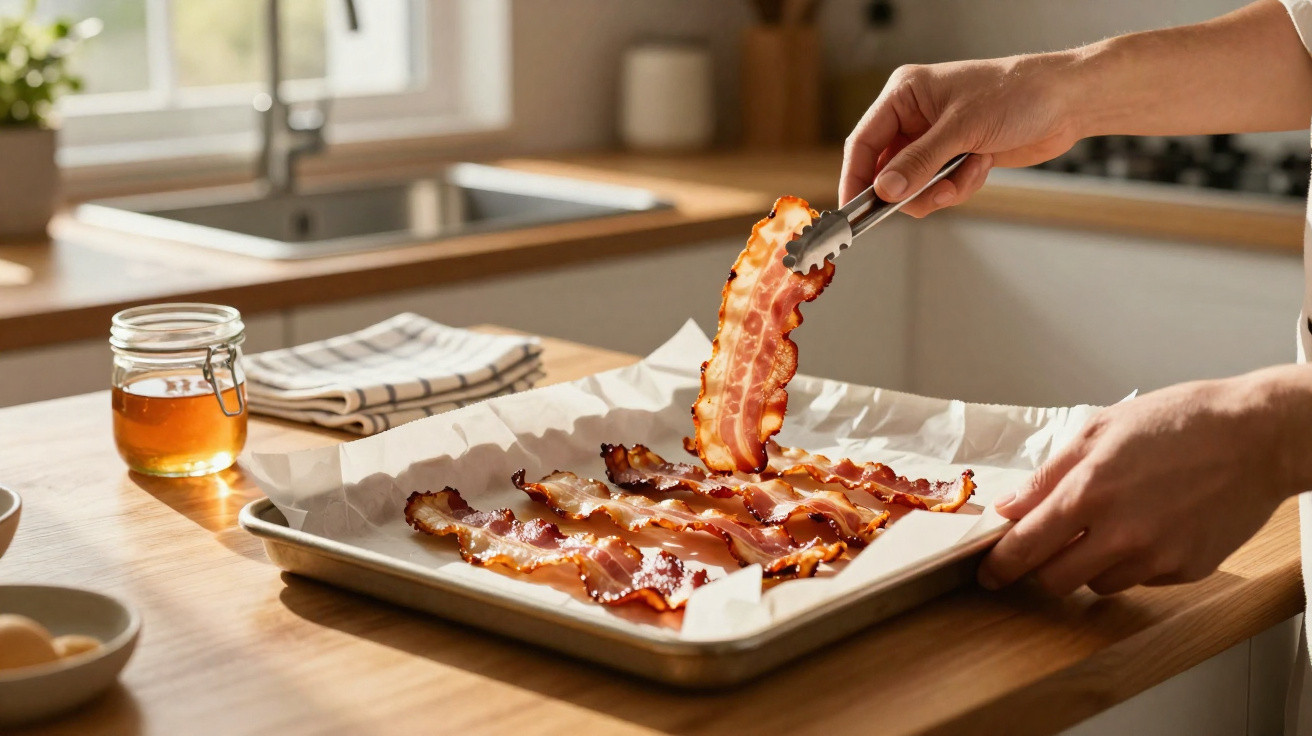
Then the small differences become clear. The bacon cooks more consistently. Its fat gathers softly rather than baking itself onto the metal. Once it is cooked, you pick up the parchment by its corners and… that is nearly the whole job. The tray beneath is scarcely dirty, as if it had watched from the audience.
Imagine a Sunday morning: the oven is at 200°C, you are only half awake and the coffee is slowly brewing. Line a rimmed baking tray with parchment, arrange a dozen rashers and put the lot into the oven. There is no grease splashing across the hob and no need to hover with tongs, only a quiet hiss behind the oven door.
Fifteen minutes later, a tray of crisp, evenly cooked bacon comes out. The parchment shines with fat and its edges have browned, rather like a disposable frying pan. Move the rashers to a plate with tongs, then lift away the complete sheet-grease, crumbs and all-and bin it. Instead of a 20-minute soak, the tray only requires a quick rinse.
The useful part lies in the way parchment reacts to fat and heat. Its coating repels grease instead of soaking it up, preventing the bacon from sticking itself to the metal. The paper forms a slim layer between the meat and heated tray, allowing fat to render gradually and spread out rather than scorch in one area.
As the fat does not burn onto the tray, there is no dreaded scrub-scrub-scrub stage afterwards. Less caramelised residue attached to metal means less literal elbow grease. “Easier cleanup” is not merely a slogan: it is physics taking work away from your sponge.
The straightforward parchment paper method that saves your sink
Begin with a rimmed baking tray and a roll of parchment paper rated for at least 220°C. Cut a sheet slightly larger than the tray, allowing it to rise a little at the sides. This small “wall” helps contain any wandering grease.
Arrange the bacon in one layer over the paper. The rashers may touch a little, but avoid too much overlap, otherwise they will steam and remain limp. Put the tray into a cold oven, then set it to roughly 200°C. Bringing the bacon up to heat alongside the oven produces gentler, more even cooking.
Take the tray out when the rashers are a rich golden colour and slightly less crisp than you ultimately want. They will continue to cook a little while sitting on the tray.
This is the point where many of us previously got it wrong. We turned up the pan heat, packed in the bacon and then wondered why some areas burnt while others stayed chewy. With parchment, it is tempting to overload the tray “to save time”. That is the trap.
Leave a little room around each rasher, and turn the tray halfway through if your oven has hot spots. For especially crisp bacon, dab the surface with kitchen roll at the end, though it is seldom necessary. The parchment has already helped the fat to collect and wick away.
You may be concerned that the paper will smoke or blacken. Provided you remain below its maximum temperature and keep it away from the grill, it will generally only turn a toasted beige colour.
“Switching to parchment was the first time I cooked bacon and didn’t dread the sink afterwards,” said one home cook I talked to. “I used to soak pans overnight. Now I rinse and walk away.”
Line the tray first, every time
Cut the parchment to cover the bottom of the tray and rise slightly up its sides. That raised edge catches unexpected splashes.Allow the fat to cool before binning it
Leave the tray on the hob or worktop for a few minutes so the grease can thicken. Then lift up the whole sheet and discard it, or scrape the fat into a jar if you enjoy cooking with it.Rinse rather than scrub
Since the parchment captures most of the mess, hot water and a gentle sponge will usually clean the tray. No steel wool. No lengthy soaking saga.Choose parchment, never wax paper
Wax paper melts and smokes in oven heat. Parchment paper is designed for this task.
Why this small change affects more than your pan
When one minor kitchen job no longer feels troublesome, the effect quietly spreads. Bacon changes from “special occasion, prepare for carnage” into “I can actually do this on a weekday without resenting myself later”. You no longer start mentally bargaining with the mess before you have even cracked the eggs.
We have all had that moment when the prospect of washing up is enough to abandon breakfast altogether. The calculation suddenly works in your favour. Lining a tray with parchment takes seconds; scrubbing on baked-on grease can take half an hour, along with your patience.
That small exchange changes how often you choose to cook instead of reaching for something uninspiring but tidy, such as a dry cereal bar grabbed as you head out of the door.
| Key point | Detail | Value for the reader |
|---|---|---|
| Use parchment on a rimmed baking tray | Forms a non-stick, grease-catching layer beneath the bacon | Much less scrubbing; the tray often needs only a quick rinse |
| Bake at moderate heat (around 200°C) | Allows even rendering, with less splatter and less burnt-on fat | More reliably cooked bacon with less mess and supervision |
| Cool, lift and discard the sheet | Allow the fat to thicken, then remove the entire mess in one action | Quick, low-effort cleaning and a tidier sink |
FAQ:
Question 1 Can I reuse parchment paper for multiple bacon batches?
You can often reuse it once if it is not too dark or brittle, particularly when cooking another batch of bacon immediately. Beyond that, it usually becomes too brown and tears easily, so use a fresh sheet.Question 2 Does bacon still get crispy on parchment, or does it steam?
It still becomes crisp. The fat renders and gathers slightly, while the hot oven dries the surface. For very crisp edges, cook it for an extra minute or two and do not crowd the rashers.Question 3 Is parchment paper safe at high oven temperatures?
Most parchment is rated to around 220°C. Check the packaging, stay below that temperature and keep it away from the grill element so it does not scorch or singe.Question 4 Can I save the bacon fat when I cook on parchment?
Yes. Let the tray cool slightly, tip it and pour the rendered fat from one corner of the parchment into a heatproof jar. You can then discard the sheet while keeping the liquid gold.Question 5 Is this really better than using a non-stick pan on the hob?
For many people, yes. Bacon baked in the oven on parchment requires less attention, creates fewer splashes and leaves virtually no crust to prise from the pan. Let’s be honest: nobody really scrubs those stovetop pans with joy every single day.



Comments
No comments yet. Be the first to comment!
Leave a Comment