
You finish a “deep clean” cycle and open the dishwasher expecting a fresh, steamy, lemon-like scent.
Instead, a warm blast of nastiness meets you. It is somewhere between wet dog, old fish and an unidentifiable school-canteen smell.
With the door half open, you may wonder how an appliance designed to wash dishes can fail to smell clean itself. You have used premium tablets, lemon-scented rinse aid and a “machine cleaner” that cost more than a perfectly good bottle of wine.
Then somebody points to an unassuming yellow box at the back of the cupboard: baking soda. It is the same powder used for banana bread and clearing drains. Could it really deal with the odour inside that stainless-steel chamber?
Why dishwashers begin to smell
Before you scatter any powder, it is useful to know what creates the odour in the first place. A dishwasher is effectively a warm, damp enclosure where food debris, grease and detergent residue come together. That makes it an ideal setting for bacteria and biofilm, particularly in filters, rubber seals and out-of-sight corners.
Over time, minute pieces of food collect beneath the filter and around the door gasket. A hot wash does not make them vanish. Instead, they gradually decompose and release gases that your nose detects immediately, even when the interior looks like nothing but gleaming metal.
Imagine the pattern: salmon on Sunday, lasagne on Monday and curry on Tuesday. The plates enter the machine after “just a quick rinse”. There are a few rice grains, a trace of cheese and fishy sauce spread across a pan.
The wash jets send those remnants around the appliance. Some are rinsed away, while others are forced into the filter or lodged in narrow gaps. A few days later, opening the door releases that combined, stale buffet of odours again. It is not a pleasant food memory, but a sour cloud that hangs around.
Chemically, these unpleasant smells are largely volatile organic compounds and acidic residues released as food breaks down. Dishwasher detergents are made to cut through grease and lift stains, rather than neutralise every odour molecule. This is where baking soda can make a difference.
The white powder has a mild alkaline pH and a crystalline structure that enables it both to react with odour-producing compounds and to trap them. Rather than simply adding fragrance, it changes the conditions that create the smell.
How baking soda works in a dishwasher wash cycle
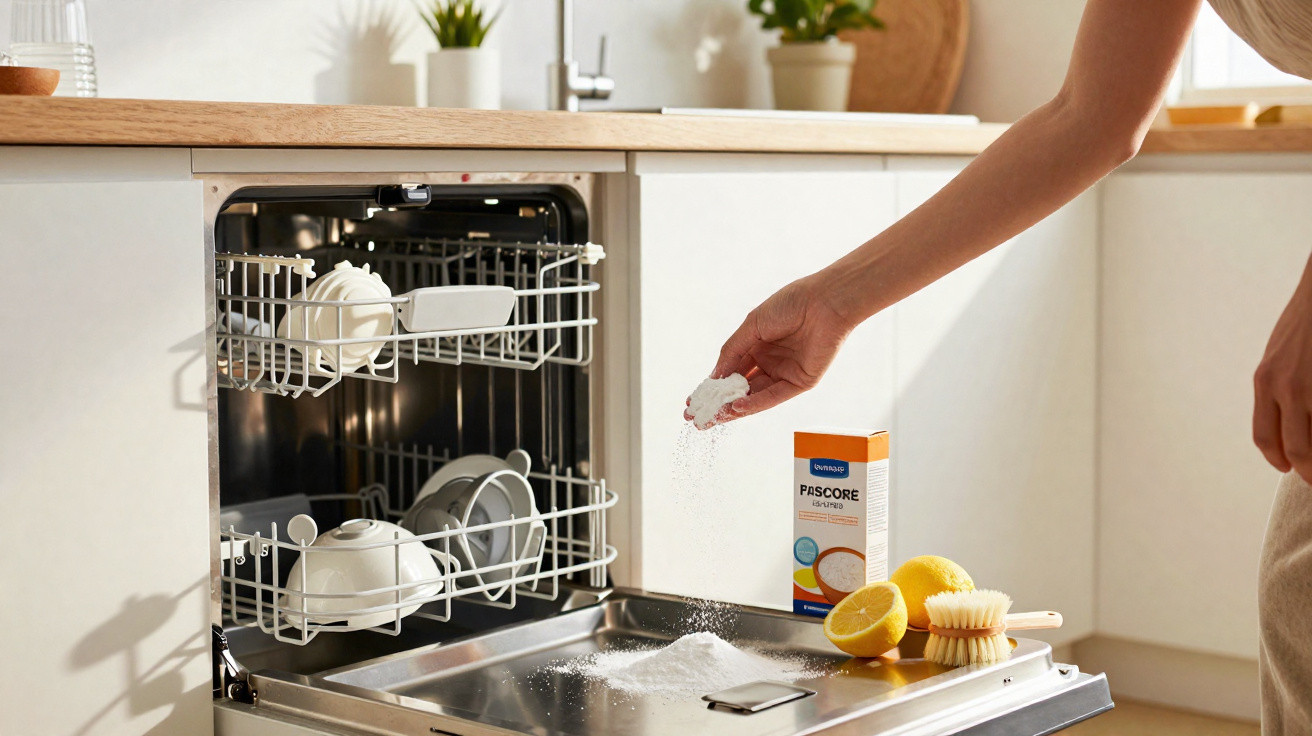
The most straightforward approach is to scatter roughly half a cup of baking soda across the base of an empty dishwasher, then select a hot cycle. Leave out the dishes and detergent: the hot water and powder can work on their own.
As water moves through the dishwasher, the baking soda dissolves and travels through the spray arms, past the filter and sump, and around the tub walls. It buffers the water, loosens minor mineral deposits and interacts with the trapped food acids that make you wrinkle your nose.
For more persistent odours, many people follow a two-stage “shock treatment”. Run a hot cycle first with a cup of white vinegar in a dishwasher-safe bowl on the top rack. When that cycle has finished, sprinkle baking soda over the bottom and run a short, hot wash.
The vinegar wash can help break down grease and detergent film. The following baking soda cycle then neutralises lingering odours and refreshes the tub environment. It is rather like washing your hair before using a mild scalp treatment, instead of relying on strong perfume to cover up the issue.
There is a reason this pairing has become a viral cleaning tip. Vinegar is acidic and baking soda is mildly alkaline. When used separately, rather than combined in the same bowl, they address different types of residue in the appliance.
Baking soda is also mildly abrasive, so it provides a gentle scrubbing action within the dishwasher without scratching steel or plastic. Its alkalinity can also counter lingering acidic molecules responsible for sour or rancid odours. It’s chemistry, not magic, even if it sometimes feels like magic when the stink finally disappears.
Using baking soda safely in your dishwasher
The reassuring part is that baking soda is among the gentlest cleaning products to use in a dishwasher. What matters is applying the correct amount at the right time. For a standard refresh, half a cup over the base of the empty tub once or twice a month is sufficient.
Distribute it evenly rather than allowing it to gather in one corner. Next, select a hot programme, ideally as close as possible to the machine’s “intensive” or “hygiene” setting, so the powder dissolves fully and circulates throughout the appliance.
Some people add one tablespoon to a dirty load alongside their usual tablet, especially after a particularly pungent meal. That can work as an occasional boost, provided you do not put baking soda in the dispenser in place of detergent.
Problems arise when it is overused. Emptying a whole box into the dishwasher every week will not make glasses shine any more brightly. It may leave a light powdery residue and build up around the filter if that filter is never cleaned. Realistically, nobody does that every day.
Bosh, a major appliance manufacturer, sums it up like this: “Baking soda can help reduce odors when used periodically in small amounts. The most effective odor prevention remains regular filter cleaning and correct use of detergent.”
- Use it monthly, not daily
Keep a baking soda cycle for occasions when odours appear, or run one monthly for upkeep. - Keep it out of the dispenser
Scatter it on the base of the tub and leave detergent in its designated compartment. - Combine it with routine care
Empty and wash the filter, wipe the door seal and scrape plates before loading to achieve the best results.
Beyond the baking soda trick: rethinking “clean”
Putting baking soda in the dishwasher is more than an old-fashioned tip from the back of a grandmother’s cookbook. It offers a small shift in the way we view cleaning: less fragrance and more action directed at the cause. The aim is not to make the appliance smell of artificial citrus, but to remove what is making it smell in the first place.
After trying it a few times, you may notice other habits changing as well. You inspect the filter more regularly. You stop using the dishwasher as a rubbish compactor. You recognise that most odour problems begin with what is loaded into it, rather than with the machine itself.
There is also a quiet pleasure in resolving a “modern appliance problem” with something that costs a few pence and does not arrive in vivid neon plastic. You do not need to be exceptionally tidy or fixated on cleaning to enjoy that small victory when you open the door and smell simply… nothing.
Some people will continue to favour specialist products, which is perfectly fine. Yet if that yellow box is already in your cupboard, it may deserve a genuine place in your kitchen beyond the occasional cake.
Every household has its own routine, smells and shortcuts. How you use your dishwasher reflects your days: hurried mornings, late evening meals, children’s plates stacked over adults’ plates, or one coffee cup sitting by itself.
Sharing small tips such as adding baking soda on a Sunday morning while drinking your first coffee is how home routines now spread. It is not through instruction manuals, but through accounts of “I tried this, and suddenly, the smell was gone.” Your dishwasher does not have to smell like a spa. It only needs to fade back into the background of your everyday life.
| Key point | Detail | Value for the reader |
|---|---|---|
| Why dishwashers smell | Food particles, grease and moisture lead to bacteria and odour build-up in filters and concealed areas | Helps readers identify the true cause of the problem instead of merely masking it |
| How baking soda works | Mildly alkaline and slightly abrasive, it neutralises acidic odour molecules and refreshes the tub | Reassures readers that the tip relies on straightforward, safe chemistry |
| Safe, practical routine | Half a cup on the base of an empty machine, using a hot cycle alongside regular filter cleaning | Provides readers with a clear, repeatable method for keeping odours away over time |
FAQ:
- Can baking soda damage my dishwasher? Used in small quantities, around half a cup for each empty cycle, baking soda is generally safe for most modern dishwashers. It is gentle, non-corrosive and widely recommended as an occasional deodoriser.
- Can I mix baking soda and vinegar in the same cycle? It is preferable to use them in two separate cycles. If mixed directly, they mostly neutralise one another, which reduces their cleaning effect. Run vinegar first, followed by baking soda.
- Can I skip detergent and only use baking soda? No. Baking soda has none of the enzymes or surfactants required to remove grease and heavy food deposits. It complements detergent rather than replacing it.
- How often should I use baking soda in my dishwasher? Once a month is enough for maintenance, or after particularly smelly loads containing fish or eggs. If you need to use it more frequently, you should also clean the filter and spray arms.
- Why does my dishwasher still smell after using baking soda? Persistent odours usually indicate physical build-up somewhere in the appliance. Inspect and clean the filter, drain area, spray arms and door gasket. Baking soda helps with smells, but it cannot remove trapped pieces of food by itself.




Comments
No comments yet. Be the first to comment!
Leave a Comment