
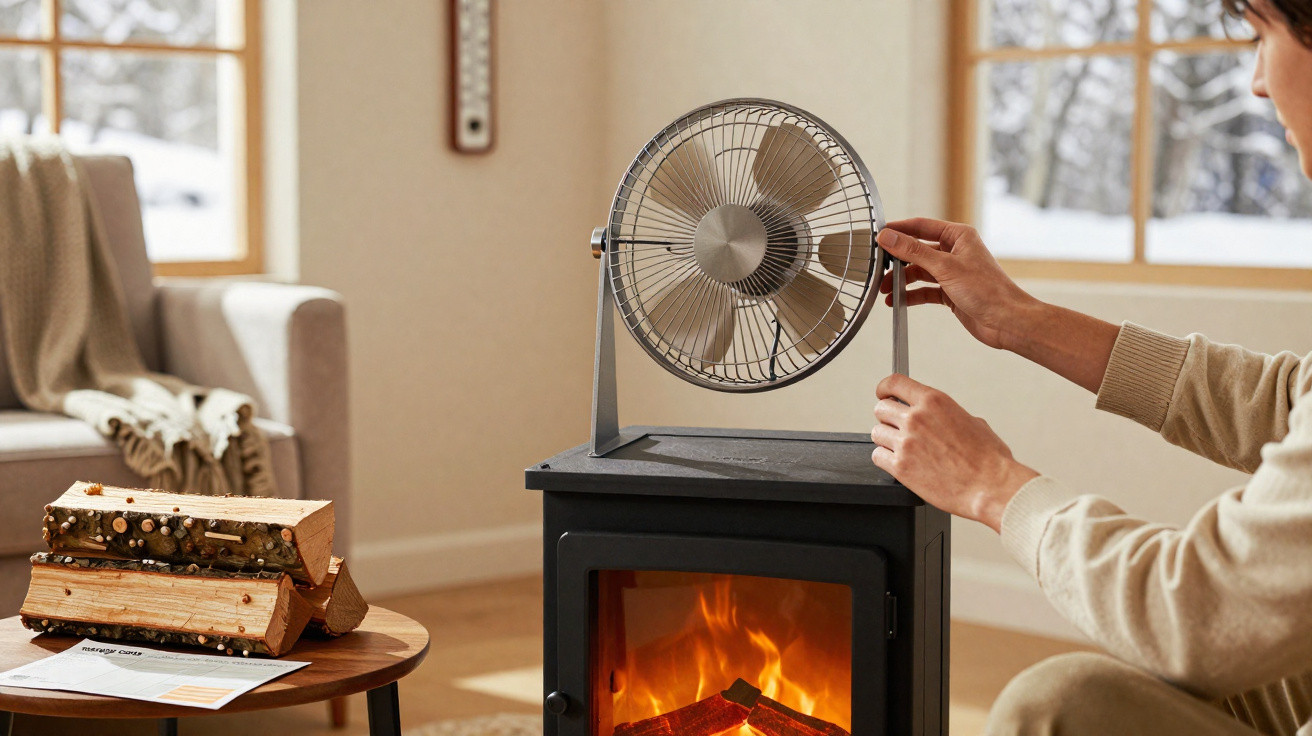
The first log has scarcely taken hold before the living room begins to feel different. The cold bites at the windows outside, while indoors the wood stove glows and crackles quietly, as though sharing ancient tales. You settle down expecting the enveloping warmth promised when you bought it. Yet your feet remain chilly, and the heat seems to linger in front of the glass, leaving the rest of the room only mildly comfortable.
A friend visits, glances at the glowing stove and starts laughing: “You’re heating the ceiling, not your house.”
That evening, they take a small metal accessory from a bag. It has no electronics or mains lead: simply a compact, unobtrusive object placed on top of the stove.
Ten minutes later, the room feels completely different.
The small wood stove fan that makes all the difference
The accessory appears almost too basic to be convincing. It is a small heat-powered fan, generally with four or five blades, which begins to rotate silently as the stove warms up. There is no plug, battery or switch; the heat from the stove top alone powers it.
From the sofa, you can suddenly feel a gentle flow of warm air reaching you rather than rising uselessly towards the ceiling. The glass continues to glow and the logs still crackle, but the warmth is more evenly spread and less confined to one corner of the room.
You have not replaced the stove or increased the fire, yet the level of comfort has noticeably improved.
A family living in a small countryside stone house tried one last winter. Before fitting the fan, the temperature near the sofa sat at around 18°C, while directly above the stove it climbed to nearly 24°C. That meant a six-degree difference within the same room.
After using the stove fan for several days, their thermometer showed something else: 20–21°C in the main living space, 22°C close to the stove, and a far steadier temperature in the hallway. Their firewood stack lasted longer. They began lighting the stove slightly later in the afternoon and stopped running it at full power at 7 p.m.
It may not sound dramatic on paper, but the impact on both their heating costs and comfort was striking.
What this inexpensive device does is rooted in straightforward physics. A wood stove mainly produces heat through radiation and convection, but warm air naturally rises and often remains trapped at ceiling height without assistance. This is why your head may feel warm while your toes are freezing.
By directing a mild stream of warm air horizontally across the room, the fan disrupts the “hot bubble” above the stove and moves heat to the places where you spend time: around the sofa, dining table and walkways. The same heat is suddenly distributed more effectively.
Across an entire season, these few degrees of more evenly spread warmth can mean burning fewer logs, feeling less inclined to overload the stove, and enjoying the quiet sense of being warm “all the way through”, rather than on only one side of your body.
How to use a wood stove fan to save money
The key is its position and the way it is used. Place the fan on a flat, stable and suitably hot area on top of the stove, usually towards the rear so that it sends air over the stove and into the room. Do not put it directly on a flue pipe or on a delicate enamelled section.
Most models begin rotating at about 50–60°C and perform at their best once the stove is properly hot. Light the fire as you normally would, then after a short while the blades will start turning slowly and pick up speed as the temperature increases.
As the fire dies down and the stove cools, the fan gradually slows before stopping, like a small mechanical heartbeat following the rhythm of your evening.
One common error is expecting instant miracles on the first night. You light the stove, set down the fan and anticipate tropical conditions straight away. That is not how it works. The fan improves the circulation of heat already being produced; it does not multiply it tenfold.
Another regular mistake is positioning the fan too close to the flue pipe or immediately beside a wall. The air can then rebound poorly or rise too quickly, reducing much of the benefit. A clear, central location on the stove top is generally most effective.
In reality, hardly anyone checks the room temperature five times daily using three separate thermometers. You judge it by how you feel, whether your shoulders relax and how long you keep your jumper on. On that basis, the difference is often hard to deny.
“Before the fan, my kids crowded right in front of the stove and complained as soon as they moved away,” says Clara, who lives in a 90 m² house with a single wood stove. “Now the heat reaches the end of the room. The fire is the same, but our evenings don’t feel like musical chairs in front of the flames.”
- Choose a fan suited to your stove
Review the recommended temperature range, and avoid very cheap models that may warp within a few weeks. - Shield the fan from excessive heat
Use the supplied base or a heat shield if the top of your stove reaches particularly high temperatures. - Clean it once or twice each season
Quickly dusting the blades and base is enough to keep the airflow running smoothly. - Do not handle it while hot
Its body can become extremely hot, so allow the stove to cool before moving the fan. - Monitor your wood use
Over a number of weeks, check whether you are loading slightly fewer logs while retaining the same comfort. This is where the genuine saving can be found.
More than a gadget: another way to heat your home
This small accessory reflects a subtle change in the way we approach heating. Rather than fighting the cold by burning increasingly more wood, we learn to move and distribute the heat we already generate. The flame remains unchanged, but its circulation around the home is different.
Many wood stove owners describe finding a new “sweet spot” after adding a fan. They no longer feel compelled to overfire the stove simply to warm the far end of the room. The fire can remain gentler and more moderate, with less concern about wasting logs up the chimney.
On cold nights, this alters your relationship with the stove. Instead of being a radiant altar that you must stand beside, it becomes a truly gentle heart for the home.
| Key point | Detail | Value for the reader |
|---|---|---|
| Better heat distribution | Moves warm air horizontally around the room rather than allowing it to remain near the ceiling | More even comfort, fewer cold corners |
| Lower wood consumption | Makes it possible to maintain a slightly lower fire while achieving the same perceived warmth over time | Potential savings on firewood over the season |
| Zero energy use | The fan is powered by stove heat via a thermoelectric module | No additional electricity cost, fully autonomous accessory |
FAQ:
Question 1 Does a wood stove fan genuinely save money, or is it merely a comfort gadget?
When used properly, it mainly enhances comfort, but this can often lead to savings because you are likely to burn slightly less wood for the same warmth. Across a full winter, the difference can become very real.Question 2 Can I use a fan with every type of wood stove?
Most fans are made for freestanding stoves with a flat top. With inset stoves or stoves that have a very uneven or enamelled surface, check the compatibility and temperature limits in the product information.Question 3 Is it noisy in a quiet living room?
Good-quality models are remarkably discreet. At most, you may hear a faint mechanical rustle, which is often masked by the natural crackle of the fire and household sounds.Question 4 Does it also work with pellet stoves?
Only where the pellet stove has an accessible top surface that becomes sufficiently hot. Many pellet stoves already include built-in fans, meaning the benefit is less pronounced, although some owners still use one to soften the airflow.Question 5 What should I expect to pay for a dependable stove fan?
Most worthwhile models cost between £30 and £80. Paying a little more than the lowest prices often brings better durability and more consistent performance over successive seasons.






Comments
No comments yet. Be the first to comment!
Leave a Comment