
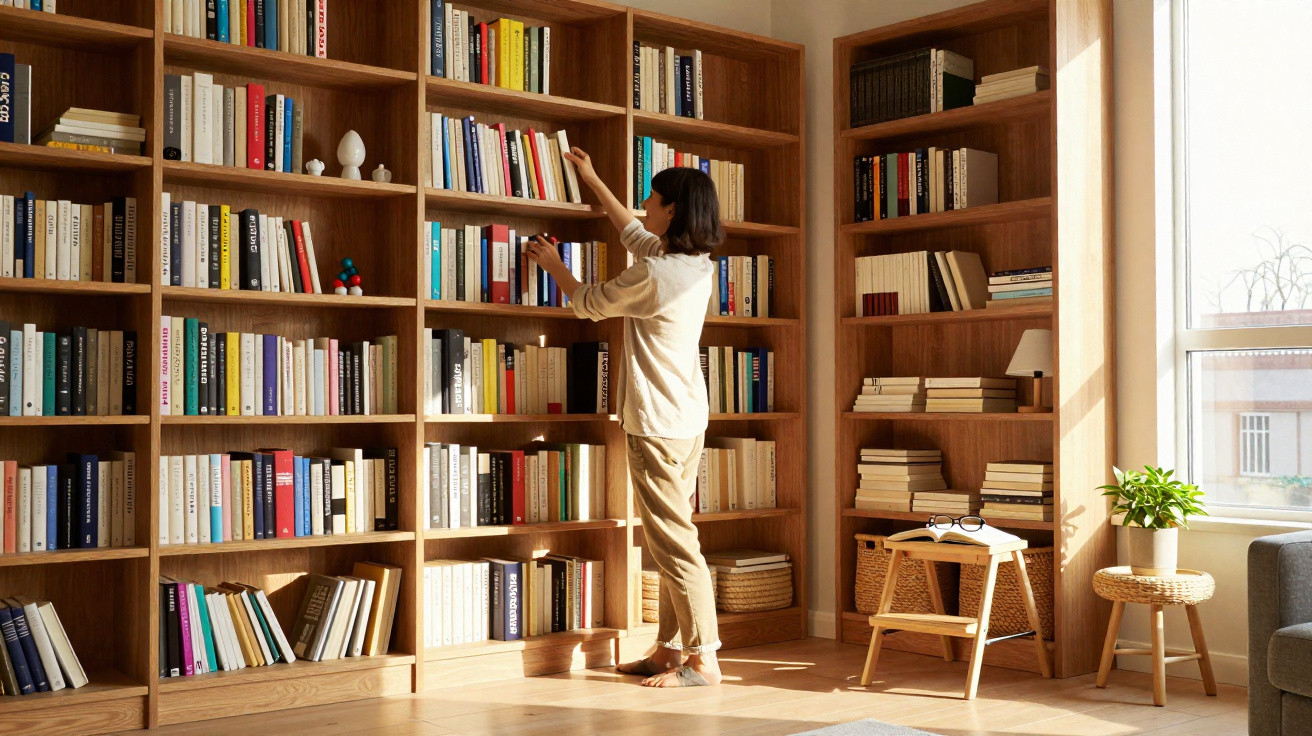
She paused in the doorway of her home library, slowly turning as her eyes travelled across the book spines as though she were deciphering an unfamiliar language. Crime fiction sat beside cookbooks, travel guides were squeezed between poetry and parenting titles, and one hardback slumped wearily over a row of paperbacks. Everything had technically been “put away”, but nothing seemed easy to locate. With a laugh that was equal parts apologetic and defensive, she said: “I know where things are… roughly.” In theory, the room was lovely; in reality, it was impractical. That is the understated problem with many home libraries: they preserve our memories and ideas, while the way we arrange them quietly makes them harder to use. Then, one day, you urgently need a particular book and your own library will not help you find it.
Why tidy home libraries can still feel chaotic
The odd thing about untidy bookshelves is that, initially, they seldom appear chaotic. Most books are standing upright, the colours are reasonably coordinated, and the dust is more or less managed. Viewed from across the room, it all looks “fine”. The disorder exists in your mental map - or, more accurately, in the lack of one. You reach for a title but do not know where your hand should go. That brief hesitation happens every time you search, gradually training you not to bother. Shelves intended to draw you in begin to resemble a wall you would rather not scale.
One rainy Sunday in London, I saw a couple hunting for their copy of “Sapiens” shortly before friends were due for dinner. Their living room contained three tall bookcases, with another narrow unit in the hallway. It took them eleven minutes to find it. “I swear it was somewhere here,” one said, gesturing towards a sea of non-fiction. Eventually, the book emerged from behind a pile of magazines and an old Kindle, banished to a partly empty shelf that had once been considered “temporary”. That small, slightly awkward delay summed up their entire arrangement: there was no consistent principle, only decisions made on separate days and never reconsidered.
Without a firm rule for where books belong, each new purchase becomes a fresh negotiation. Do you wedge it beside an author you loosely connect it with? Do you create another “miscellaneous” section, which then spreads like ivy? Over time, these tiny compromises create resistance. Rather than arranging books around what you actually need - quick access, easy browsing or reading by mood - you place them wherever there happens to be room. Your shelves end up recording your buying history rather than reflecting your reading life. This is why some home libraries look impressive yet feel unexpectedly uninviting when you approach them with a specific book in mind.
Home library methods that balance beauty and usability
The most effective change sounds unexciting on paper but can transform daily life: choose one primary organising principle, then allow aesthetics to work within it. That principle might be genre, “work versus pleasure”, or “read versus to-be-read”. Once you have chosen, each shelf stops being a general dumping place and becomes more like a neighbourhood. You can still arrange books by colour within a genre, or display your favourite hardbacks at eye level, but everything is held in place by a recognisable structure. The mind likes knowing where a search starts, even if the arrangement is not flawlessly exact.
One client split her living-room bookshelves into four broad areas: fiction, non-fiction, cookbooks and children’s books. Her fiction was alphabetised, while non-fiction was sorted into broad subjects: history, science, memoir and “brainy but fun”. The important part was not the labels themselves, but the fact that they matched the language she naturally used when talking about books. She would say things such as, “I need a light novel,” or “Where are the parenting books?” Those expressions became real, physical sections. Inside them, she was free to vary height, colour and orientation. Her shelves began to look purposeful, despite her not buying anything new.
A system lasts not because it is clever, but because it forgives. Alphabetical shelving works well until you bring home an author whose surname belongs halfway along a completely full shelf. Sorting books chronologically by publication year may sound romantic and scholarly, until you try to recall when a particular essay collection was published. A useful domestic system has flexibility: series can remain together even when a title technically belongs in a different category; oversized art books can have a dedicated low, sturdy shelf; and the to-be-read pile can become an open, face-forward area instead of a guilty stack on the floor. A strong bookshelf layout does not penalise you for being human. It provides simple default places for the next book you acquire.
Small bookshelf design decisions that make a big difference
Begin with how your body moves rather than with theoretical rules. Keep books you use every week between hip and eye level. This is the gold zone for everyday reading. Reference works, dictionaries and heavy coffee-table books can sit on lower shelves, where their weight creates less risk. Use the highest shelves for light, occasional items: travel guides, seasonal books or that specialist photography collection you adore but rarely open. Once these practical considerations are in place, you can create visual rhythm by alternating upright rows with horizontal piles, deliberately leaving a little empty space, or adding a plant or framed photograph where it will not obscure titles.
The frequent mistake is treating bookshelves as a Pinterest project before treating them as a library. It becomes all rainbow and no system. There is nothing wrong with arranging by colour if that is truly how you remember books. Some people genuinely picture covers in their mind. Others remember a plot, subject or mood; making those readers use colour order is like organising their memories alphabetically by shoe size. And, during a hectic week, you may leave a book on the nearest surface rather than taking it back “home”. Let’s be honest: nobody really does that every day. What matters is knowing where “home” is when you do have ten spare minutes to put the room back in order.
A designer I met once captured good shelving in a phrase I still borrow:
“Your bookshelves should look like you live with them, not like you borrowed them for a photo shoot.”
To put that idea into practice, favour small actions you can repeat over ambitious weekend transformations.
- Keep a small “returns” basket close to your main reading area for books waiting to be returned to the shelves.
- Choose plain, uncomplicated bookends so that sections do not topple whenever you remove a book.
- Reserve at least one empty cubby or half-shelf as a flexible area for new additions or a rotating “reading now” display.
The calm of home libraries that work for you
There is an unusual sense of calm on the first evening after you have properly reconsidered your shelves. You stand before them not because they need tidying, but simply to look at them. Your hand reaches the right book in two seconds, without that inward frown of uncertainty. The room seems larger, although nothing has shifted except paper and wood. This is not about perfection: a lived-in library will always feature a slightly uneven row, a bookmark sticking out or a novel hovering between categories because you are still reading it. That is part of its appeal. What changes is the background chatter in your mind: less “Where on earth did I put that?” and more “What do I feel like reading tonight?”
Practically speaking, a well-arranged bookshelf becomes a map of your life to date. A glance along the spines reveals different phases: the crime-thriller fixation, the sudden collection of gardening books, the shelf of language guides from the year you promised yourself you would move abroad. We have all had that moment when we discover an old book from a difficult time and realise how far we have come. When your library has a coherent arrangement, those accidental rediscoveries happen more frequently. You notice more of what you already own, so you reread more, lend more and make slightly more intentional purchases. It gently influences your reading habits without requiring any grand resolution.
There is a social effect as well. When your shelves make sense, guests ask different things. Instead of saying, “Wow, you have a lot of books,” they may say, “Oh, I love how you grouped your travel writing,” or “Can I borrow this essay collection?” Children learn that cookbooks belong here, bedtime stories belong there and graphic novels live on the low shelf they can reach by themselves. The room quietly teaches its own rules. Ultimately, organising a home library is less about control than it is about hospitality - for your future self, for those who share your home and for the ideas you have not encountered yet but are already making space for. The shelves are only furniture. What you are truly arranging is a route back to your own curiosity.
| Key point | Details | Why it matters to readers |
|---|---|---|
| Choose one primary organising logic | Decide whether the main division is genre, function (work vs leisure), or status (read vs to-be-read), then apply it consistently across every bookcase. | It gives your mind a dependable place to begin, meaning a book can be found in seconds instead of through a vague, frustrating search of every shelf. |
| Use the “gold zone” for high-use books | Keep everyday reading between hip and eye level; use lower shelves for heavy or seldom-used volumes, and the highest shelves for light or decorative collections. | This matches the layout to natural movement, reduces strain and makes you more likely to use the books you own. |
| Create a visible “reading now” or TBR section | Set aside one or two shelves, or one cube, for current reading and upcoming titles instead of allowing them to accumulate randomly on tables and floors. | It turns intention into a physical area, helps you follow through with books already in your possession, and keeps other surfaces free of visual clutter. |
FAQ
- Should I organise by colour or by genre? If you genuinely recall books through their covers, colour-coding can be effective as well as visually striking. For most people, genre or theme is more useful, with colour and height incorporated within those sections for visual interest.
- How often should I reorganise my bookshelves? One complete reorganisation each year is normally sufficient, alongside small ten-minute adjustments when new books arrive. Treat it like editing a wardrobe: frequent, light clear-outs prevent the need for a major purge.
- What can I do if I have more books than shelf space? Begin by setting a strict “double-row” limit, avoiding the practice of concealing complete rows behind others. Next, make a donate-or-sell box and move anything you are unlikely to read or consult again. Any essential overflow can be kept in labelled storage boxes organised by category.
- Is it okay to mix decor items with books? Yes, provided objects do not block access to titles or turn the shelves into a display that collects dust. Aim for roughly an 80/20 split between books and objects, and choose unobtrusive decoration such as photographs, small plants and simple bookends.
- How do I handle oversized art and photography books? Give them a dedicated, robust lower shelf or coffee-table space, where their weight is properly supported and their covers can occasionally be displayed face-out. Keeping books upright when they are too tall gradually warps their bindings.




Comments
No comments yet. Be the first to comment!
Leave a Comment