
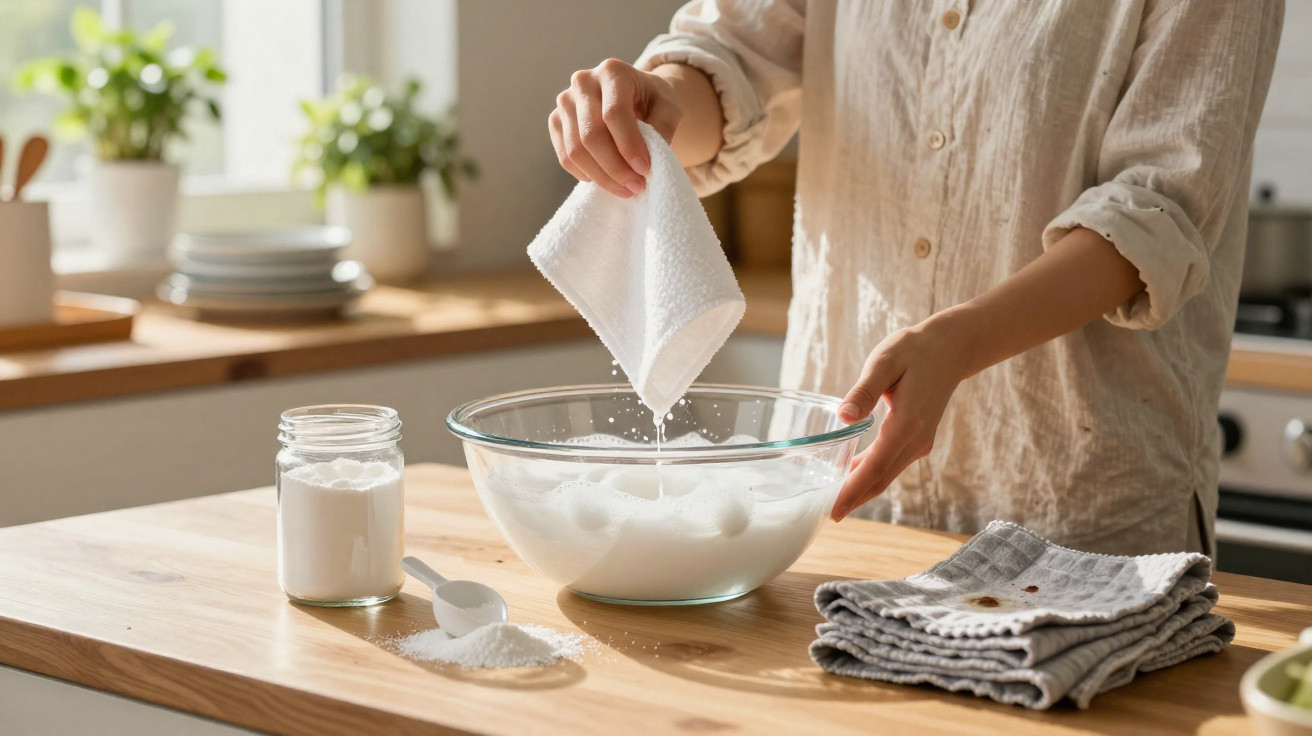
Anyone who enjoys cooking will know the issue: after a few months, even high-quality tea towels can look grey, greasy and somehow unhygienic. Laundry detergents make big promises and are often expensive, yet stubborn stains still remain. For many people, however, the answer is already in the cleaning cupboard: an ordinary white powder that delivers what bleach and similar products merely promise.
The forgotten laundry-room powder used by our grandparents
The product is sodium percarbonate, generally known simply as “percarbonate”. Its name may sound as though it belongs in a chemistry laboratory, while the product itself appears rather unremarkable: a white, slightly coarse, odourless powder.
Yet this powder is remarkably effective. It is regarded as a solid form of hydrogen peroxide. When it comes into contact with sufficiently warm water, it releases what is known as active oxygen. And that can do far more than provide a little brightening.
“Active oxygen attacks stains directly within the fibres instead of merely concealing them visually.”
Unlike chlorine-based bleaches, percarbonate has little effect on cotton fibres. It cleans thoroughly without making fabrics yellow over time or causing them to become brittle. What remains is water, oxygen and washing soda – substances that are considerably less problematic for water and the environment than many modern specialist cleaners.
Why ordinary detergents often fail on tea towels
Tea towels in particular have to cope with a great deal: grease, egg, tomato sauce, coffee, tea and red wine, as well as germs from raw food. Conventional heavy-duty detergents often remove the smell, but the visible grey film tends to remain.
There are several reasons for this:
- Grease and protein settle deep inside the fibres.
- Hard water leaves limescale deposits, which make greying more noticeable.
- Many wash cycles now run at 30 or 40 °C to save energy.
- Optical brighteners improve appearance only; they do not brighten the fibre itself.
This is exactly where percarbonate works: rather than covering stains, it chemically breaks down their colour-causing components. The result feels like a genuine restoration of the textiles, rather than make-up.
How active oxygen works: temperature determines the result
One common mistake is to add the powder to a 30 °C wash and expect it to “help somehow”. In lukewarm water, however, percarbonate remains largely inactive.
“Only from around 40 °C does percarbonate release noticeable amounts of active oxygen; at 60 °C, the reaction is in full swing.”
The process cannot be seen, but it is highly effective: the released oxygen oxidises organic residues, including fats, dyes from sauces and tannins from tea and coffee. At the same time, the combination of heat and oxygen acts like a small hygiene programme for the fabric. That is a clear benefit for tea towels, which regularly come into close contact with food.
Anyone who washes only at 30 °C misses almost all of this potential. A simple adjustment to the routine is therefore worthwhile: either use a separate soak in hot water or run a 60 °C or boil wash regularly, allowing percarbonate to develop its full effect.
The “miracle soak” for grey and stained tea towels
For heavily soiled towels, a pre-soak is far more effective than simply adding a dash of extra product to the washing machine. The method is straightforward, although it requires a little time.
Step-by-step instructions for an active oxygen soak
- Fill a heat-resistant bowl, tub or bucket with very hot water (at least 40 °C; for cotton, 60 °C is better).
- Stir one to two tablespoons of percarbonate into each litre of water until the granules have dissolved completely.
- Place the dirty tea towels straight into the solution, fully submerge them and move them around gently.
- Leave them to soak for two to six hours depending on the level of soiling, or overnight in extreme cases.
- Then wring them out lightly and machine-wash them as usual.
Dried-on tomato sauce, red wine marks and dark coffee or tea stains come out much more effectively this way than with detergent alone. Many people report that, after such a soak, tea towels look as though they have just come from the shop, despite having been used for years.
When percarbonate is unsuitable and caution is needed
Useful though the powder is, it is not suitable for every fibre. Animal-based materials are especially sensitive:
- Wool
- Silk
- Cashmere and similar blends
Here, the combination of an alkaline solution and oxidation can damage the fibre structure. The consequences can include roughness, felting or even brittleness. Percarbonate may also lighten printed coloured fabrics if their dyes are not colourfast.
“Percarbonate is ideal for pure cotton and linen in white or strong, well-fixed colours – but not for delicate fibres.”
If in doubt, test it on an inconspicuous area first. If the fabric fades quickly, it is better to use a conventional delicate-wash detergent.
Making sodium percarbonate safe and practical at home
Although percarbonate is considered a “greener” product, it should not be handled carelessly. In concentrated form, the powder can irritate skin and eyes.
Practical household rules include:
- Wear household gloves when measuring and stirring the powder.
- Do not inhale the powder, so avoid creating clouds of dust.
- Do not mix it with acids such as vinegar in sealed containers – gas formation can cause pressure to build up.
- Keep it away from children and pets.
Those who follow these points will have a highly manageable yet effective product in the cupboard, capable of replacing many specialist cleaners.
How percarbonate compares with other household remedies
| Product | Strength | Weakness |
|---|---|---|
| Percarbonate | Powerful stain remover, hygienic effect, ideal for whites | Unsuitable for wool/silk, needs heat |
| Vinegar | Removes limescale, reduces odours | Not a genuine stain remover, can damage rubber |
| Baking powder/bicarbonate | Neutralises odours, provides gentle cleaning | Much weaker on old stains |
| Chlorine bleach | Fast bleaching effect | Damages fibres, can cause yellowing, unpleasant smell |
Percarbonate performs particularly well in combination with hard water. It is already present in small quantities in many products. By dosing it separately, you can tailor the amount precisely to the degree of soiling – potentially saving money on expensive specialist detergents.
Why it is worth keeping a small supply in the cleaning cupboard
Sodium percarbonate is useful for more than tea towels. Many people also use it for:
- greyed bed linen
- white cotton T-shirts with deodorant marks
- dishcloths and microfibre cloths (follow the manufacturer’s instructions)
- cotton nappies and flannels
As the powder keeps for a long time when dry, a medium-sized bag will usually last for many months. An airtight container is sensible, as moisture in the air can trigger the reaction prematurely.
Anyone starting out with percarbonate should begin with a small dose and gradually find the optimum amount. Using too much brings no additional benefit, whereas the right dose can achieve surprising results with old textiles.
What terms such as “active oxygen” actually mean
Many detergents heavily promote “active oxygen” without explaining what it means. At its core, it is generally the very same mechanism as percarbonate: when it meets water, oxygen compounds form and attack the components of stains.
The difference is one of control: anyone using pure percarbonate knows how much actually enters the wash water and can adjust both the temperature and soaking time with precision. This makes the method transparent and predictable – and helps explain why so many households continue using it after their first attempt.

Comments
No comments yet. Be the first to comment!
Leave a Comment