
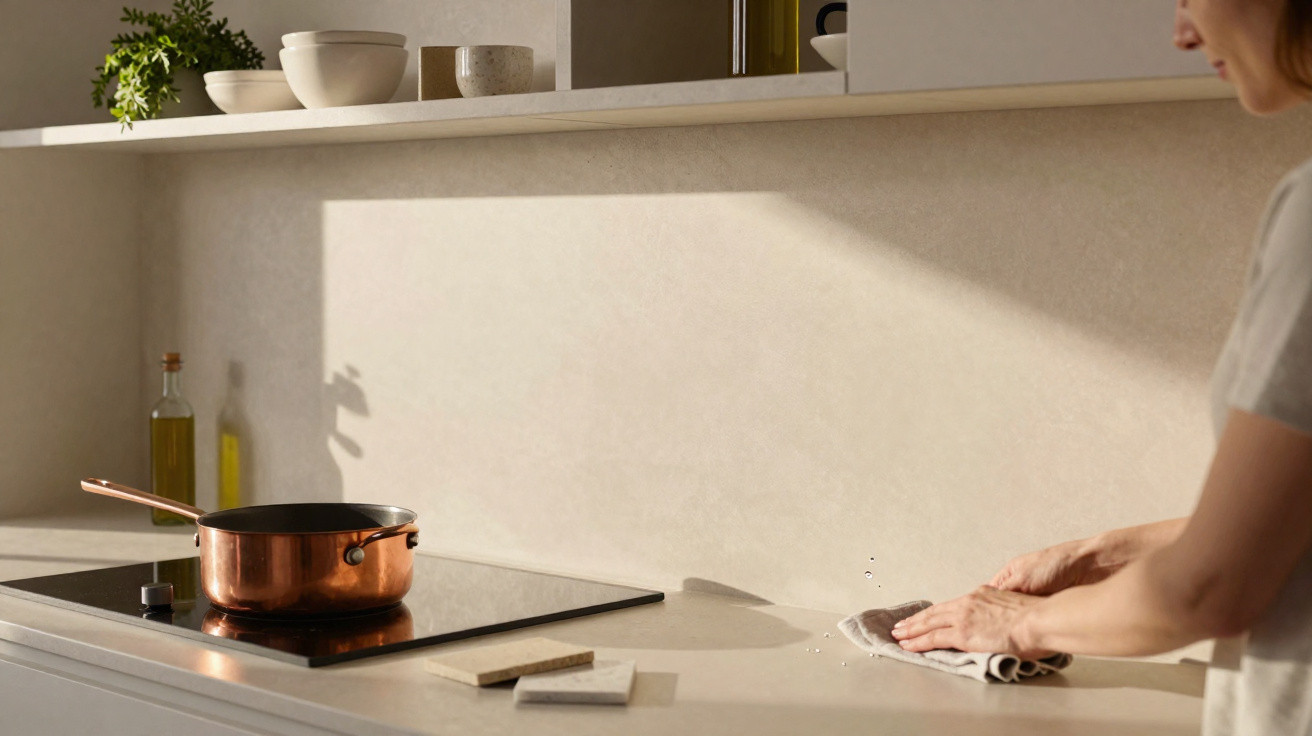
No more endless scrubbing: the traditional tiled splashback is disappearing from modern kitchens, replaced by smooth, seamless surfaces.
Anyone who has ever tackled greasy grout behind the hob with an old toothbrush will understand why a clear trend is now emerging. Rather than using small individual tiles, designers, kitchen studios and private homeowners are increasingly choosing uninterrupted, smooth splashbacks that run from the work area right up to the extractor hood. What was seen only in designer lofts and professional kitchens a few years ago is becoming mainstream, finding its way into ordinary rented homes and owner-occupied properties.
Why the tiled kitchen wall is becoming outdated
For decades, tiles were considered the obvious choice: affordable, hard-wearing and available everywhere. Yet more and more households are moving away from them, for very practical reasons.
More sense of space, less visual clutter
An uninterrupted splashback acts as a visual continuation of the worktop. It draws the eye towards the back of the room instead of interrupting it at every grout line. The result is something you notice as soon as you enter the space.
“The kitchen feels larger, calmer and considerably more premium – without gaining a single square metre of floor space.”
Several factors create this effect:
- No grout lines: The eye does not get caught on patterns, so the surface appears to be made from one continuous piece.
- More even light distribution: Smooth finishes reflect light more consistently, making the kitchen feel brighter.
- Less visual disorder: Particularly in open-plan kitchen-living spaces, the cooking area blends more harmoniously into the living room.
Especially in city flats with a compact kitchenette, a seamless splashback can make a real difference: the very same kitchen suddenly appears one size bigger.
The real irritation: grout, grease and water marks
However attractive tile patterns may be, grout proves to be their weak point in everyday use. It is precisely where everything unwanted in a kitchen collects: frying grease, water marks from washing up and tomato sauce from cooking pasta.
A monolithic panel with no visible divisions changes that:
- Usually, one wipe with a soft cloth is enough.
- There are no porous grout lines that can discolour or swell.
- No stubborn marks are left behind the hob.
“In everyday life, the smooth splashback is what many people secretly want: a genuine cleaning miracle that does not look like one.”
Anyone using their kitchen every day – whether for family meals, meal prep or a home-working coffee – soon notices how much time and frustration this simplification saves.
From professional kitchens to the home: where the trend began
Many people know smooth, continuous walls from cookery programmes, hotel kitchens and contemporary restaurants. Hygiene, rapid cleaning and an uncluttered appearance matter in those settings – and that is exactly what is now filtering into private homes.
Seamless splashbacks convey a particular message: serious cooking happens here, but with style. The room looks tidy and almost zen-like, without becoming cold or clinical. Depending on the chosen material, colour and finish, the look can range from cosy and rustic to pared-back and urban.
These materials have become established
Anyone looking for a smooth splashback now has a wide selection, from premium materials to smarter budget-friendly options.
| Material | Strengths | What to consider |
|---|---|---|
| Quartz | Easy to maintain, uniform colour, stain-resistant | Do not use aggressive abrasive cleaners |
| Dekton & ultra-compact panels | Highly heat-resistant, exceptionally durable, slim appearance | Professional fabrication and precise fitting are required |
| Natural stone (marble, granite, quartzite) | One-off pieces, luxurious appearance | Requires regular sealing; take care with acids on marble |
| Resin & solid surface (e.g. Corian) | Seamless, repairable, ideal for wet areas | More sensitive to very high temperatures; use trivets |
| Innovative composite materials | Many decors, highly robust, often more affordable | Check the quality of the backing board and edges |
One trick many kitchen designers favour is using the same panel for both the work surface and the splashback. It creates a built-in appearance, as though everything has been carved from a single block.
How to switch successfully to a seamless splashback
It always looks straightforward in photographs: one large panel fixed to the wall, and the job is done. In reality, it requires a fair amount of planning. Taking a careful approach at this stage avoids problems later.
The foundation: a sound wall surface
The biggest enemy of a flawless finish is an uneven or crumbling wall. Small ripples and dents show up immediately behind continuous panels, particularly on matt, plain-coloured surfaces.
- Have walls filled and smoothed before measuring the panel.
- Rule out moisture in the masonry, especially behind sinks and on external walls.
- Check the wall’s load-bearing stability if heavy natural stone is planned.
Although thorough preparation costs a little more, it prevents expensive material from bending or developing stress later on.
Millimetre precision: cutting and installation
Unlike small tiles, a large panel leaves almost no room to compensate for inaccuracies. Cut-outs for sockets, window sills and switches need to be planned precisely.
“Install the kitchen first, then measure – not the other way round. That is how the panel, cabinets and technical fittings will truly work together later.”
Kitchen designers pay attention to:
- The exact position of every connection, including those for future appliances.
- Subtle finishing edges using clear silicone or silicone matched to the colour.
- Having enough people available to fit heavy panels without causing damage.
Colour, height and finish: matching the splashback to the kitchen style
Seamless does not mean dull. On the contrary, because no patterns compete for attention, the material itself becomes more prominent. That offers plenty of scope for creativity.
Current looks, from warm to ultra-cool
- Mineral tones: Sand, warm grey and earthy shades bring calm and comfort without appearing rustic.
- Continuous surfaces: A worktop and splashback in the same material, sometimes extended right up to the window lintel, create a “kitchen cocoon”.
- Matt finishes: These are more forgiving of fingerprints and feel soft and homely – ideal for open-plan living areas.
- Metal accents: Slim strips of brass or brushed steel incorporated into the splashback make a clear design statement.
Those who enjoy colourful cooking do not necessarily need a brightly coloured panel. Neutral wall tones work exceptionally well with coloured cabinet fronts, timber shelving or striking lighting.
What the new splashback reveals about our kitchens
The move away from small-format tiles fits a wider trend: away from furniture clutter and decorative excess, towards clean lines and manageable day-to-day upkeep. A kitchen should look smart without feeling like a second job.
“The seamless splashback represents a promise: less scrubbing, more enjoyment of cooking and spending time together.”
Major retailers and chains are already responding. Many current kitchen systems offer coordinating panels directly, sometimes in durable laminates or composite materials that recreate the look at a lower cost. This means the style is achievable on a tighter budget too – perhaps only behind the hob and sink, while the rest of the wall remains simply painted.
Risks worth keeping in mind
Despite all the benefits, a few considerations should not be overlooked:
- Damage: A scratch or impact on a large panel is more noticeable than damage to a single tile.
- Repair work: Replacing it is more involved, especially with natural stone or bespoke composite materials.
- Taste: Highly dramatic decors may put off potential buyers when a property is later sold.
For this reason, many experts recommend timeless surfaces and forms. The splashback then becomes a stage on which accessories, tableware, plants and textiles can provide variety.
Practical examples for everyday life
What does this look like in practice? Here are several typical real-world scenarios:
- Family kitchen: A durable composite panel behind the sink and hob, a warm finish, and a magnetic knife rail fixed directly through the panel.
- Small rented kitchen: A slim, seamless panel in a light shade across the full run of units, with open timber shelves above for glasses and spices.
- Loft design kitchen: Continuous natural stone from the worktop to the lower edge of the wall cabinets, paired with black taps and concealed lighting beneath the wall units.
What all of these versions share is that the splashback is no longer viewed simply as a “splash-proof zone”, but as a design element that shapes the entire kitchen.
Anyone considering modernising their kitchen does not need to replace everything immediately. During a renovation that is already planned, it is often enough to invest in a smooth, made-to-measure panel instead of new tiles. The kitchenette will then feel almost like a new room – and the next marathon cleaning session will not be needed.



Comments
No comments yet. Be the first to comment!
Leave a Comment