
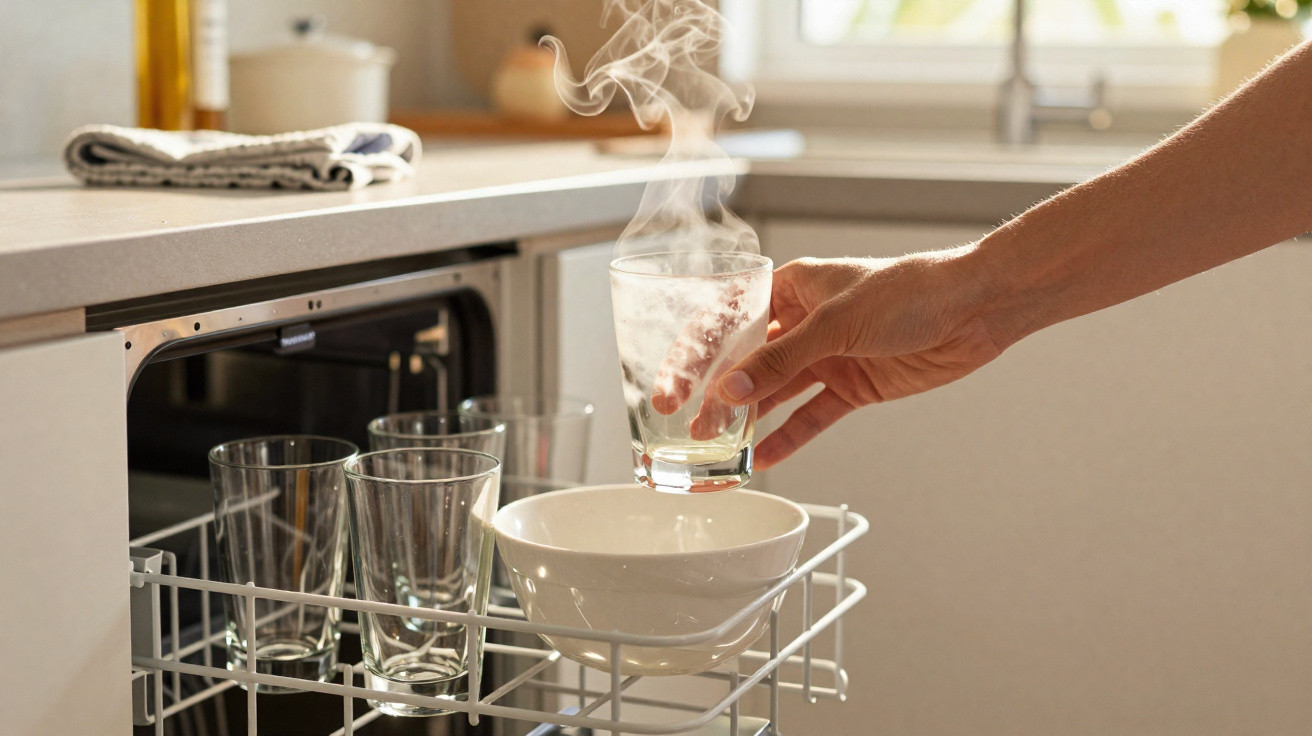
There is a quiet little kitchen humiliation that many of us know well: you open the dishwasher, get a faceful of hot steam, and find the plates looking brilliantly clean… while the wine glasses on the top rack seem as though they have been washed in milky chalk. You rub one with your thumb, but the peculiar cloudy coating stays put. It reflects the light in exactly the wrong way, silently announcing: “These will look terrible when your friends come over.” You blame bargain glassware, the dishwasher tablets or the appliance, then hide the glasses at the back of the cupboard and hope nobody spots them.
But perhaps the real culprit is the top rack - and the answer lies in a simple plume of warm vinegar steam.
When ‘clean’ glasses still look disappointing
Most of us have experienced the deflating moment of setting the table, holding a glass to the window and feeling a slight drop in the heart. Your dishwasher has dutifully completed its cycle, you selected the ‘glass care’ programme as the handbook advised, but the rim appears dusty and the bowl is dull and misty. It does not seem unclean; it simply looks wrong, as though all its sparkle has slipped away unnoticed. Do you wash it again, or act as if you have not seen it?
Serving a good drink in a cloudy glass brings a very particular sort of embarrassment. Sparkling water looks lacklustre, wine loses its jewel-like brightness, and even ordinary tap water can seem faintly suspect. It is not entirely rational, yet it touches the part of us that wants to appear as though life is under control. The plates match, the cutlery is more or less aligned, but those glasses expose you in the most unhelpful way.
Let’s face it: after a twelve-hour day, nobody wants to hand-wash every piece of treasured glassware merely to keep it immaculate. The dishwasher should be the adult answer - the civilised convenience that saves you from an evening of washing-up foam. When the appliance you depend upon to contain domestic chaos gradually strips the lustre from your glasses, though, it can feel surprisingly personal. That is when people begin grumbling about “hard water” and “cheap detergent”, wondering whether cloudy glasses are simply their fate.
The overlooked culprit on the dishwasher top rack
One point that is seldom mentioned is that the top rack is not an entirely harmless place. Your glasses remain there for hours among hot water, detergent and minerals circulating from the tap supply. The upper shelf may feel protected and gentle, safely away from the clatter of plates and pans, but it can become the worst location for delicate glassware when several factors combine. Hard water, powerful tablets and high temperatures can create a perfect storm above.
The spray on the top rack is often finer yet more persistent, leaving droplets to cling to the glass and dry more gradually. Particularly with hard water, these droplets can leave minute traces of calcium and magnesium behind, accumulating in thin, pale layers. You will not see it after the first wash. Eventually, however, a closer look reveals that the entire glass is covered by a flat, cloudy film. This is generally not grime but mineral scale fixed in place by heat, rather like microscopic kettle limescale.
People sometimes decide that a glass has been ‘etched’ - and therefore permanently damaged - when it is actually concealed beneath a chalky deposit. Genuine etching means that the glass surface has corroded, commonly because strong detergents or very soft water have acted like a slow acid. In many British kitchens, especially where the water is hard, the simpler problem is scale. The top rack is merely where this understated chemistry becomes most obvious, precisely where your ‘best’ glasses are kept.
How your dishwasher encourages cloudy deposits
A dishwasher is effectively a miniature chemistry laboratory dressed up as a household essential. Detergent, heat, water hardness and plastic components interact in ways most of us never consider. Tablets and pods are strong products, intended to tackle grease on roasting trays and baked-on lasagne. For fine glassware - particularly thin crystal or glass with a higher lead content - that may be rather like reaching for sandpaper when a soft cloth was needed.
When the water is hard and the rinse aid is running low - or when the appliance’s softener is not functioning correctly - each hot wash leaves behind a minute mineral residue. It often goes unnoticed on crockery. On transparent glass, it appears as stubborn, patchy fog on a cold window. Every cycle adds a further near-invisible layer, which is heated, dried and set. The top rack, where glasses stand upright and still, becomes a particularly convenient place for this residue to settle.
Heat plays a part as well. Leaving eco cycles aside, many of us choose the hottest wash without much thought, especially following a large meal or a disaster involving a sticky pan. Greater heat helps tablets dissolve, but it also helps minerals bind in place, rather like low-temperature firing in a pottery kiln. Gradually, your glasses lose the brightness you originally bought them for. They may not be beyond saving; they are often simply covered in a scale layer that an ordinary cycle cannot remove.
The unexpected power of warm vinegar steam
This is where an appealingly simple solution comes in: warm vinegar steam. There is no need for a specialist device or an expensive ‘glass rescue’ product, only something you are likely to have tucked away in a cupboard already. Ordinary supermarket white vinegar is mildly acidic. That modest acidity can dissolve dishwasher-baked mineral deposits, especially when warmth and steam are part of the process.
There is an oddly pleasing quality to the ritual. The kettle clicks off, a faint wave of warmth fills the kitchen, and a light vinegar scent rises, bringing to mind chip shops and pickled onions. Use that smell constructively and it begins to release the haze from glassware without scrubbing, harsh abrasives or damage to the glass itself. It is less like battling dirt and more like persuading the shine to return.
In straightforward terms, you are offering the minerals a gentler, slower way out. Rather than attacking the glasses with an even stronger detergent, you allow a warm, mild acid to weaken the bond between the cloudy layer and the surface. It is like soaking a plaster until it slips away instead of pulling it off in one go. The method is quiet, faintly old-fashioned and unexpectedly soothing.
How to restore cloudy glasses using vinegar and steam
Step 1: Make a small vinegar sauna
Set a heatproof bowl or wide measuring jug in the sink. Add a generous splash of plain white vinegar - around 250 ml will generally treat several glasses. Pour in roughly the same quantity of freshly boiled kettle water, creating a warm, steamy mixture with a mildly sharp but manageable smell. It does not need to be bubbling fiercely; it only needs to be hot enough for visible wisps of steam to rise.
Hold the first cloudy glass upside down above the bowl, allowing the steam to reach its outer surface. Do not immerse it at this stage; let the warm acidic vapour gently settle on the dull areas. Turn the glass slowly as condensation gathers in tiny beads across it. Keep it over the steam for around one to two minutes, allowing a little longer for any especially lifeless patch.
Step 2: Allow the vinegar to do most of the work
Once you have steamed it, dip a soft cloth or non-scratch sponge into the warm vinegar solution. Lightly wipe the exterior, following its shape and concentrating on the base and the section immediately below the rim. These are often the first areas where the cloudy layer begins to lift. If the cloth initially catches slightly before suddenly moving more freely, that is the scale starting to release.
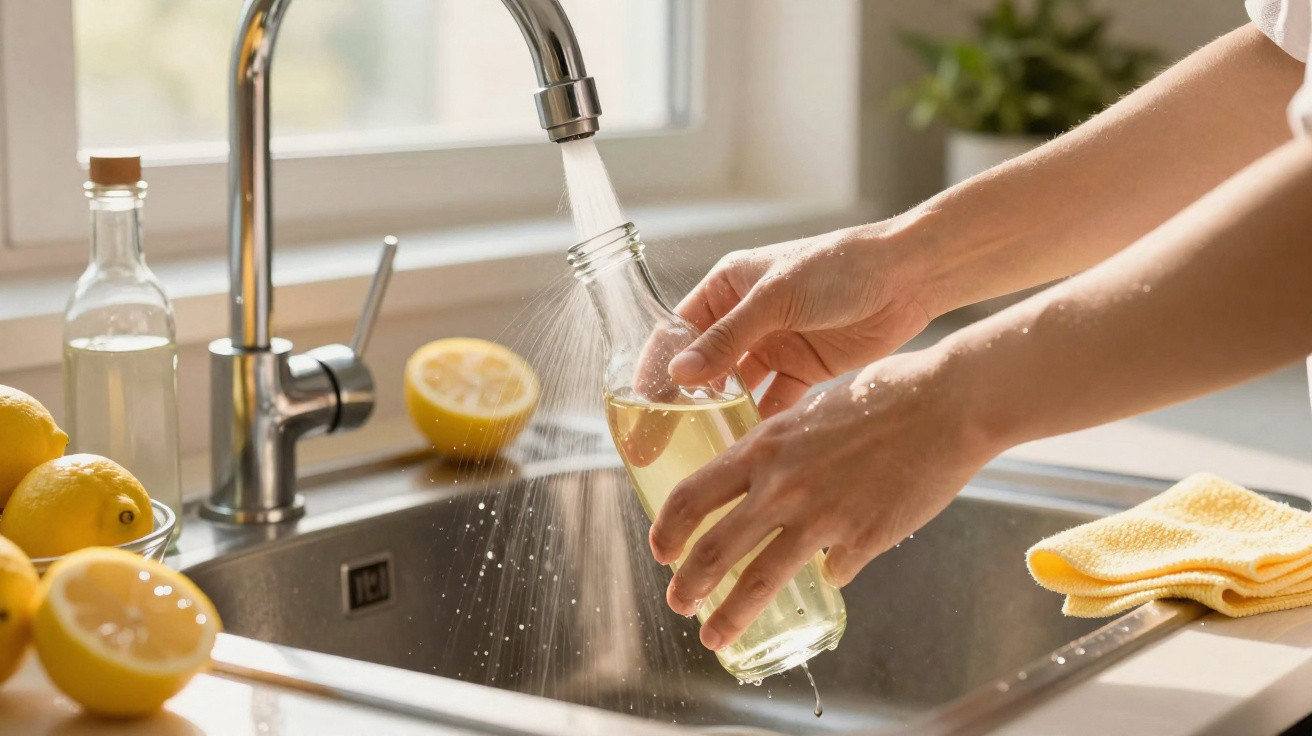
For more persistent deposits, briefly place the cloudy part of the glass directly in the warm vinegar mixture for three to five minutes. There is no need for a lengthy soak; steam and warm acid are usually more useful than leaving cold vinegar to sit forlornly in a glass for an hour. After soaking, remove it, wipe it once more with a gentle touch and rinse it beneath warm running water. When you raise it to the light, the improvement is often immediately visible.
Step 3: Dry the glasses properly
This is the stage most of us hurry through, despite it being where the final touch of transformation takes place. Blot the glass dry with a clean lint-free cloth, then polish it briefly while it remains just slightly warm. The residual heat helps the last moisture disappear without forming fresh mineral marks. Catch it at the right angle and the glass regains its clear, ringing transparency, as if it has been given fresh lungs.
When treating a whole set, add a little additional hot water to the vinegar bowl after every few glasses so that the steam does not fade away. The mixture need not be replaced constantly; if it is warm and still has a faint sharp scent, it remains effective. By the final glass, you may feel the quiet satisfaction of recovering something you had assumed was beyond help. It is only a small household success, but it can feel unexpectedly meaningful.
When vinegar steam cannot restore the glass
Sometimes you can steam, soak and polish with care, yet the glass continues to look strangely matt. When no amount of cloudiness shifts, even slightly, genuine etching is the probable cause. That is not a surface deposit; it means the glass itself has slowly been eaten away by strong detergent and unsuitable water softness. No amount of vinegar can replace the missing glass.
Etching is often identifiable because the dullness is even and almost silky, while the surface may feel slightly rough if you run a fingernail over it. It can develop more quickly with thinner glass, very soft water, or repeated hot cycles using heavy detergent doses. At that stage, the shine is essentially lost for good. Whether to keep using the glass is a matter of acceptance rather than restoration: are you content to drink from something that will never truly sparkle again?
There is a modest but genuine sadness in recognising this. These are frequently glasses tied to memories - wedding presents, purchases for a first flat, survivors of late-night toasts. Understanding the difference between etching and scale helps you choose which glasses are worth saving, and which battles cannot be won. The vinegar steam method belongs to the hopeful middle ground: the ‘not quite gone yet’ collection slowly fading away on the upper shelf.
Preventing the cloudiness from returning
Adjusting how you use the top rack
After putting in the effort to steam your glasses back to clarity, it is worth protecting that restored shine. The easiest adjustment is not to put glassware through the hottest and longest programme every time. Choose a gentler or glass-specific cycle where possible, and avoid putting everything through the same punishing wash as the lasagne dish. The top rack ought to be the dishwasher’s peaceful level, not a chemical battlefield.
Check the rinse aid level and, where your machine has one, the integrated softener setting. The small symbols and sliders hidden inside the door do matter in this case. When set correctly, they allow water to run from the glass in a sheet instead of clinging as mineral-heavy droplets that dry into fresh cloudiness. Altering little plastic dials may not be glamorous, but it is easier than reviving your glassware with steam every month.
The simple routine that preserves clarity
If you live in a hard-water area, it is worth accepting that the dishwasher is in a constant uphill struggle. This does not require endless descaling tablets or elaborate daily routines. A monthly ‘vinegar steam session’ for your most-used glasses may be enough - rather like a spa treatment for the cupboard. Once they are clear, rotate their use so that the same four dependable glasses are not always facing the heat and minerals on the front line.
There is a gentle, almost old-fashioned satisfaction in looking after belongings in this manner. They become more than disposable objects; they are quiet companions to everyday life - the glass you choose in the evening, the one that makes an ordinary drink feel like an occasion. A bowl, hot water and a glug of vinegar cannot solve every kitchen problem. Yet they may restore something you thought the top rack had taken permanently: that crisp, light-catching sight of a glass that genuinely looks clean again, and the quietly proud feeling it brings.



Comments
No comments yet. Be the first to comment!
Leave a Comment