
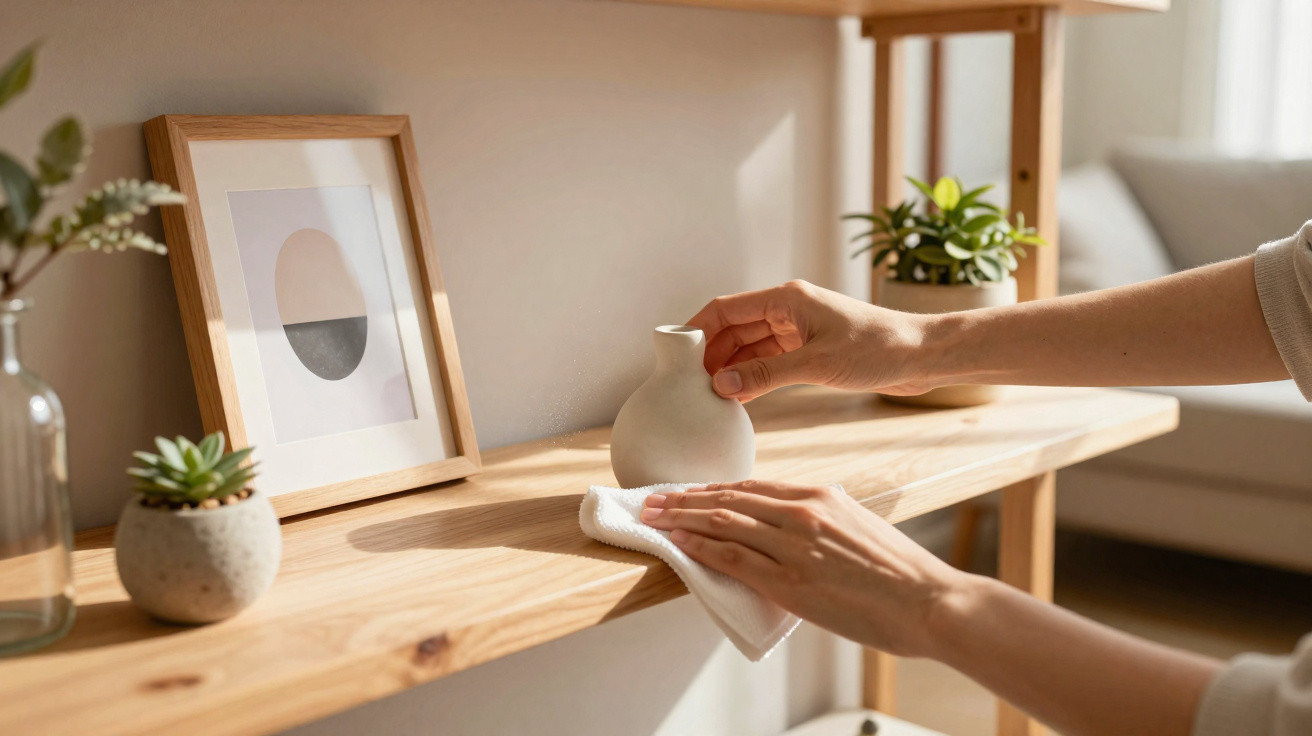
Sunday morning: you have just cleaned the living room, lined up the candles neatly and admired your favourite ceramic vase shining in the light. You make a coffee, reply to a few messages and get on with your day. A few days later, you enter the room again, sunlight falls across the shelf… and there it is: a pale grey coating over every decorative object, making your home seem as though it has aged by ten years overnight.
You blow across a figurine, run a finger over a photo frame and realise that your “pretty things” are really dust magnets. The more objects you display, the more your shelves resemble a museum for airborne particles. It is not because your home is dirty; there is simply more dust than you can keep up with.
A silent battle is taking place between your décor and the dust you cannot see.
Why dust loves your decorative objects so much
Walk past a packed shelf and it is easy to see that dust has taken over. It settles on every rim, inside every fine groove of a carved wooden box and across each uneven clay pot. Ironically, the pieces that give a home character are often those that gather dust most quickly. Smooth television screens are simple to wipe down; delicate mementoes from a holiday five years ago are far less forgiving.
Decorative objects tend to be small, stationary and left untouched for weeks. For particles drifting through the air, that makes them an ideal landing place.
Imagine a friend carefully arranging a gallery wall, miniature sculptures, travel treasures and photo frames. The finished space looks as though a Pinterest board has sprung to life. Yet, two weeks later, sunlight reaches the edge of the shelf and everything suddenly appears worn out. A fine border of dust clings to each item, as if it had been stored in a sealed attic.
She launches into a frantic clean-up, picking up a random cloth and rushing from one object to the next. Instead of lifting the dust, the cloth merely shifts it about; the smallest items nearly topple, and she ends up irritated because her “perfect corner” looks even worse. The uplifting feeling her décor was meant to create has become a maintenance problem.
Dust is not simply “dirt from outside”. It contains fabric fibres, dead skin cells, pet hair, pollution, cooking residue and microscopic particles that are continually moving around your home. These particles drift, strike an object, adhere through static electricity or oils, then settle. The more irregular and textured an item is, the more firmly dust tends to hold on.
Shelves positioned near windows or radiators are exposed to greater air movement. In open-plan homes, dust can travel from the kitchen into the living room. Objects displayed in groups also form small corners where particles collect. So, when dust seems to arrive “out of nowhere”, it is actually following a highly logical route.
Simple habits that quietly block dust buildup
The most effective defence against dusty décor is not a wonder spray but a small, regular habit. A quick weekly pass using the appropriate tool is usually enough. For most objects, use a soft microfibre cloth or an electrostatic duster; make the cloth slightly damp for non-porous surfaces. Move around the room and clean the tops of frames, vase edges, figurine shoulders and the leaves of artificial plants.
Treat it like brushing your teeth: brief, routine and unremarkable. If you deal with dust before it becomes noticeable, it never gets the chance to build into a thick layer, while fragile items are spared exhausting deep-cleaning sessions.
Another useful approach is to limit how many items are left fully exposed. This does not mean getting rid of them, only arranging them more thoughtfully. Put perfume bottles on a tray, place a treasured figurine beneath a glass dome or store small souvenirs in a box. Your style remains the same; you simply alter the surfaces where dust can settle.
Realistically, hardly anyone follows this routine every day. However, once you decide that every new decorative piece should be grouped or protected in some way, you prevent extra dusting work for your future self. You are creating décor that is easy to maintain, rather than only attractive on its first day.
The main mistake is overly forceful cleaning. It is easy to reach for abrasive cloths, apply too much cleaning product or spray straight onto delicate items. Moisture can seep into wood, fragrances may fade and painted surfaces can lose their finish. Dust leaves, but the damage stays.
“Dust is light and stubborn at the same time. If you fight it too hard, you hurt the object more than the dust,” says a professional home stager who spends her life arranging and preserving decor for photoshoots.
- Choose microfibre rather than paper towels for most surfaces.
- Dust before vacuuming, so that fallen particles are collected afterwards.
- Cover candles when they are not in use to prevent waxy dust coatings.
- Occasionally rotate objects so concealed areas do not turn into dust traps.
- For intricate items, think about closed shelving or glass-fronted cabinets.
Living with decorative objects you love, not objects you serve
Behind all this discussion of dust is a quieter question: do your decorative objects support your life, or do you work for them? When a room is filled with items that constantly need wiping, moving, rearranging and lifting, it becomes difficult to relax in it. You begin to tread carefully. Every time you pass the crowded shelf, you feel a small sense of irritation, knowing that one shaft of sunlight will reveal the dust again.
By contrast, choosing several statement pieces, grouping smaller items, shielding fragile ones and doing a simple weekly round with a duster makes your décor feel easier to live with. Cleaning day no longer feels daunting: you know what needs doing, and it takes ten minutes.
| Key point | Detail | Value for the reader |
|---|---|---|
| Controlled routines | Brief, regular dusting with suitable tools | Less buildup and no overwhelming “deep clean” sessions |
| Smart object placement | Grouping items and covering delicate or textured pieces | The same décor style with far less maintenance |
| Material awareness | Gentle methods tailored to wood, glass, ceramics and metals | Longer-lasting objects, with fewer scratches or faded finishes |
FAQ:
Question 1 How often should I dust decorative objects to prevent buildup?
Once a week is a sensible schedule for most homes. In particularly dusty locations or urban areas, a quick twice-weekly pass over the most exposed items - near windows, vents and radiators - keeps things manageable without making it feel like a chore.
Question 2 What’s the best way to dust very intricate or fragile objects?
Try a soft make-up brush or a small artist’s brush. Lightly tap or sweep away the dust, catching it with a microfibre cloth held beneath the object. Do not spray products directly onto the piece, particularly if it is old wood, painted or collectible.
Question 3 Do air purifiers really help with dust on decor?
They may lower the total number of particles circulating in the air, especially in homes with pets or close to a busy road. They will not eliminate dust, but they can slow how quickly it settles, leaving fewer visible layers on shelves and objects.
Question 4 How can I keep fake plants from looking dusty and dull?
Once a month, take them into the shower or onto a balcony and rinse them gently with lukewarm water. Leave them to dry upside down. Between rinses, remove loose dust with a dry microfibre duster or a hairdryer set to cool and low power.
Question 5 Are there materials that collect less dust than others?
Glass and smooth ceramics are among the easiest materials to clean because dust does not cling to them as readily. Strongly textured fabrics, rough timber, carved stone and open-weave décor, including some baskets, capture more particles and require gentler, more frequent dusting.




Comments
No comments yet. Be the first to comment!
Leave a Comment