
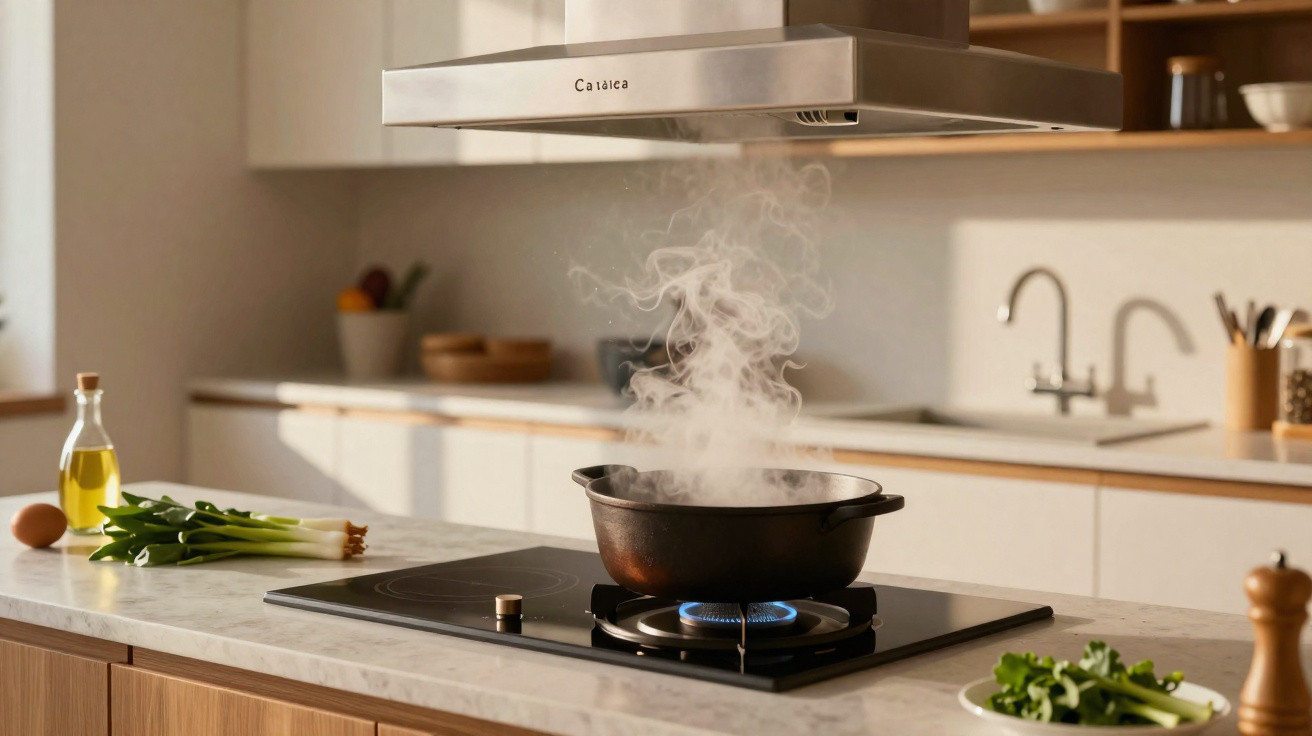
No heavy metal canopy hanging over the hob, no “statement” centrepiece clamouring to be noticed. Instead, there is an uninterrupted expanse of pale stone, a fine shadow gap above the cooktop and the almost imperceptible hum of a concealed fan. When the homeowner asked, “But… where’s the ventilation?”, the designer at the property laughed.
That is the understated revolution currently reshaping high-end kitchens. The theatrical, oversized decorative range hoods that dominated Pinterest for a decade are discreetly making their exit. Hidden systems, slim slot vents, ceiling-integrated units and downdrafts are taking their place, allowing the architecture and finishes to stand out.
It is rather like a noisy party guest leaving: all at once, you can hear the room again. Subtlety is moving in.
Why decorative range hoods are vanishing from dream kitchens
Spend a few hours looking around recently renovated houses and the absence soon becomes noticeable. The enormous metal or plaster hood, once positioned as the kitchen’s crowning feature, has disappeared from many of the most progressive schemes. Designers are removing visual distraction from cooking areas, and the hood is frequently the first thing to go.
Rather than a substantial box, there are serene, unbroken splashbacks. Cupboard runs continue in one fluid line. A discreet slot within a ceiling bulkhead handles the air extraction. The point is unmistakable: kitchens are no longer appliance showrooms. They are living spaces that must feel airy and visually cohesive.
Once you know what to look for, the change is equally apparent on social media. A 2014 “dream kitchen” image typically featured white Shaker cupboards, metro tiles and a vast stainless-steel hood above a professional-style range. Contrast that with the 2024 images now filling designers’ feeds: stone-clad walls, integrated cooktops and virtually no visible metal.
One New York architect said that more than 70% of her clients last year requested concealed ventilation, even when this required a larger ductwork budget. They were not pursuing a labelled trend; they were responding to the atmosphere of the room. “We love how open it looks,” one homeowner wrote below a reveal photograph. “It doesn’t feel like a restaurant kitchen in my living room anymore.”
There is a practical reason behind the shift as well. Those dramatic hood canopies were often neither correctly sized nor properly positioned or ducted. Appearance regularly came before performance. The result was a vast “feature” that could be loud, ineffective or hardly ever operated at full speed.
As open-plan layouts brought cooking, eating and relaxing areas closer together, that arrangement became less acceptable. No one wants to speak over a thundering fan while guests are sitting 1.5 metres away. Designers began to favour quieter motors, longer duct routes and improved capture instead of visual theatre.
The outcome is an organic progression: ventilation that performs better while remaining less visible. Function is no longer expressed through a large chrome box above the hob. It means preserving a peaceful room while a Bolognese sauce quietly simmers.
The discreet ventilation solutions kitchen designers favour
Speak with kitchen designers today and a different vocabulary emerges: ceiling cassette, integrated liner, downdraft and recirculating plinth. Their shared principle is straightforward. The functional components are concealed within existing surfaces - the ceiling, upper cupboards or even the worktop.
Ceiling-integrated hoods are a popular choice in contemporary homes. Picture a neat rectangle set flush into plaster and painted to match the ceiling. The fan and ductwork sit above it, often with a remote motor positioned on the roof or an external wall. What remains visible is merely a narrow edge and restrained grille, rather like an understated skylight for air.
Built-in hood liners, concealed inside bespoke cabinetry, offer another option. In place of a large stainless-steel unit, there may be a timber or plaster “chimney” that merges into the cupboards or wall finish. Open the cabinet and the actual hood module, including its filters, is inside. Increasingly, this exterior casing is intentionally restrained rather than sculptural.
A growing number of households are also selecting cooktops with integrated ventilation. A narrow opening at the centre or rear of the hob draws steam down as it rises. Out of sight, the air is either extracted externally or filtered and recirculated. This approach does not suit every layout, but it resolves a genuine issue on islands where a huge suspended hood would overwhelm the room.
One London couple had an awkward beam directly above the point where a conventional hood would have sat over their island. Their designer suggested a downdraft system that rises silently from the worktop when required. “We were skeptical,” they admitted later, “but now guests ask where the extractor is, and we love that little magic trick.”
This is the emotional attraction of discreet ventilation: it creates visual lightness. The kitchen can feel like part of the living area rather than a separate practical zone dominated by industrial equipment. On demanding days, not having a visible “machine” above your head can genuinely alter the feeling of standing at the hob.
Concealing the hood also enables other features to take centre stage from a design perspective. Stone veining, a shaped splashback, open shelving or one window above the cooktop can suddenly become the focus. Designers refer to “quiet luxury” and “soft minimalism”, but these terms often amount to one thing: no enormous metal box monopolising the view.
There is a technical benefit, too. Remote motors and intelligently planned ducting can make these hidden systems considerably quieter than traditional exposed hoods. Less sound, less visual disorder and equivalent or improved performance: for many homeowners, that is an easy exchange to make.
How to select hidden ventilation that works in everyday life
With any design trend, it is tempting to replicate the appearance and assume performance will follow. Ventilation does not work like that. Begin by standing in the kitchen and observing where steam actually travels while you cook. Trace that route with your eyes: this is where the “invisible” system must discreetly intercept it.
Where the cooker is on an external wall, a cabinet-integrated liner hood with correctly installed ducting that exits directly through the rear can be both unobtrusive and powerful. Above an island, a ceiling cassette located directly overhead - rather than 0.5 metres away - will generally outperform a decorative suspended hood. In compact flats, a recirculating downdraft or vented hob may represent the most realistic compromise.
Focus less on brand names than on capture area, airflow and noise ratings. A subtle vent that feels comfortable enough to use daily will keep a home fresher than a “showpiece” hood you dislike switching on. Quiet, dependable extraction is better than heroic but irritating performance.
We have all experienced the “I’ll just open a window” phase. It works for roughly ten minutes on a favourable, windless day while you are preparing something mild. Then a single batch of pan-fried salmon demonstrates why proper extraction matters. Let’s be honest: no one truly runs a hood at full power every day, particularly when it screams like an aircraft.
The concern around concealed systems is that they may look exceptional but prove disappointing in use. This occurs when the layout, duct length and motor capacity are not planned as one system. Consider a whisper-quiet ceiling cassette attached to a long, winding duct with no cleaning access. It may work on paper, yet within a year it will be noisy and underpowered in reality.
When designers plan it correctly, the reverse happens. A family in a compact Paris flat chose an integrated hood liner in a shallow cabinet with smart carbon filters. “We were scared the smells would linger,” they said after moving in, “but honestly it’s better than our old big hood we barely used.” The effective element was not the gadget itself. It was the fit between their lifestyle, cooking routines and technical design.
Concealed ventilation also requires an honest assessment of how you cook. If you seldom deep-fry or sear at intense heat, you may not need the heavy-duty system demanded by a restaurant range. If wok cooking or indoor grilling is a regular habit, maintaining performance while keeping the system discreet will require more effort.
“A good ventilation plan is like good lighting,” says interior designer Maya Ortiz. “You only notice it when it’s wrong. When it’s right, the room just feels calm, and you can focus on being there, not on the hardware.”
From a practical standpoint, several questions can help you make sense of the options:
- What do I genuinely cook in a typical week - rather than in my fantasy life?
- Where can ducting realistically be routed in my home?
- How near can the intake sit to the actual plume of steam and smoke?
- What level of noise will I accept while conversing in the same room?
- Who will clean or maintain the system, and how often?
That sort of plain-speaking checklist is much less glamorous than a mood board, but it separates a kitchen that looks superb in photographs from one that still feels good after ten years. The finest discreet systems almost disappear from your consciousness. You switch on the fan, talk with friends and forget it is there as the air quietly refreshes the room.
The quiet future of kitchen design and what it reveals about us
There is something telling in the decline of the decorative range hood. For a long time, kitchens were places for display: the chef’s range, the oversized pot filler and the polished chimney hood declaring, “Serious cooking happens here.” In many homes today, the status symbol is a space that remains seamless and relaxed, even in the middle of preparing a meal.
Discreet ventilation is perfectly suited to that mood. It makes no demand for attention. It does not boast about the volume of air it can move. It places the experience of occupying the room ahead of its technical appearance. On a human level, this reflects a wider wish to conceal life’s machinery rather than remove it.
We still cook pasta, sear steaks and occasionally burn toast. Smells, steam and smoke have not changed. Our tolerance for visual and acoustic clutter has. Hidden hoods, ceiling slots and vented cooktops are more than a stylistic shift; they are a collective choice in favour of calmer daily surroundings.
While scrolling on a small screen through images of almost invisible vents and uninterrupted stone, you may feel a pull of longing. “I want my kitchen to look like it can breathe.” That sentence captures the discreet trend. It is neither clinical nor ostentatious. It is simply a place where the technical elements retreat enough for life - messy, aromatic, shared life - to take the foreground.
| Key point | Detail | Why it matters to the reader |
|---|---|---|
| Discreet systems are replacing statement hoods | Designers favour hidden liners, ceiling cassettes and vented cooktops | Helps explain why “no hood” images are appearing repeatedly in inspiration feeds |
| Performance still matters more than aesthetics | Capture area, ducting and noise determine how effectively a system operates | Helps you ask more informed questions when planning a renovation |
| Design should suit real cooking habits | Heavy searing requires stronger extraction than occasional pasta evenings | Avoids costly mistakes and everyday frustration in a new kitchen |
FAQ:
- Are decorative range hoods officially “out” of style? They have not disappeared altogether, but they are no longer the default focal point. Many high-end projects now conceal the hood or make it visually restrained, with bold hoods treated as a deliberate exception rather than the norm.
- Do hidden ventilation systems cost more? Frequently, yes, because they require more careful planning, duct routing and sometimes remote motors. However, they can also reduce spending on decorative cladding and free up budget for items you see and use every day.
- Can discreet hoods really handle heavy cooking? If correctly sized and installed, they can perform very effectively. The essential point is to match the appropriate type - ceiling unit, liner, downdraft or vented hob - to your layout and cooking style, then provide the necessary ductwork and power.
- What if I live in a flat and can’t vent outside? Recirculating systems with high-quality filters are improving, especially alongside induction cooktops, which create fewer combustion by-products. They are not flawless, but can offer a sound compromise for renters or residents of shared buildings.
- How do I keep a hidden hood easy to maintain? Ask where the filters are located, how they are removed and whether the duct connection can be reached if necessary. Easy filter access and a simple duct route make cleaning more achievable, helping performance remain closer to its first-day level.






Comments
No comments yet. Be the first to comment!
Leave a Comment