
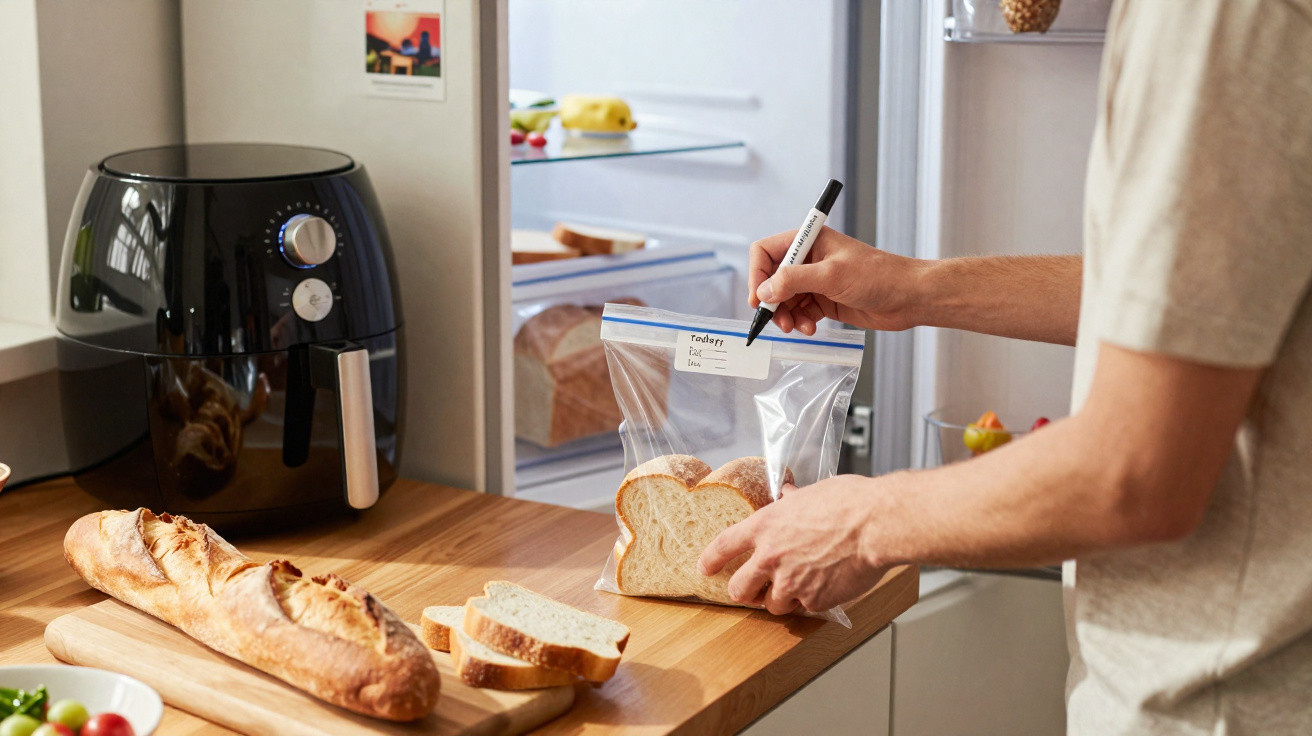
In France, freezing bread helps to reduce waste, provided it is shielded from air and moisture.
Published on 12 June 2025, the source article on bread storage methods notes that a baguette or loaf can lose its texture very quickly when left uncovered. The freezer is a practical answer, although the wrapping chosen and the defrosting method make all the difference.
When to put bread in the freezer
Bread that is already very dry will not regain its original freshness after freezing. The aim, therefore, is to freeze leftovers promptly, while the crumb is still soft and the crust has not yet become hard.
For a baguette, it is often most convenient to cut it in half or into several portions. Sliced loaf can likewise be separated before storage. This approach prevents you from defrosting more bread than is needed for one meal.
“Bread keeps better when frozen in portions suited to its intended use: toast, sandwiches, a meal accompaniment or slices for grilling.”
Bread should also be completely cold before it is wrapped. If it has just come out of the oven or remains warm, steam trapped inside the packaging can turn into moisture. This condensation may then damage the crust during defrosting.
Why foil and ordinary bags are not ideal for freezing bread
The source article advises against using an ordinary plastic bag or aluminium foil. Depending on how they are sealed and their condition, these coverings can either trap moisture or allow air inside. As a result, a baguette may soften, develop a less pleasant texture or dry out in the freezer.
The recommended option is more securely sealed packaging: tightly cling film or a zip-lock freezer bag. The distinction is important. A resealable freezer bag designed to withstand low temperatures does not perform the same function as a thin, open bag used to carry bread home.
- Allow the bread to cool fully before storing it.
- Cut larger loaves into portions.
- Remove as much air as possible before sealing the packaging.
- Write the freezing date on a label.
- Store the bread at the back of the freezer, where the temperature is more stable.
For country-style bread with a thick crust, the article suggests extra protection: first wrap the loaf in baking paper, then place it in a freezer bag. The baking paper prevents direct contact with the plastic, while the bag reduces exposure to freezer air.
The freezing date: a useful reference point
Labelling portions means items at the back of the freezer are less likely to be forgotten. The article recommends eating the bread within three months to retain its flavour qualities as effectively as possible. Over time, freezing does not automatically make bread unsafe to eat, but its texture and aromas may diminish.
Slow defrosting to protect the crumb
Allowing bread to return to room temperature is the gentlest method. Simply take it out of its wrapping and place it on a wire rack. Air can then circulate around the crust, preventing it from becoming soggy against a flat surface.
This method is especially suitable for a loaf, half a baguette or several slices intended to accompany a meal. It requires some planning, but reduces sudden temperature changes.
Once defrosted, bread should be eaten within a reasonable period. Refreezing it is not a good practice, as every defrosting cycle alters its texture and can make storage more difficult.
Using the oven to restore a crisp crust
For a baguette taken from the freezer, the oven remains the option highlighted by the source. Preheat it to between 180 and 200°C, lightly moisten the underside of the bread, then put it straight onto a wire rack for around ten minutes.
“A small amount of moisture and the oven’s heat create steam, helping the crust become crisp again without drying out the crumb too quickly.”
It is best not to use aluminium foil at this stage. Covering the bread traps steam, leaving the crust soft instead of allowing it to dry and turn crisp.
Cooking time varies according to the size of the piece and the oven’s actual power. A slice needs less time than a whole baguette. Watch the browning carefully, particularly if the bread has already partly defrosted.
An air fryer for smaller portions
An air fryer can be suitable for slices, bread rolls and individual portions. It heats up quickly and circulates hot air around the bread. According to the article, a few minutes are enough to give it a firmer texture again.
This technique suits occasions when one or two slices are needed without switching on a full-sized oven. It still requires regular checks: a thin slice can become hard very quickly under intense heat.
The situation in France: a way to cut food waste
In France, bread is among the foods often thrown away despite still being usable. Freezing makes it possible to buy a baguette or loaf without having to eat all of it on the same day. It also provides a reserve for unexpected meals.
Bread that has already lost its crispness can be used in other ways too: croutons, breadcrumbs, French toast or toasted slices. These options do not replace proper freezing, but they help avoid throwing away leftovers that have become too dry.
A microwave can be useful for quickly warming a slice. The source recommends covering it with a slightly damp paper towel to limit drying. This method warms the crumb, but does not recreate the crispness achieved in an oven or air fryer.
For people who enjoy morning toast, freezing slices separately offers a clear benefit: they can go directly into the toaster one at a time. A whole baguette, however, benefits from being reheated in the oven to recover a crust closer to that of freshly baked bread.





Comments
No comments yet. Be the first to comment!
Leave a Comment