
There is a small domestic battle played out in countless kitchens. Half asleep, you fill the electric kettle, press the switch and, while the water heats, spot it again: the pale, crusty ring at the bottom. Cloudy flakes drift through your tea. A faint but persistent smell remains, however thoroughly you rinse.
One day, you try vinegar; the next, washing-up liquid; then a random “miracle” product found on TikTok. The kettle froths, the room smells unpleasant, and it still looks worn out.
With a sigh, you put it back in its corner and promise yourself you will deal with it “properly” another day.
But there is a quieter, almost effortless way to win this particular battle.
Why limescale in your electric kettle is more than an eyesore
When you first spot limescale, it is easy to dismiss. It is only a white film or a crust at the bottom, nothing especially alarming. Then, one morning, a tiny chalky fragment floats into your cup and your otherwise perfect tea no longer feels quite so perfect.
Your kettle may begin to sound different as well: louder and more strained, as though it is working harder than necessary. You may not say it aloud, but you can sense it: the appliance is ageing sooner than it should.
For many people, the moment of truth comes when visitors are involved. A friend asks for a herbal tea, you boil the water and pour it - only to see a thin layer of cloudy residue swirling on the surface. You apologise, laugh it off and assure them that “usually it’s not like this.”
Some people quietly replace their kettle every few years, assuming that it is “just what happens.” Others scrub until their hands ache or buy aggressive chemical descalers that smell like a laboratory. All this fuss over one simple cup of hot water.
The cause is actually straightforward. Tap water contains minerals, chiefly calcium and magnesium. When water is heated, these minerals crystallise and stick to the metal or heating element. Over time, layer upon layer of limescale forms.
That crust creates insulation between the water and the heat source. The kettle therefore uses more energy, takes longer to boil and wears out sooner. It affects more than appearance or flavour: it can also influence your electricity bill and the life of an appliance used every day.
Citric acid for electric kettle limescale: the surprisingly simple trick
Forget the vinegar smell that spreads through your whole flat. Forget washing-up liquid that never seems to rinse away completely. The understated solution trusted by many careful home cooks is food-grade citric acid.
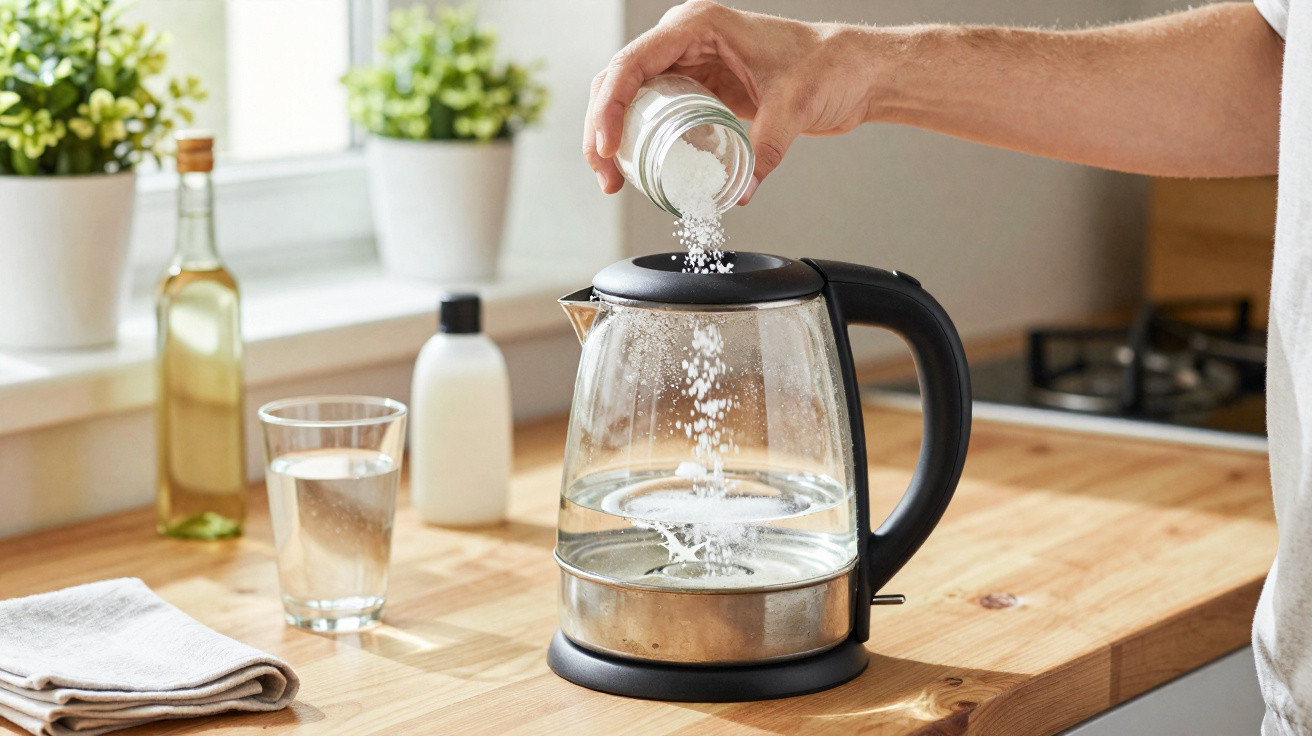
You will usually find it in the baking or cleaning aisle, sold in small sachets or tubs. Resembling fine salt, it dissolves fully in hot water and works quickly. There is no need for frantic scrubbing; simply let the chemistry do the work.
The basic process is this. Fill the kettle halfway with water and bring it to the boil, then unplug it. Add 15–30 g of citric acid crystals - around one to two tablespoons - to the hot water, then swirl gently. Leave it for 15 to 30 minutes.
When you return, the limescale will generally have softened or disappeared altogether. Tip away the water, rinse once or twice with fresh water, then boil one final kettleful to flush away any remaining residue. That is all. No unpleasant smell, no aftertaste and no gritty sensation - just clean metal again.
This near-effortless approach works because citric acid reacts with limescale. It gently chelates the minerals, breaking the bonds that hold them to the heating element and kettle walls. Unlike vinegar, it does not leave a sharp odour lingering in the air for hours.
Unlike strong chemical descalers, it is also inexpensive, easy to obtain and useful for several other household jobs. Realistically, nobody carries this out every day. However, doing it once a month - or even every two months - is enough to stop your kettle becoming a geological formation.
Making the trick fit into real, slightly messy daily life
The “ideal” routine is straightforward: once a month, choose an evening after you have finished using the kettle. Boil the water, add citric acid, leave it to work, rinse and you are done. It takes around 5 minutes of actual effort; the rest happens while you sit on the sofa.
If your kettle is heavily coated, repeat the treatment twice. For especially stubborn areas, pour away most of the solution, leave a small amount in the bottom and, once the kettle has cooled, rub gently with a soft sponge. The scale should lift away with very little effort.
For most people, the challenge is not the method but the guilt. They notice the limescale, think, “I should clean this,” and then life takes over: children, work, laundry or the programme you are absorbed in. Weeks pass, perhaps even months.
Rather than pursuing an unrealistic standard of a “perfect home”, tie descaling to something you already do: the first Sunday of the month, your food shopping day or the evening you change the bed linen. A small prompt like this can make the habit almost automatic, without turning it into another chore hanging over you.
“The real shift came when I stopped fighting my kettle with random products and just used citric acid once a month,” says Claire, 34, who runs a small café and goes through several kettles a year at home and at work. “My energy bill dropped a little, my tea tastes better, and my kettles simply last longer. It’s not glamorous, but it works.”
- Use food-grade citric acid to keep the process safe and suitable for kitchen use.
- Always unplug the kettle before adding citric acid or touching its interior.
- Rinse and re-boil once with clean water before using it for drinks again.
- Descale approximately every 4–8 weeks, according to the hardness of your water and how frequently you boil it.
- With plastic kettles, use a lower dose and a shorter soaking period to protect the material.
Living with limescale without letting it quietly win
There is a quiet sense of relief in opening the kettle and seeing bright metal rather than a chalky deposit. Tea tastes fresher, coffee seems less bitter and the kettle no longer sounds like an old train struggling up a hill. It is a small thing, certainly, but daily life is made up of small things.
This low-effort routine says something about how we care for the objects that look after us. You do not need to be obsessive or scrub every weekend. You only need one simple method, one product and a loose rhythm that suits your actual life.
We have all had that moment of looking around the home and wondering, “When did everything get so… tired?” A clean kettle will not answer the larger questions, but it is one of those quick household victories that restores a little sense of control. It is a reminder that not everything calls for a replacement purchase, a complicated trick or a miracle spray advertised online.
Sometimes the solution really is as quiet as a spoonful of white crystals and ten minutes of waiting. It is the sort of tip you can send to a friend in a message or pass on to someone moving into their first flat.
| Key point | Detail | Value for the reader |
|---|---|---|
| Citric acid as a descaler | One to two tablespoons in freshly boiled water, 15–30 minutes soak | Fast, low-effort cleaning without bad smell or harsh chemicals |
| Energy and lifespan | Removing limescale improves heat transfer and reduces strain on the kettle | Lower energy use and a kettle that lasts longer before needing replacement |
| Simple routine | Link descaling to a recurring monthly moment or task | Less guilt, more consistency, better-tasting hot drinks every day |
FAQ:
- Can I mix citric acid and vinegar for extra strength? There is no real advantage in combining them, and the vinegar smell will take over. Citric acid on its own is generally powerful enough for a household kettle, including in hard-water areas.
- Is citric acid safe for all types of kettles? It works effectively on stainless-steel and most metal kettles. For plastic or coated models, use less product, reduce the soaking time and always check the manufacturer’s guidance first.
- How often should I descale if I live in a hard water area? If your water is particularly hard and you use the kettle every day, descaling every 3–4 weeks is a sensible routine. If a visible crust forms more quickly, shorten the interval slightly.
- What if the limescale doesn’t disappear after one treatment? Repeat the citric acid soak once or twice. For stubborn areas, allow the kettle to cool, retain a little solution in the bottom, then rub gently with a soft sponge or brush.
- Will citric acid leave a taste in my drinks? After rinsing the kettle and boiling clean water once, there should be no noticeable flavour at all. If you are particularly sensitive, rinse twice and discard the first boiled water.


Comments
No comments yet. Be the first to comment!
Leave a Comment