
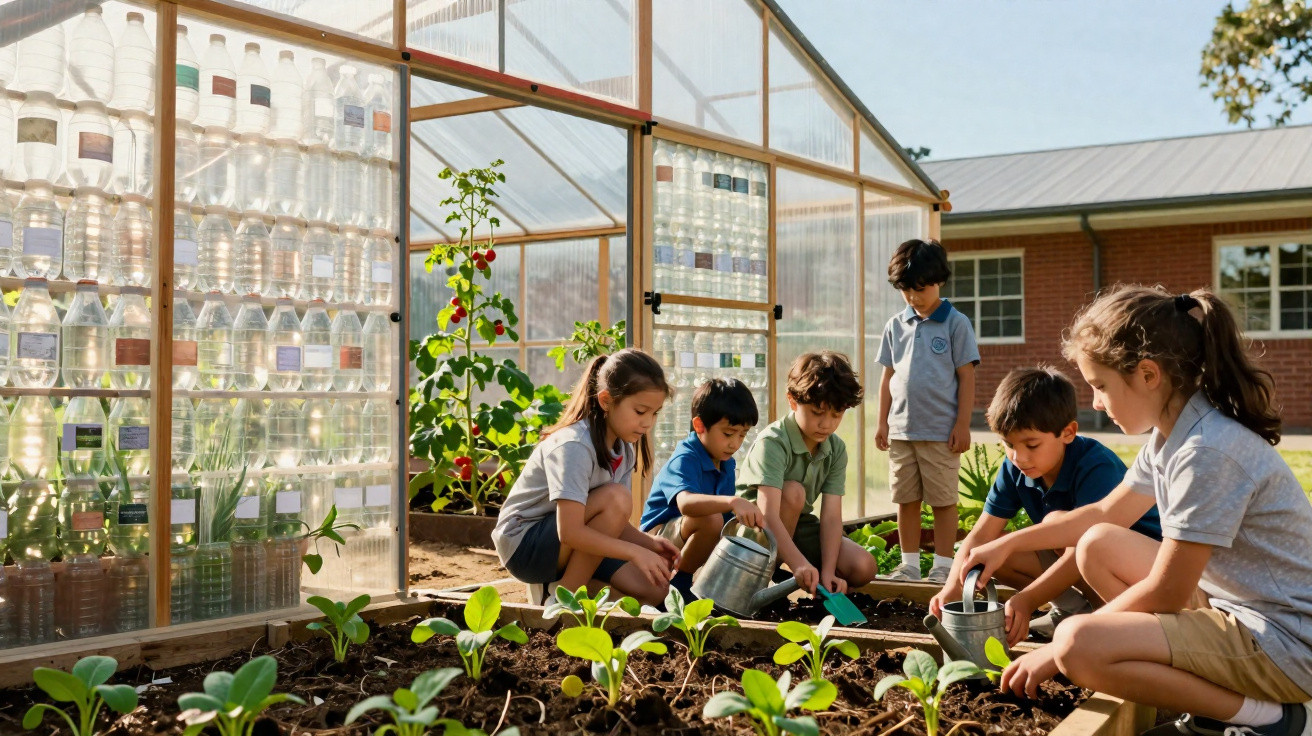
More than 2,000 plastic bottles that might otherwise have gone into the bin have been given a new purpose at a school in Canberra, Australia. Pupils, teachers and families collected the containers to build a greenhouse for the vegetable garden and science lessons, creating a sheltered area that can extend growing periods throughout the year.
How did thousands of bottles become greenhouse walls?
The project, known as “Plastic Palace”, was created at Richardson Primary School. Teacher Kate Davis began planning it years before it was completed, originally calculating that around 2,000 bottles would be needed. The build eventually expanded to accommodate an entire class, requiring even more containers.
The bottles were incorporated into a sturdy timber frame. The recycled containers alone do not make up the finished structure: the framework supports the transparent rows and keeps them in position, creating walls that shield plants from the wind and provide conditions unlike those in the open school garden.
How are the bottles fitted together to create the walls?
The method involves cleaning the containers and arranging them into long columns before securing them to the timber frames. This approach makes use of a substantial volume of discarded packaging while still allowing light to pass through the recycled greenhouse enclosure.
- The bottles are collected and cleaned;
- The base of each container may be removed so they can slot together;
- Each bottle is placed inside another to create a column;
- The columns are set upright within the timber frames;
- The rows are fixed in place to withstand wind and remain aligned;
- Doors and ventilation points complete the structure.
Why does this space extend the growing period?
The transparent walls allow solar radiation to enter while limiting seedlings’ direct exposure to wind and sudden environmental changes. This produces a more sheltered microclimate, supporting germination, seedling growth and the extension of certain growing cycles.
That does not mean plastic bottles automatically turn a structure into a professional greenhouse able to grow every species in every month of the year. Its performance is shaped by the climate, solar orientation, ventilation and construction; under suitable conditions, however, the protected setting broadens growing opportunities across the year.
What did pupils gain beyond a place to grow plants?
The construction also became a hands-on environmental education project. Rather than simply talking about recycling in the classroom, the school community had to gather thousands of containers and see how much material is used before enough is available to build the walls.
- Discarded bottles were given a second use;
- Pupils followed genuine construction stages;
- The greenhouse now houses seedlings for the school vegetable garden;
- The space enables experiments involving plants and climate;
- The community took a direct role in collecting materials;
- Recycling and food production now share the same setting.
A greenhouse that also reveals the limits of recycled plastic
The bottles remain exposed to sunlight and, over time, the plastic deteriorates and must be replaced. The structure also relies on timber, fixings, maintenance and suitable ventilation, demonstrating that reusing containers does not remove the need for a robust design.
The project’s greatest outcome lies in the combination of recycling, cultivation and environmental education. More than 2,000 containers stopped being simply waste and became part of a space where children can grow seedlings, monitor plant development and understand in practical terms how long a disposable object can remain useful before becoming waste again.




Comments
No comments yet. Be the first to comment!
Leave a Comment