
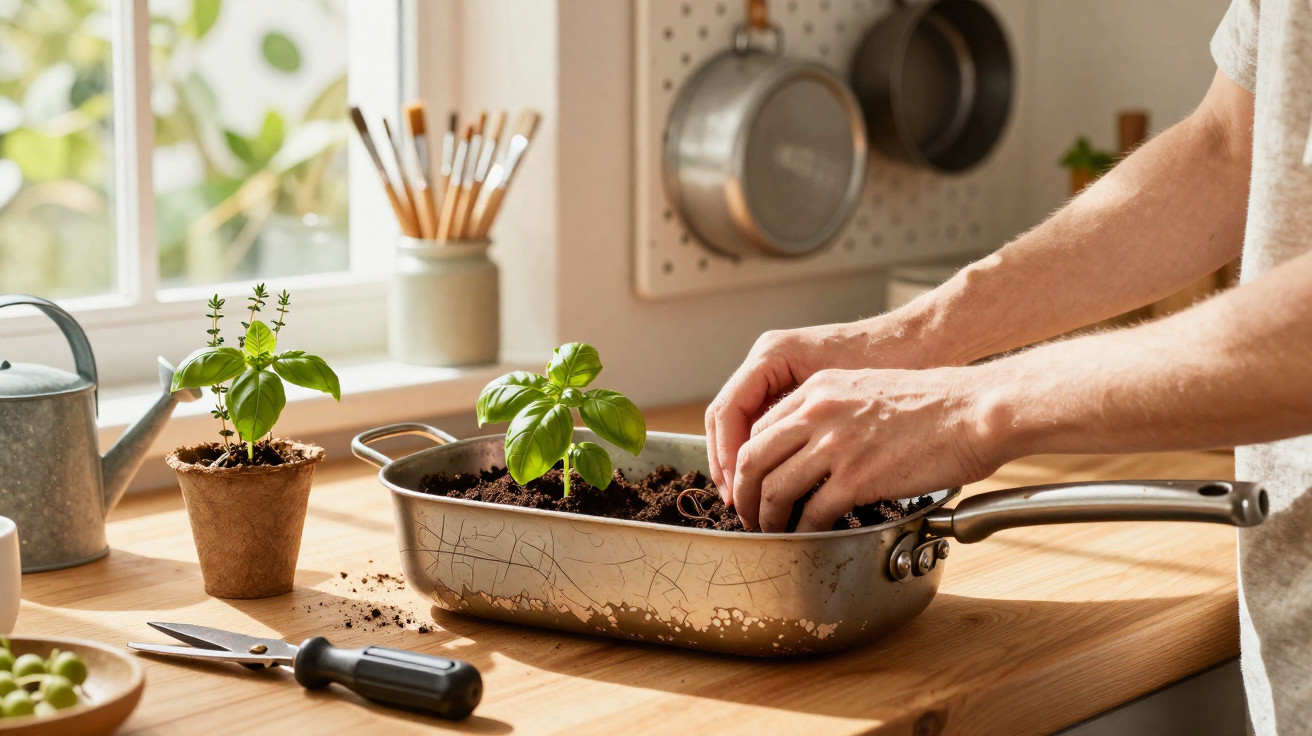
A peeling non-stick pan may have reached the end of its useful life in the kitchen, but it does not necessarily need to go straight into the bin. If the coating is badly worn, coming away in flakes or leaving extensive areas of metal exposed, it is sensible to retire the utensil from food preparation. Away from the hob, however, its body can take on entirely different uses, such as a plant pot or a household organiser.
Can a scratched non-stick pan actually be harmful?
The main known concern with PTFE coatings is not a minor surface scratch. The German Federal Institute for Risk Assessment states that small particles which may detach from the coating are chemically inert, and there is currently no evidence that accidentally swallowing them causes harmful effects. The established problem arises chiefly when an empty coated pan is overheated, particularly at temperatures above around 360 °C.
That does not mean a heavily peeling pan should remain in use for cooking. Once the surface has clearly lost its integrity and its non-stick performance is already impaired, replacing it prevents further deterioration of the utensil and allows it to be repurposed without food contact.
- A small surface scratch is not the same as a coating lifting away over large areas;
- an empty non-stick pan should not be left over a high heat;
- a severely deteriorated coating shows that the utensil has lost its original purpose;
- once retired from the kitchen, the pan should not be used for food preparation again;
- the container can still be useful for several purposes that do not involve heating.
How can you turn an old pan into a plant pot?
One option is to use the container as a plant pot. Its base must allow excess water to drain away, so that roots are not left permanently waterlogged. If holes need to be made, use suitable equipment and follow the tool's safety guidance; if you do not have the right setup for the job, a workshop can drill them for you. It can then be used like any other pot with drainage.
Which plants suit this type of container?
Shallower pans can work well for species with relatively compact roots, whereas deeper containers provide more room for larger plants. Before planting, consider the available volume, the number of drainage holes and where the pot will be positioned, as metal containers can become very hot when left in direct sunshine for many hours.
There is also a visual benefit. Old pans may retain their original appearance or become part of a growing area alongside other repurposed containers. The key point is to permanently reserve the item for gardening once it has come into contact with soil, fertiliser or other materials not intended for food preparation.
- Choose a growing medium suitable for the selected species;
- make sure water can drain through the base;
- do not allow water to collect inside the container;
- monitor how hot the metal becomes in very sunny spots;
- do not return the pan to cooking use later.
How can a peeling pan become an organiser?
Without any structural alterations, the pan can hold paintbrushes, ribbons, pegs, cables, packaged screws, craft supplies or small workshop accessories. Its handle also makes it easier to carry everything between a worktop, cupboard and work area, while deeper models can gather items that would otherwise be left scattered around.
Why repurpose it before throwing it away?
A pan that has lost its non-stick coating has not ceased to have a usable structure. Removing it from culinary use when the surface is badly degraded, then assigning it a purpose that involves no heating, makes it possible to get more use from a durable container without relying on the coating that originally formed part of the product.
As a plant pot or organiser, the old non-stick pan no longer faces the very conditions that are most concerning in its original role: high temperatures and direct contact with food. It gains a straightforward second purpose instead of being forgotten in a cupboard or discarded as soon as it starts to peel.


Comments
No comments yet. Be the first to comment!
Leave a Comment