
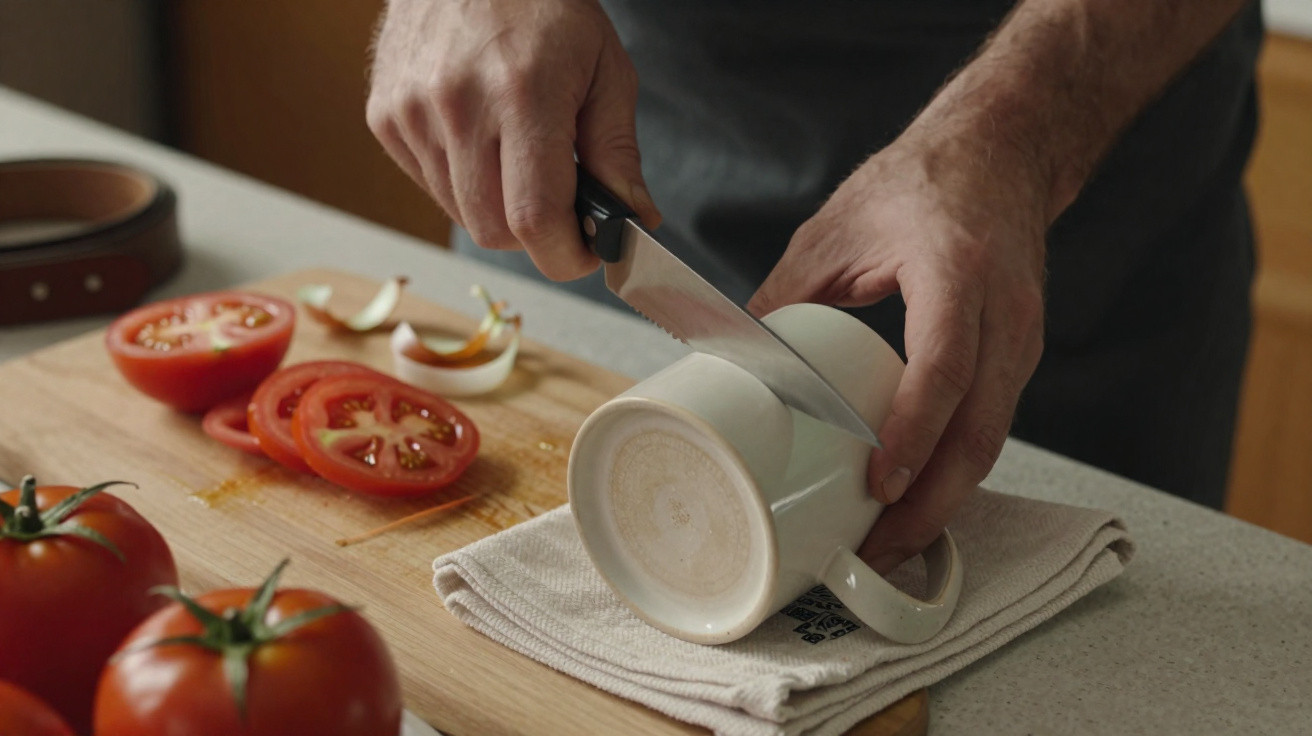
A chipped mug. A blunt chef’s knife. Dinner time is getting ever closer. What can you do when the blade can barely mark a tomato and every shop is closed?
Cool ceramic. Beneath it sits a coarse, unglazed ring – the sort of detail you overlook until you inspect it properly. The knife next to it had been losing its confidence for weeks, reducing carrots to squeaky shards. I had attempted the familiar fixes – the paper test, several runs over a steel and an exasperated sigh – but it still would not cut. So I searched online, looked in my cupboard, and followed the simple logic of friction and materials. It seemed slightly ridiculous yet oddly exciting, rather like borrowing a stranger’s umbrella in a downpour. I washed the mug, took a breath and held the blade at a shallow angle. After several strokes, the tomato gave way with a clean, quiet cut. A tidy strip of red skin slipped off. I stared, part pleased and part doubtful. What had happened?
Why a mug can revive a dull knife
The light-coloured ring underneath a ceramic mug holds the answer. Because it is unglazed, it has a faintly rough, abrasive texture that works much like a very fine sharpening stone. It is no miracle cure, but it can provide a useful quick refresh. As steel passes over ceramic, tiny burrs are brought into line and the cutting edge regains its bite. It is a small piece of kitchen alchemy involving something already in your cupboard. Since the process is gentle, it is also unlikely that a burst of enthusiasm will damage the blade. You are simply encouraging its edge back towards sharpness. It is quietly practical and unexpectedly gratifying.
My first attempt was on my everyday 20 cm chef’s knife, which tackles more onions than weekends tackle laundry. After two minutes on the mug and a few gentle strokes against a tea towel, it cut paper as neatly as the first line from a newly sharpened pencil. I also tried a budget paring knife that normally slides over garlic. The mug method did not transform it into a samurai sword, but it certainly changed “ugh” into “oh!”. The technique felt awkward on a well-worn serrated knife, so I did not continue. Different tools do not all respond to the same repair.
The principle is straightforward. Sharpening takes away a minute curl of metal to form a fresh apex, whereas honing merely straightens the edge already present. As the mug’s ring acts as a fine abrasive, the result is closer to honing-plus. It cannot reshape an edge that is genuinely damaged, but it can restore one that has become tired. Unglazed ceramic is sufficiently hard to work against hardened steel, while the broad base remains stable on the worktop. Maintaining the right angle matters more than applying force. A steady motion counts for more than speed. The mug provides the surface; your hand determines the result.
How I sharpen a knife with a mug in under three minutes
Turn the mug upside down so that the unglazed ring is accessible. Clean the ring first, as grit or sugar crystals could leave marks in the wrong place. Set the knife at approximately 15–20 degrees, then sweep it from heel to tip across the ring in one fluid arc. Use only light pressure. Alternate sides, completing two or three passes per side. I prefer to begin with the side facing me before changing over. Keep the angle consistent, as though you were buttering toast in exactly the same manner each time. Wipe down the blade, check it on paper or a tomato, and then strop it briefly on the reverse of a leather belt or a folded tea towel. That is all.
The usual mistakes include pressing down too firmly, hurrying the movement and raising the angle at the tip. Each of these damages the edge instead of refining it. Listen to the contact: a consistent, gentle hiss suggests that you are doing it correctly, while a harsh squeal indicates that the blade is tilted too steeply. Keep your fingers above the spine rather than anywhere near the edge. A mug can slide on a damp worktop, so secure it with a tea towel. Realistically, no one is likely to do this every day. Still, spending a minute on it now and again is preferable to complaining about crushed tomatoes for a month.
Most of us have experienced the moment when a failing blade turns dinner preparation from a pleasure into a chore with one drag. I had not intended to try this at all. Yet it worked well enough, consistently enough, to feel like a modest domestic superpower.
“The trick isn’t strength,” a chef once told me, “it’s angle, patience, and knowing when to stop.”
- Maintain a low, consistent angle.
- Make gentle, even passes – do not saw.
- Switch sides to prevent a biased burr.
- Complete the process with a quick strop on leather or fabric.
- Stop once the edge cuts cleanly.
Does the mug knife-sharpening method actually last?
In brief: yes, for routine cooking. My chef’s knife retained its mug refresh through a week of onions, peppers, herbs and roast chicken. It was not surgically sharp, but it was keen again. With harder steels, the change seemed less dramatic but endured for longer. Very inexpensive blades lose their sharpness more quickly, although the refresh is so fast that this is barely an issue. Think of the mug technique as maintenance rather than rescue. If your knife has chips, a rolled tip, or a wildly thick bevel, you need a proper stone or a pro. Regard the mug as the friend who arrives with tea after a difficult day: helpful, but not miraculous.
| Key point | Detail | Benefit for the reader |
|---|---|---|
| Mug = fine abrasive | The unglazed ring aligns and refines the edge | Free, quick and already in your cupboard |
| Angle beats pressure | 15–20° with light, even strokes | Sharper results with less risk |
| Maintenance, not miracles | Excellent for touch-ups, not major repairs | Saves time and extends blade life |
FAQ:
- Is it safe to sharpen on a mug? Yes, provided you keep your fingers above the spine, use light pressure and steady the mug on a dry tea towel.
- Will this ruin my knife’s finish? No. You are working only on the edge rather than the blade face. Wipe the blade afterwards to clear away fine metal dust.
- What angle should I use? Around 15–20 degrees. As a quick visual guide, picture two stacked pound coins between the blade and mug.
- How often should I do it? Do it when the knife crushes tomatoes or catches on paper. For many home cooks, this means weekly or following a large amount of preparation.
- Can I use any ceramic? Only use unglazed ceramic. Glazed finishes are too smooth, and plates often slip. A sturdy mug is the best option.

Comments
No comments yet. Be the first to comment!
Leave a Comment