
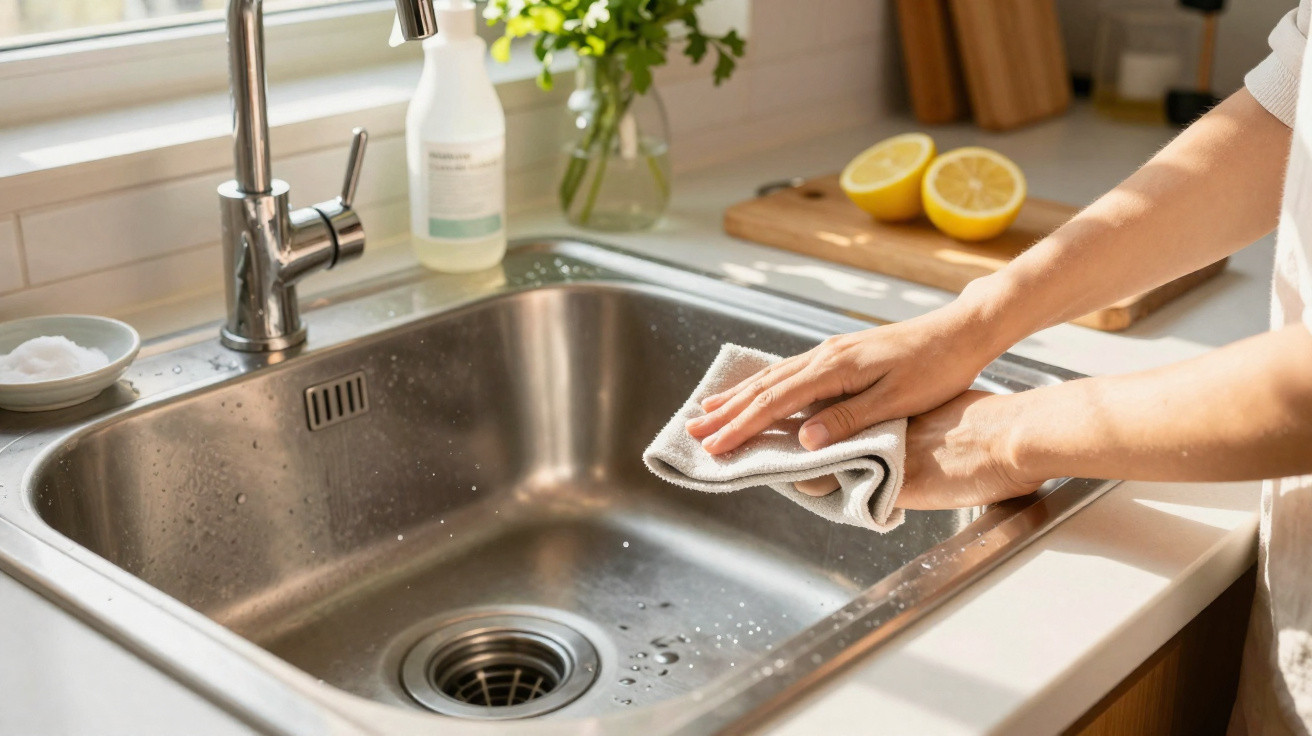
In the morning, light often falls at an angle across the worktop and exposes what we would rather ignore: a dull grey stainless-steel sink, speckled with white marks, that looks “clean but never truly spotless”. The night before, it looked perfectly acceptable. Then a saucepan was left to dry, a few drops of hard water remained, and the surface lost its shine. We all know that slight irritation when a sink looks worn despite having nothing broken about it. A quick wipe with a sponge changes very little, while some products make grand promises yet achieve no more than a bit of foam. In reality, the right method is often remarkably simple. The outcome can be genuinely surprising.
Why stainless steel becomes dull, even in a very clean kitchen
Stainless steel has a reassuring reputation: it stands up to almost anything, does not rust easily, and copes with both large family meals and impromptu dinners. In everyday use, however, it retains every dried water droplet, splash of sauce, greasy film left by washing-up and tiny traces of washing-up liquid. Over time, light no longer reflects properly from the surface. Instead, it catches unevenly, rather like on a window that has not been rinsed well.
In hard-water areas, the effect is even easier to spot. A household using its sink several times a day may notice whitish marks in under a week, particularly around the plughole and tap. These are not necessarily scratches or permanent wear: in many cases, they are mineral deposits combined with an almost invisible greasy layer. It is hardly glamorous, but it is reassuring to know.
One frequently overlooked detail is the direction of the metal itself. A stainless-steel sink has fine lines, sometimes barely visible, which form its natural “grain”. Scrubbing in circles with an abrasive sponge disrupts this pattern and leaves a matt appearance, even after a thorough clean. Stainless steel does not respond well to harsh treatment in the pursuit of shine. It favours gentle, consistent cleaning in the same direction as its grain.
The simple way to restore shine to a stainless-steel sink without damaging it
The key is a two-stage clean: remove grease first, then tackle limescale. Put a few drops of washing-up liquid onto a non-abrasive sponge dampened with warm water, clean the entire sink following the grain, then rinse it. Next, soak a microfibre cloth in warm white vinegar and lay it over the dull areas for five to ten minutes. The limescale will lift more readily, without needing to scrub as though the sink has personally offended you.
Once the marks have dissolved, rinse generously and dry the surface straight away with a clean cloth. This is the step that makes the real difference, despite taking barely more than thirty seconds. Let us be honest: hardly anyone does it every day. Keeping a folded microfibre cloth beneath the sink makes this small task easier to turn into a habit, especially after draining pasta or rinsing vegetables.
For an almost mirror-like finish, place one or two drops of cooking oil onto a dry microfibre cloth, then polish gently in the direction of the stainless-steel lines. The smallest amount is enough: the aim is to enhance the appearance of the surface, not make it slippery.
“The best result does not come from a miracle product, but from a sink that has been thoroughly rinsed and dried immediately.”
- Choose a soft sponge or microfibre cloth, never wire wool.
- Rinse off the vinegar after it has worked, particularly on areas close to the tap.
- Always rub in the direction of the grain to maintain the satin finish.
- Finish by drying the whole surface: this is when the shine appears.
Mistakes that dull stainless steel without you noticing
The most common instinct is to reach for the green scourer as soon as a mark proves stubborn. On a heavily soiled saucepan, this may seem effective; on a sink, it is often the start of permanent damage. Overly harsh powders, chlorine-based products and cleaners intended for other materials can also leave the surface looking cloudy. It is better to repeat a gentle method twice than spend years living with an established scratch.
The vinegar-and-bicarbonate-of-soda combination is also surrounded by a small domestic myth. The fizz suggests a formidable, almost dramatic reaction, but the two products largely neutralise one another when mixed straight away. Bicarbonate of soda can be useful on its own as a gentle paste with a little water for an isolated mark; vinegar works better on its own against limescale. Each simply has its own purpose.
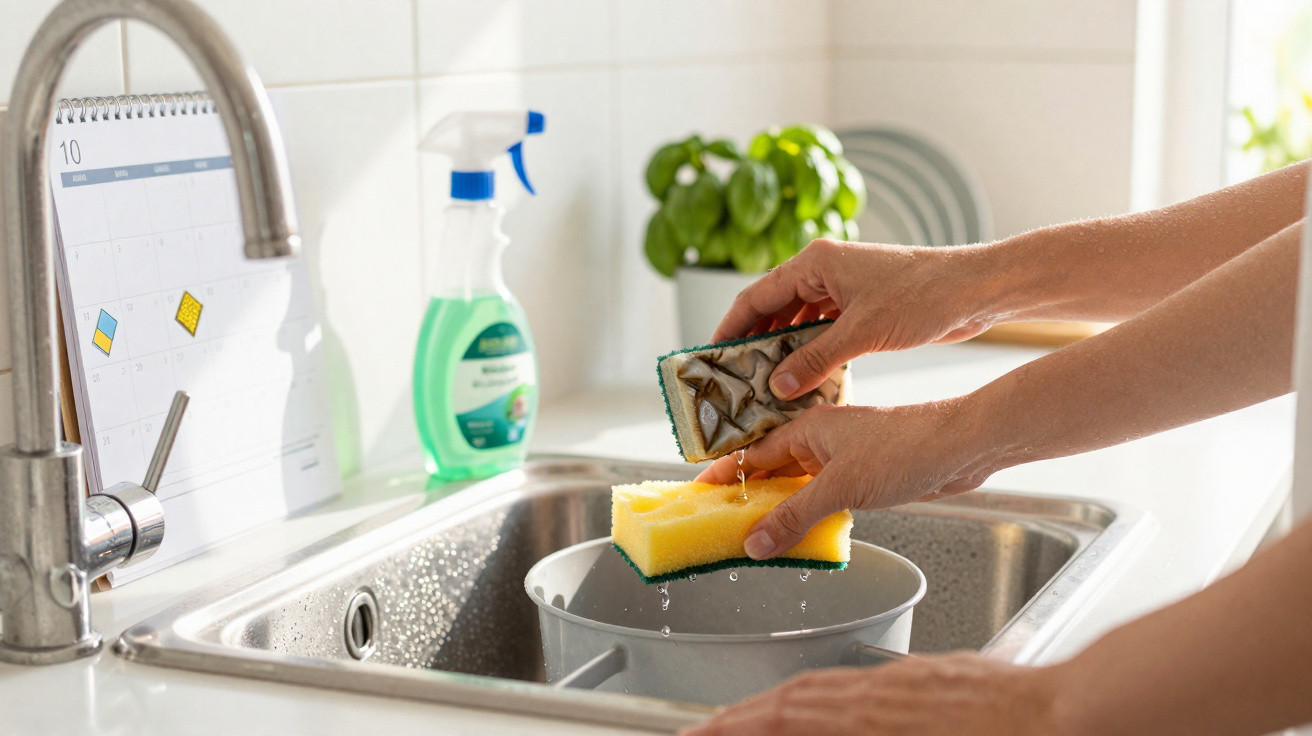
It is also worth considering what is left in the sink bowl: a wet sponge, rubber mat, opened tin or metal utensil forgotten after a meal. Standing moisture can create orange or dark marks that cause unnecessary concern. They do not always indicate corrosion of the sink, but they should be cleaned promptly with a bicarbonate-of-soda paste and a soft sponge. A clear sink dries more effectively, and the difference is visible by the next day.
A shiny stainless-steel sink can transform the whole look of the kitchen
There is something unexpectedly satisfying about seeing stainless steel catch the light again after a few well-chosen steps. The kitchen has not changed, the cupboards are the same and the tap is not new, yet the whole room looks better cared for. That impression often comes from surfaces we use without really seeing: the sink, splashback and worktop. When they become crisp and clean again, they make the room feel more orderly.
The most realistic routine remains the most effective: a gentle clean after heavy use, white vinegar when limescale returns, followed by quick drying. There is no need to aim for a showroom kitchen every evening. The point is to stop deposits building up until the day you assume the stainless steel cannot be rescued. Often, it simply needs a little attention again.
And if your sink still has a few fine marks despite everything, that is not necessarily a failure. They can also reflect hurried meal preparation, children helping to wash lettuce, and Sundays when you hosted too many people. A well-used stainless-steel sink does not have to be perfect; it can be clean, bright and honestly lived in. That distinction is more than worth keeping a small microfibre cloth close at hand.
| Essential point | Detail | Benefit for the reader |
|---|---|---|
| Clean in the direction of the grain | The fine lines in stainless steel should guide the movement of the microfibre cloth or soft sponge. | The surface retains its satin finish, and tiny scratches become far less noticeable. |
| Remove limescale, then dry | White vinegar works on mineral marks for a few minutes, before a full rinse and immediate drying. | Whitish rings disappear, and the sink regains a more even shine. |
| Polish with very little oil | One or two drops on a dry cloth are enough to complete the clean without greasing the sink bowl. | The metal reflects light more effectively, creating that clean, almost-new appearance sought every day. |


Comments
No comments yet. Be the first to comment!
Leave a Comment