
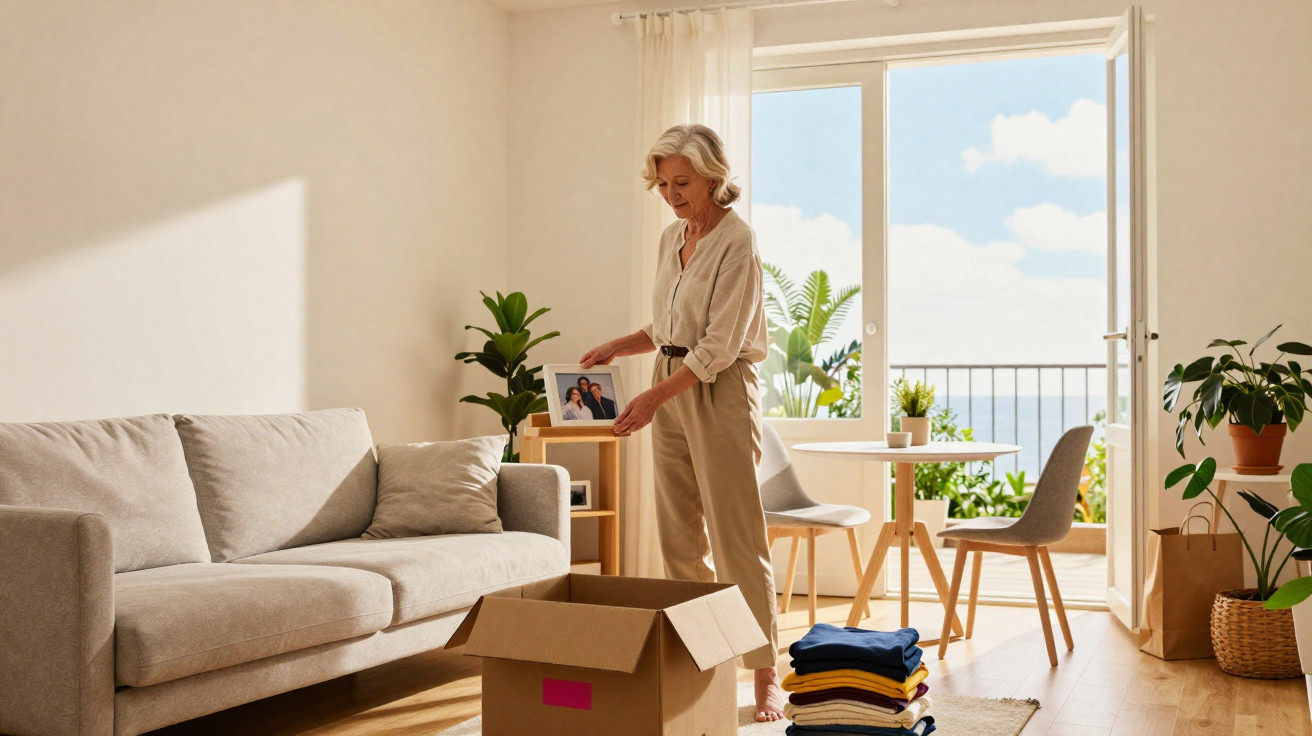
On a Saturday morning, standing outside her former detached house, Françoise takes one last look at the shutters she once repainted without a second thought. At 69, the 112 m² home she bought with her husband more than thirty years ago had come to demand more than it gave back: a roof needing attention, a garden requiring upkeep, rising energy bills and rooms that had fallen silent after the children moved out. A few months later, she is living in a 38 m² flat on the third floor of a small development near local shops. She says she sleeps better, walks more and no longer dreads the next quotation. The transition was not easy, but it changed something far deeper than the contents of her boxes.
The family home can become an invisible burden
At first, Françoise could barely bring herself to discuss it. To her, leaving the house felt like giving up part of her life: the cherry tree planted when her daughter was born, the guest bedroom and the height marks on the hallway wall. We all know how a place filled with memories can make it hard to recognise what it costs us in the present. Every winter, she delayed the façade work. Every spring, she promised herself she would find someone to deal with the garden. The house was still standing, of course, but it was asking more and more of her.
Eventually, the costs made the choice real. Between heating, property tax, insurance, minor repairs and outdoor maintenance, Françoise reckoned that her house cost her nearly €750 in some months, excluding unexpected expenses. A leak beneath the sink, a loose gutter or a temperamental boiler was enough to throw her budget off balance. In her 38 m² flat, the bills are clearer and her energy use has fallen sharply. She does not claim to have become wealthy. She simply says she has room in her budget again to invite her grandchildren over, go to the cinema or replace her glasses without calculating every expense for three weeks.
Moving into a smaller property is not purely a financial matter. As we get older, ordinary tasks can take on a different scale: climbing a stepladder, clearing snow from a path, moving a lawnmower or checking a damp cellar. A compact, well-located and suitable home can bring a very practical kind of peace of mind. Françoise chose a building with a lift, a level-access shower and a bakery five minutes away. These are not minor details when you want to stay independent for as long as possible. Let us be honest: nobody really maintains a large house alone every day without ever feeling tired.
Moving from 112 m² to 38 m²: the sorting process that changes everything
To avoid experiencing the move as a wrench, Françoise gave herself time. One Sunday afternoon, she began with just one room - the study - and three boxes: keep, donate and sell. This straightforward system stopped her from being overwhelmed by possessions and memories. She advises measuring the future home before deciding which furniture will come with you. Her large Normandy sideboard would not fit in the living room, so she passed it on to her son, albeit with a pang of regret. In its place, a light shelving unit now holds her photographs, novels and two houseplants.
The most common mistake is trying to fit an entire former life into a new home. Françoise realised this when she attempted to keep six chairs around a table designed for four. For several days, the flat felt cramped, almost unwelcoming. Then she removed two pieces of furniture, moved an armchair beside the window and allowed the light to travel through the room. A small space does not forgive clutter, yet it can be remarkably comfortable. Every object needs a reason to be there, without turning that principle into a punishment. Some impractical belongings can still carry genuine emotional value.
She also suggests planning the layout before moving day: high-level storage, a bed with drawers, a folding table, hooks behind doors and soft lighting in darker corners. The aim is not to live in a catalogue-style interior, but to make everyday movements easier.
“I was afraid I would not have enough room. In reality, what I lacked most was time and lightness,” says Françoise, sitting in her living room, where everything is within easy reach.
- Measure furniture before signing or moving;
- Set aside a dedicated area for paperwork and keepsakes;
- Try out essential journeys: shopping, the doctor, transport and visits to loved ones;
- Keep a small budget reserve for adjustments after moving in.
A smaller retirement on paper, a more open everyday life
Françoise had not expected her new neighbourhood to matter so much. From her house, she would take the car to buy bread, visit a friend or go to the pharmacy. Now she goes downstairs with a canvas bag, passes the florist, sometimes stops at the market and returns home without feeling as though she has completed an expedition. These brief exchanges have changed the tone of her days. She knows the first name of the neighbour on her floor and the waiter at the café where she reads the newspaper on Wednesdays. Ageing at home does not necessarily mean remaining in the house where you brought up your children.
For her, the most unexpected benefit is psychological. She no longer spends weekends anticipating what will need repairing, pruning or cleaning. Her flat takes less effort to manage, leaving space for activities she always used to postpone: a watercolour class, lunches with former colleagues and a few train trips away. She has also learned to accept that her children stay overnight less often, while making the most of the time together when they do visit. A pack of cards has replaced stacks of leaflets and quotations on the coffee table. It is an unassuming scene, but it reflects a different way of living in retirement.
This decision will not suit everyone, and Françoise readily acknowledges that. Some people are attached to their garden, their pets, a workshop or being immediately close to family. Others do not want to sell an inherited property or are wary of shared ownership buildings. The right question, then, is not “should I live in a smaller home?”, but “what do I truly need to feel well tomorrow?”. A 38 m² home may appear tiny to those looking only at the numbers. For Françoise, it has become a space that is easier to heat, clean and love. That kind of freedom cannot be measured in square metres.
| Key point | Detail | Added value for the reader |
|---|---|---|
| Assess the real cost of a detached house | Beyond any remaining mortgage, add together energy, insurance, property tax, garden costs, repairs and future works. | A realistic view of the budget helps you decide without guilt or haste. |
| Prepare to sort belongings gently | Work room by room, measure furniture and distinguish useful items from those that can be passed on. | The move becomes a chosen transition rather than an ordeal imposed on you. |
| Choose a neighbourhood as carefully as a home | Shops, transport, healthcare, a lift, neighbourly connections and accessibility matter as much as floor space. | A well-situated small flat can support independence and a more active social life. |
Comments
Высокий уровень комфорта
Leave a Comment