
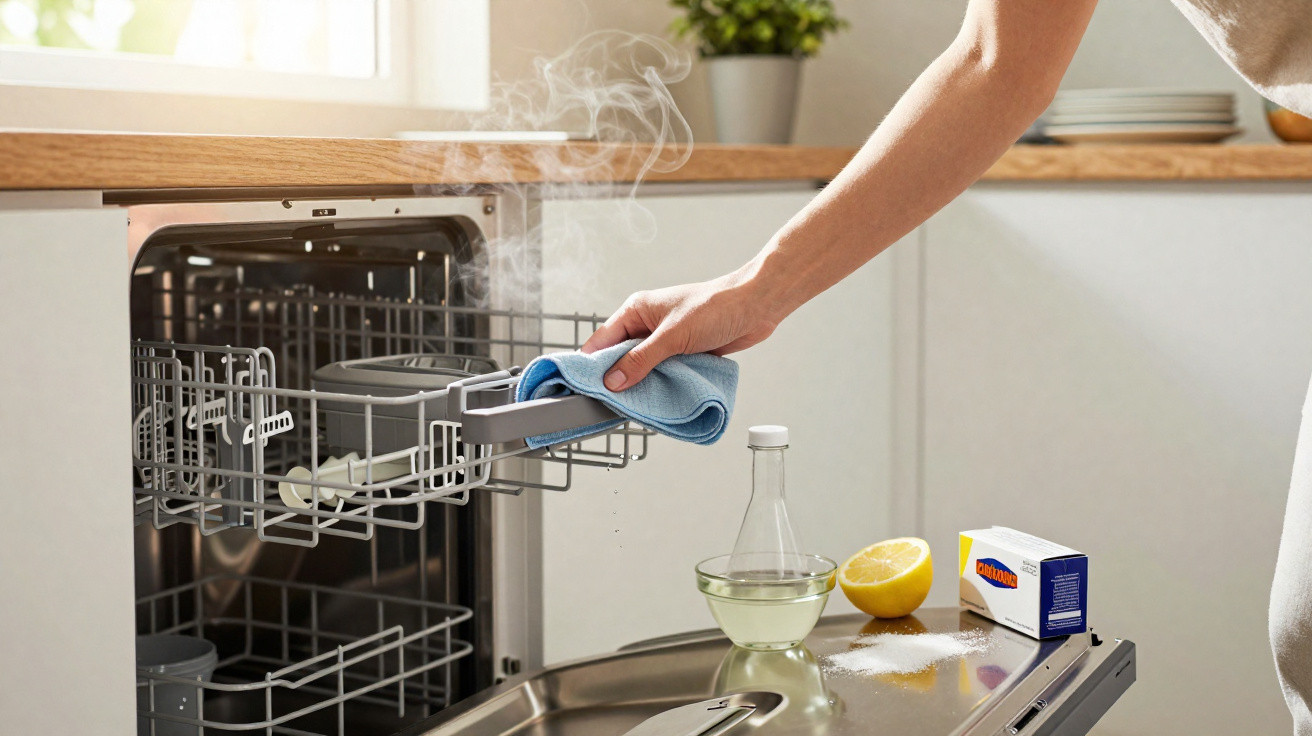
After a dinner that has gone on a little too long, you open the dishwasher intending to put away the clean glasses… and the smell stops you in your tracks. It is a mix of dampness, cold grease and forgotten food debris that seems to have made a home behind the door. We all know that awkward moment when we wonder whether the dishes are truly clean, even if they come out gleaming. Worse still, the issue often returns without warning, particularly after a few weeks of quick meals and hastily started cycles. The good news is that a monthly clean is often enough to transform the feel of the whole kitchen. And it is not especially difficult.
Steps 1 and 2: remove what feeds bad odours
A bad smell almost never appears from nowhere: it frequently starts in the filter, the discreet component at the bottom of the dishwasher that is easy to overlook between washes. Unscrew it and you may find grains of rice, part of a label, sauce residue or an unappealing greasy film. Sitting in warm water, this mixture becomes a real feast for bacteria. Set aside five minutes, remove the lower basket and carefully take out the filter. Rinse it under hot water, then scrub it with an old toothbrush and a few drops of washing-up liquid.
For Sophie, a mother of two and a fan of Sunday gratins, the smell became so strong that she opened the window before even starting a cycle. She assumed her appliance was ageing badly, until she cleaned the filter after nearly three months of neglect: a layer of grease had built up there, along with several pieces of pasta trapped in the mesh. The effect of this straightforward task was immediate. Manufacturers often advise checking the filter every two to four weeks, depending on how the machine is used. In a household running one cycle a day, a monthly inspection is by no means excessive.
Once the filter is clean, turn your attention to the tub and the door seal, two places where moisture remains trapped for a long time. Use a damp microfibre cloth to wipe the folds of the seal, the inner edges and the lower part of the door: this is where greasy splashes dry unnoticed. If marks are stubborn, add a little diluted white vinegar, but do not pour it over delicate or electronic components. It is not glamorous, yet this is often where the smell is hiding. Let us be honest: nobody really does this every day.
Steps 3 and 4: degrease the dishwasher, then let it air
After removing visible dirt, run the hottest available empty cycle with a dishwasher cleaner or a bowl of white vinegar placed in the upper basket. This helps loosen the greasy film coating the walls and pipes, even when the machine looks clean at first glance. Avoid combining vinegar, bicarbonate of soda, detergent and other remedies in one cycle: the products can cancel each other out or leave unnecessary deposits. One well-chosen action works better than improvised kitchen chemistry.
Bicarbonate of soda can still be useful, but it is best used in a second run after the vinegar or specialist cleaner cycle. Sprinkle two or three tablespoons over the bottom of the tub, then select a short, hot programme: it helps neutralise lingering odours. A common mistake is adding a large amount of powder in the hope of a more dramatic result. It will not clean more effectively and may leave white marks. The correct dose matters more than the quantity, particularly in a machine that is already scaled up or used with very hard water.
Once cleaning is complete, leave the door slightly open for a few hours so the interior can dry properly, as a tub that is shut immediately after a cycle retains the ideal moisture for stubborn odours.
“A smell that returns quickly is rarely a mystery: it almost always points to a filter, seal or spray arm that needs checking.”
- Step 1: remove and wash the filter in hot water.
- Step 2: carefully wipe the seals and tub.
- Step 3: run a hot empty cycle with a suitable cleaner.
- Step 4: air the appliance and inspect the spray arms.
The monthly dishwasher routine that prevents unpleasant surprises
A dishwasher does not require constant attention, but it benefits from straightforward habits. Before starting a load, scrape large food scraps into the bin without necessarily rinsing every plate under litres of water: modern appliances are designed to handle some soiling, not discarded chunks of food. Also check that the spray arms rotate freely and that their small holes are not blocked by a seed, limescale or a food particle. When water does not circulate properly, it cleans less effectively and residue builds up more quickly.
A calendar reminder can help: choose an easy marker, such as the first Sunday of the month, changing the washing-up liquid bottle or receiving your electricity bill. This routine means you do not wait for the familiar moment when the smell becomes impossible to ignore in front of guests. If the problem remains after a thorough clean, inspect the drain hose and water inlet, or call a professional: standing water may indicate a drainage issue. A fresh machine smells almost… of nothing at all, which is exactly the aim.
This monthly task also says something about our relationship with everyday objects. We rarely think to thank a dishwasher that runs every evening, takes on lasagne stains and makes the kitchen a little calmer after a meal. Yet spending a few minutes maintaining it prevents waste, extends its lifespan and makes opening its door far less unpleasant. Many households have their own trick: a brush kept for the filter, a phone reminder or an empty cycle while doing the shopping. Everyone can find their own rhythm, provided they do not let bad odours make the decision for them.
| Key point | Detail | Added value for the reader |
|---|---|---|
| Clean the filter | Remove food debris and grease every month | Removes the most common source of odours |
| Wash the seals | Wipe damp folds using a soft cloth | Reduces invisible deposits and mould |
| Run an empty cycle | Use a suitable product or white vinegar, without mixing them | Sanitises the tub and improves washing performance |





Comments
No comments yet. Be the first to comment!
Leave a Comment