
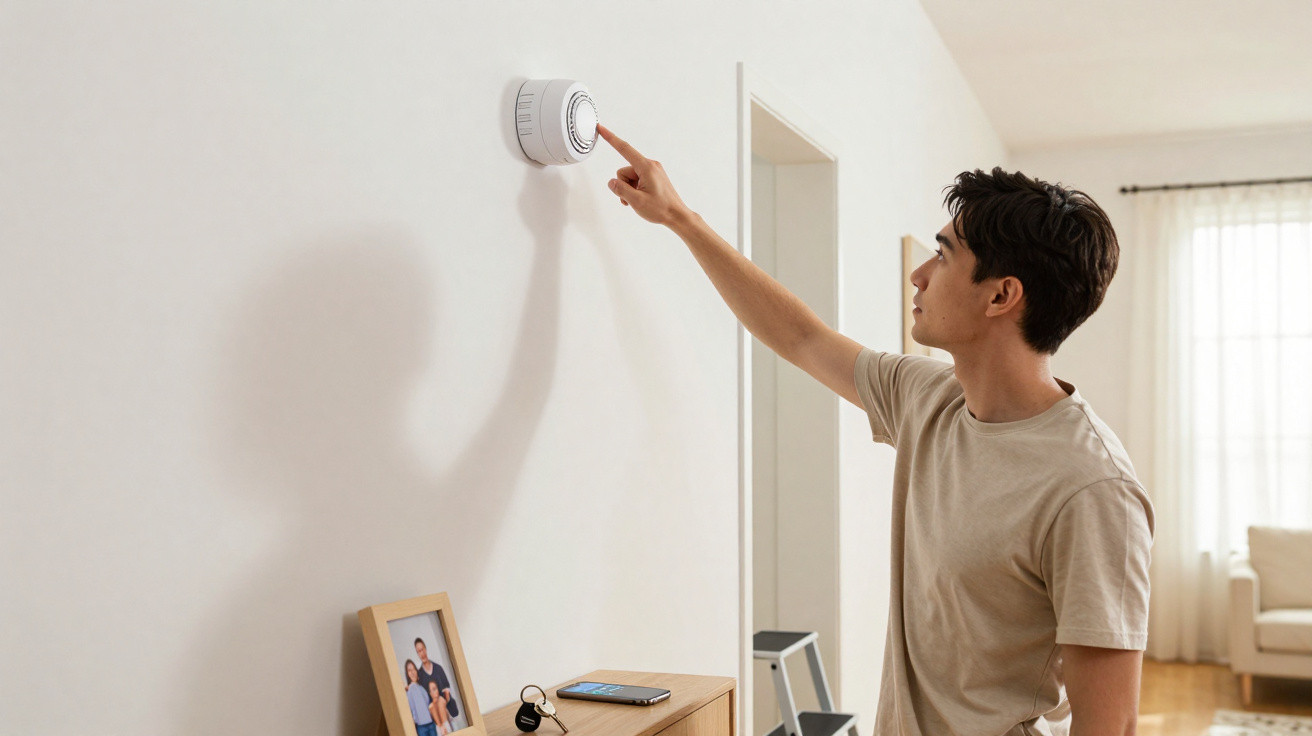
On a Sunday morning, somewhere between coffee going cold and children already in socks in the living room, a small round button on the ceiling often goes unnoticed. The smoke detector sits there, quiet and almost decorative, until the day it needs to become the loudest thing in the house. Habits observed in many homes suggest that almost 7 in 10 people completely forget their monthly check. Yet it takes less time than putting the kettle on: five seconds, little more.
The small button we see without really noticing
We all know the moment: you glance up while cleaning, changing a light bulb or opening the windows, and the detector is still there on the ceiling with its tiny flashing indicator. Because it has not raised an alarm and looks undamaged, it is easy to assume that it works. That is understandable, but misleading: a smoke detector is not something you notice when everything is fine.
In many flats, the first reminder comes at the worst possible time: in the middle of the night, with the short, repeated beep signalling a low battery. A family in Lyon recently said they put their detector in a drawer “to sleep peacefully”, promising to deal with it the following day. Three weeks later, it was still there. The issue is not a lack of willingness; routine simply swallows up small urgent tasks.
The figure of 7 households in 10 forgetting this test mainly reflects one very simple reality: we confuse having a detector with having a working detector. It may be properly mounted, contain a battery and still be unable to sound an alarm loudly enough if there is smoke. A silent device is not always a ready device. The monthly test exists to remove that uncertainty, without waiting for the next audible warning.
The 5-second smoke detector test: a simple habit often put off until tomorrow
The process involves just one action: find the central or side button labelled “Test”, then hold it down for around five seconds. The alarm should sound clearly, producing a loud continuous or pulsed tone depending on the model. If nothing happens, if the sound is weak, or if the device only makes a faint click, check the battery, the connection or the detector’s overall condition.
There is no need to choose a dramatic moment: the first day of the month, after paying a bill, or on Sunday before taking the bins out will do. The key is to link this action to an existing routine, rather than relying on an abstract good intention. Let us be honest: nobody really does this every day. A phone reminder called “Smoke test – 5 seconds” is often enough to prevent it being forgotten.
A common mistake is to test the detector using a lighter flame, a cigarette or cooking fumes. This is neither needed nor recommended: the test button is designed to check the alarm without exposing the device to residue or unnecessary heat.
“The best detector is the one that works on the day you do not expect it to.”
- Hold the “Test” button for five seconds once a month.
- Warn children and close neighbours if the alarm is particularly loud.
- Replace the battery as soon as the first regular beep sounds, rather than waiting until the following weekend.
- Gently clean the vents using the brush attachment on the vacuum cleaner.
- Check the replacement date printed on the back of the device.
A tiny smoke detector habit that can change the atmosphere at home
A smoke detector does not prevent a fire, but it provides vital minutes to react, wake the occupants and call the emergency services. At night, when the sense of smell is less alert and sleep slows reactions, this alarm becomes a discreet but essential presence. Its purpose is not to offer reassurance simply because it has been fitted; its purpose is to give an early enough warning.
A device that goes off for no apparent reason can also irritate an entire household, especially when it is close to a kitchen or a poorly ventilated bathroom. Before taking it down or removing its battery, it is better to check its location, dust build-up and the manufacturer’s instructions. A detector must never be silenced permanently, even when it has chosen the wrong time to make itself heard.
Its working life matters just as much as its battery. Many detectors have an operating life of around ten years, sometimes less depending on the model, and that date is easily forgotten in everyday life. Checking the back of the unit during the monthly test shows whether the device is nearing the end of its service life. It seems like an ordinary detail until the day it is not.
There is also a question that is rarely asked: who carries out the test when nobody feels truly responsible? In a shared house, at the home of elderly parents, in a second home or in rented accommodation, this small task can fall through the cracks. Assigning one person, writing the date on the fridge or sending a family message takes only a few seconds. It prevents everyone from assuming that somebody else has done it.
| Key point | Detail | Benefit for the reader |
|---|---|---|
| Monthly test | Hold the “Test” button for around 5 seconds | Quickly confirm that the alarm activates properly |
| Battery and power supply | Act as soon as regular beeps occur or the sound is unusually weak | Avoid discovering a fault at a critical moment |
| Working life | Check the date shown on the detector, often close to 10 years | Plan for replacement of the device |





Comments
No comments yet. Be the first to comment!
Leave a Comment