
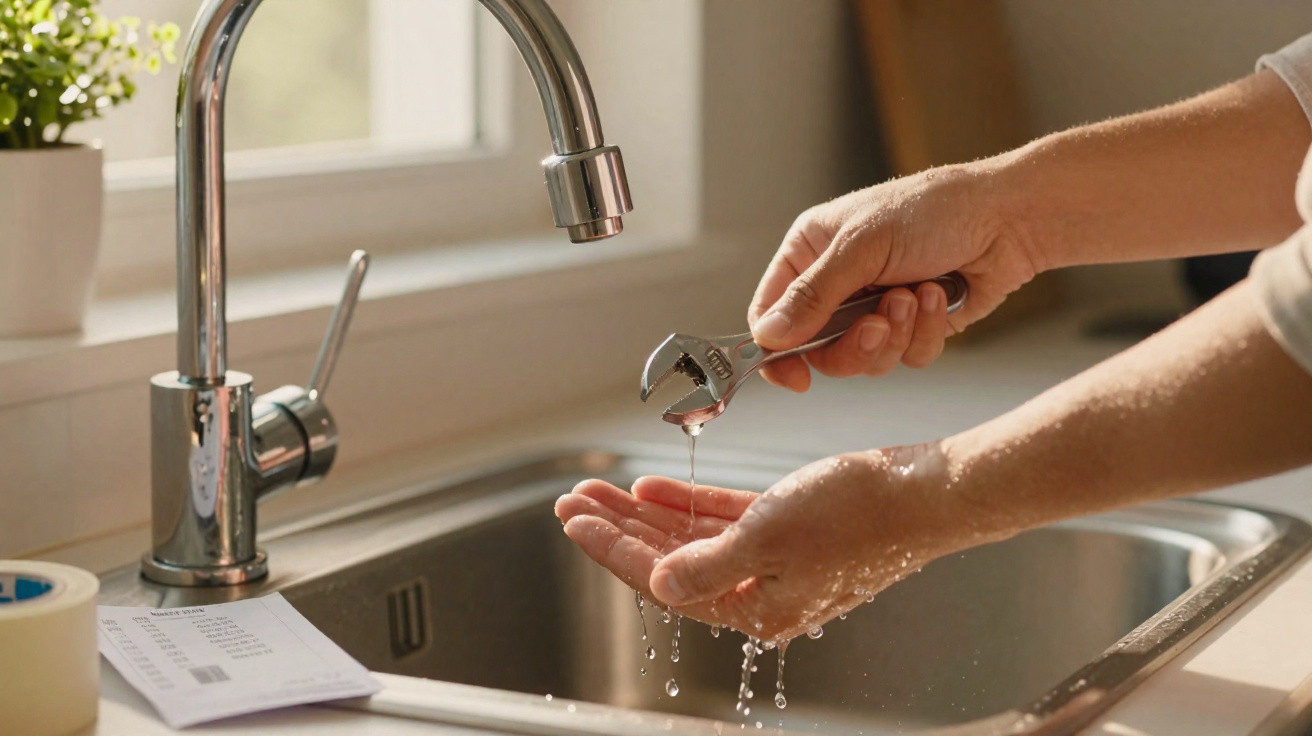
It is nearly midnight, the house is quiet, and that faint “plop” from the bathroom starts to fill the silence. You tighten the tap a little further, put a glass beneath the spout, then promise yourself you will deal with it on Saturday. Days go by, the glass fills up, it slips your mind, and the leak carries on unnoticed. There is nothing dramatic: no puddle on the floor and no bill soaring overnight. Even so, a dripping tap can waste thousands of litres of water over 12 months. It is an avoidable expense, often fixed with a washer or cartridge and ten calm minutes. That tiny sound is genuinely worth addressing.
One drop a second: the small sound that raises the bill
We have all had the moment when a leak is only audible after the television is switched off or the children are asleep. The tap drips quietly, almost politely, so it is easy to decide that it is not urgent. Yet a leak does not have to look serious to become costly: it keeps working 24 hours a day, with no breaks or weekends. Depending on the drop size, one drop every second can mean that almost 8,000 litres of water are lost in a year. That is the equivalent of several dozen baths disappearing straight down the sink.
In France, where the average cost of water and wastewater services is often between 4 and 5 euros per cubic metre, those 8,000 litres can cost between 32 and 40 euros a year. That may seem manageable until you add up the small oversights around the home: the kitchen tap, the basin tap and the toilet cistern that constantly runs just a little. A thin stream is far more worrying than a drip: at a rate of 10 litres an hour, the loss exceeds 87 cubic metres per year. At that point, the bill can rise towards 400 euros, and sometimes more.
The calculation is more concrete than it may first appear. A drop of water usually contains between 0.05 and 0.25 millilitres, depending on the tap and mains pressure; multiplied by 86,400 seconds, it becomes a significant volume. The cost differs between local authorities, as drinking water and wastewater treatment are not charged at the same rate everywhere. The response should nevertheless be the same: a steady flow is never insignificant. What vanishes drop by drop always adds up eventually. Nor is it solely about money: water that has been treated, supplied and discharged has also required energy.
The ten-minute dripping tap repair that often stops the leak
Before taking anything apart, close the isolating valves beneath the basin or sink. If there are none, or they are stuck, turn off the main water supply, then open the tap to release the remaining pressure. Put the plug in the waste, or cover it with a cloth: a small screw falling into the trap can turn a straightforward repair into a frustrating retrieval job. With many mixer taps, you simply remove the decorative cap, undo the handle and reach the cartridge. On an older pillar tap, a worn washer is often to blame.
The most useful step is to take the old part to the DIY shop rather than trying to guess its diameter. Not all washers are alike, and mixer-tap cartridges differ even more. Let us be honest: nobody does this every day, and there is no shame in taking a photograph before dismantling anything. It helps you put each component back in the correct order. Also avoid gripping chrome nuts directly with pliers: placing a cloth between the tool and the metal reduces scratches-the sort you regret as soon as the morning light reveals them.
After replacing the washer or cartridge, reassemble the tap without tightening it as though your kitchen depended on that one nut. Turn the water back on gradually, then watch the spout, the base of the tap and the connections for one minute.
“A leak fixed quickly almost always costs less than the months spent ignoring it.”
- Turn off the water before starting any work, even if the washer seems easy to reach.
- Keep the old part as a template when buying the correct replacement.
- Test both hot and cold water once everything has been reassembled.
- Call a plumber if the leak comes from the tap body or a concealed pipe.
A dripping tap also reveals our everyday habits
Fixing a leak does not mean becoming a plumbing expert overnight. Above all, it means refusing to let an irritating little detail become embedded in daily life, between shopping trips, laundry and messages answered too late. Many people delay because they worry about breaking a component, failing to find the right washer or uncovering a bigger issue. That caution is understandable. However, a ten-minute check is often enough to establish whether the repair is within reach or whether the situation needs a professional.
The easiest approach is to give water points a quick look when the bill arrives or while cleaning. A sheet of kitchen roll passed beneath a tap can reveal dampness that is not visible to the eye. Check the meter too: without using any water, note its reading in the evening and again in the morning. If it has changed, there may be a hidden leak somewhere. This small test can prevent an unpleasant surprise and prompt a useful household conversation: who noticed the noise, how long has it been there, and why was it allowed to continue?
| Key point | Detail | Benefit for the reader |
|---|---|---|
| A drop is not insignificant | Almost 8,000 litres can be wasted annually at one drop per second | Helps visualise the waste and estimate its true cost |
| The price varies by local authority | Allow for between 4 and 5 euros per cubic metre, including water and wastewater services | Relates the leak to your own water bill |
| The repair is often straightforward | Replace the washer or cartridge after turning off the water supply | Encourages prompt action before the leak worsens |



Comments
No comments yet. Be the first to comment!
Leave a Comment