
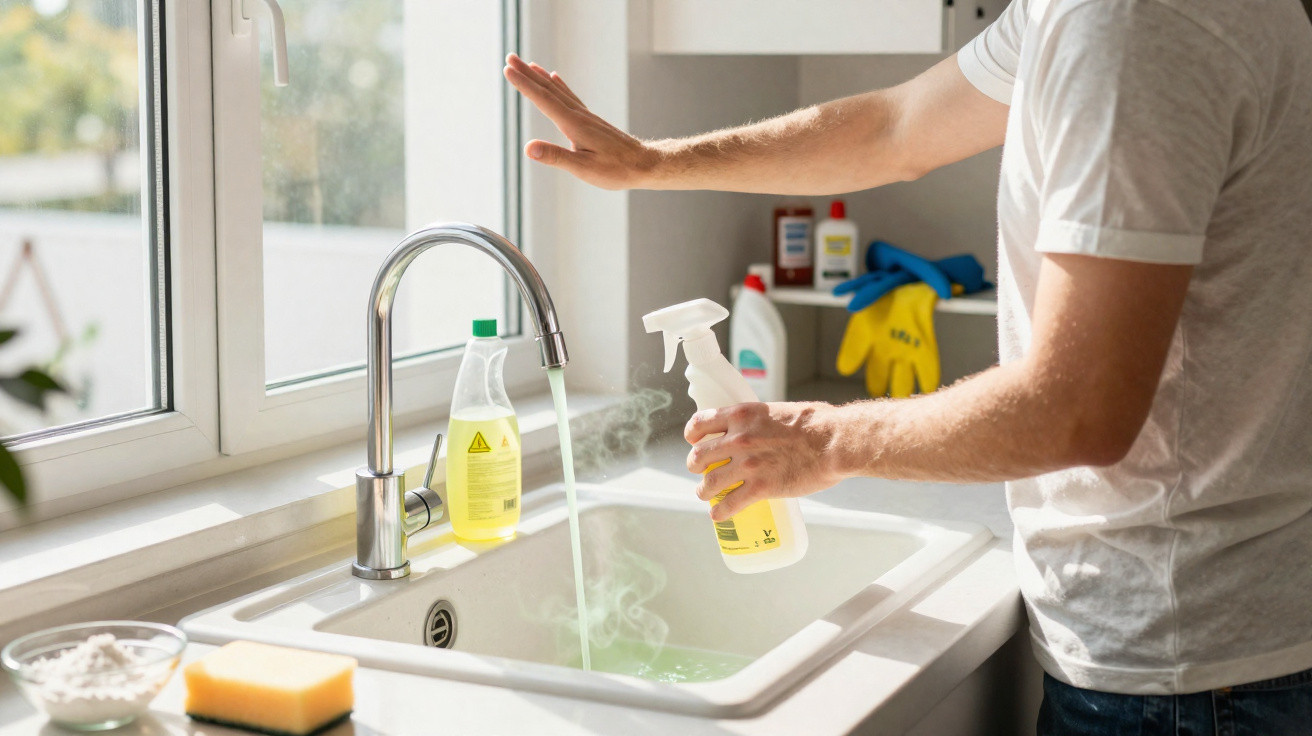
Several everyday household products become hazardous when combined. In homes, including in France, these mixtures cause accidents every year.
Good cleaning habits do not always prevent chemical hazards. As a prevention article published by an online practical-living outlet points out, certain products stored beneath the sink should never end up in the same bucket or washing-up bowl. Such combinations can produce toxic gases or corrosive reactions, sometimes in just a few seconds.
Why some household products become toxic when mixed
Household cleaners often contain powerful substances: acids, alkalis, oxidising agents and solvents. Used separately and in accordance with the instructions, they can be handled safely. However, mixing them can trigger runaway chemical reactions that release irritant or corrosive substances harmful to the skin, eyes and respiratory tract.
Most accidents happen in bathrooms, kitchens or toilets after what seems like an innocent action: trying to “boost” the effect of a product already applied by adding another one on top.
These incidents do not affect professionals alone. Emergency departments regularly report members of the public suffering from fumes after cleaning a shower, basin or floor with several products at once.
The most dangerous mixtures to avoid at all costs
Certain pairings repeatedly feature in warnings issued by poison control centres. They often involve everyday products found in almost every home.
Bleach and white vinegar: a mixture that releases chlorine
Combining bleach and white vinegar is among the riskiest mixtures. One is highly alkaline, while the other is acidic. When brought together, they react and release chlorine gas, a powerful irritant.
Even in small quantities, chlorine can cause coughing, burning eyes and throat, breathing difficulties and a feeling of tightness in the chest.
In practice, this mixture often occurs while descaling a toilet, disinfecting a shower or cleaning a basin. Someone may start with vinegar or an acidic limescale remover, then add some bleach “to disinfect”. The sharp smell that follows is a clear warning sign.
Bleach and toilet cleaners or limescale removers
The same hazard applies to many toilet gels, descalers and limescale-removing products. These cleaners contain acids-often citric, hydrochloric or phosphoric acid-which may also produce chlorine gases or other irritant fumes when mixed with bleach.
- Never pour bleach into a toilet bowl that has already been treated with an acidic toilet gel.
- Avoid applying bleach over limescale remover in the shower, sink or on taps.
- If an acidic product has just been used, rinse thoroughly with clean water before using a chlorine-based disinfectant.
Bleach and ammonia or ammonia-based products
Some window cleaners, kitchen degreasers and stain removers contain ammonia or related compounds. When mixed with bleach, they can release chloramines, which are highly irritating gases.
Chloramines can lead to watery eyes, severe eye irritation, persistent coughing, a burning sensation in the throat and, in some cases, general discomfort.
This type of mixture can occur, for example, when a multi-purpose spray is used on a surface previously treated with bleach without rinsing it first, or when a bucket is filled using water that already contains an ammonia-based product.
Other combinations never to try beneath the sink
Beyond mixtures involving bleach, other pairings are strongly discouraged in the home.
Strong acids and strong alkalis: a violent reaction
Some drain unblockers contain caustic soda, a very strong alkali. Other products are acidic, including many descalers and certain cleaners for cement and grout. If poured together into a pipe or onto the same surface, these products can react violently.
- The mixture may heat up dramatically.
- A sudden reaction may cause splashing.
- Irritant fumes may be released, affecting the eyes and respiratory tract.
Specialists advise against any homemade “cocktail” involving chemical drain unblockers. If one product does not restore drainage, it is better to rinse for a long time, wait, and then use another method, such as a drain snake, a plunger or professional help.
Acidic products and concentrated hydrogen peroxide
Low-concentration household hydrogen peroxide presents fewer problems when used on its own. However, when combined with strongly acidic products, it can intensify certain gaseous emissions or cause unpredictable reactions, particularly where heat is involved.
This combination is less common in homes than mixtures involving bleach, but poison control centres stress that people should not improvise “miracle stain remover” recipes using several bottles.
What to do if products are accidentally mixed or breathing becomes difficult
If an unusual smell develops immediately after two products have been combined, the response should be prompt and methodical.
- Stop using the products immediately.
- Ventilate thoroughly: open windows and doors, and create a through-draught where possible.
- Leave the room, especially if your throat starts to sting or you begin coughing.
- Remove clothing contaminated by splashes and rinse the skin with clean water.
- Contact a poison control centre or emergency services if symptoms are significant.
In France, poison control centres provide a telephone assessment of the risk and advise on the steps to take, explaining the procedure according to the product involved.
These services generally ask for the exact names of the products used, where the incident occurred, the ages of those exposed and the symptoms observed.
What French authorities say about household products
In France, official guidance broadly aligns with the warnings highlighted in the prevention article mentioned above. Health agencies regularly reiterate the basic rules for reducing domestic accidents involving cleaning products.
| Common situation | Recommended action |
|---|---|
| Cleaning heavily soiled toilets | Use only one product at a time, rinse between applications and avoid any mixture with bleach. |
| Descaling the shower | Choose one descaler, ventilate well, and do not add bleach or ammonia. |
| Unblocking a drain | Do not combine two different drain unblockers, follow the contact time and rinse thoroughly. |
French authorities also stress that wearing gloves, reading labels carefully and ventilating while cleaning significantly reduce the risk of an accident.
How to organise products beneath the sink to reduce risks
Some incidents result from disorganised storage: unlabelled bottles, decanted liquids and products piled together. A basic level of organisation reduces the chance of a dangerous combination.
- Keep products in their original packaging, with labels clearly legible.
- Physically separate chlorine-based products, such as bleach, from acidic products or descalers.
- Avoid large containers in which every bottle is stored together.
- Never decant products into food or drink bottles, even temporarily.
Beneath the sink, just a few centimetres of space between the most reactive products can sometimes prevent bottles being confused during cleaning.
For readers in France, this thoughtful storage should accompany other precautions: keep these products out of children’s reach, always close caps securely, and never leave a cleaning bucket unattended.
Simple alternatives for cleaning without mixing products
Some households tend to layer several products in pursuit of a spotless result. In reality, a simpler approach reduces risks while remaining effective.
Using products one after another on the same surface is possible, provided that you rinse thoroughly and wait a few minutes between applications. Hot water, a good brush or a quality microfibre cloth can often reduce the amount of product needed.
Another option is to keep bleach for situations where it is genuinely warranted-targeted disinfection, cleaning after an infectious episode or biological contamination-and use one non-chlorine multi-purpose product for everything else.
These adjustments do not remove all risks, but they reduce the temptation to carry out improvised “experiments” beneath the sink. For everyday cleaning, a degreaser, a descaler and, if necessary, a disinfectant are more than sufficient, provided they are never used together in the same bucket or on the same surface without rinsing in between.


Comments
No comments yet. Be the first to comment!
Leave a Comment