
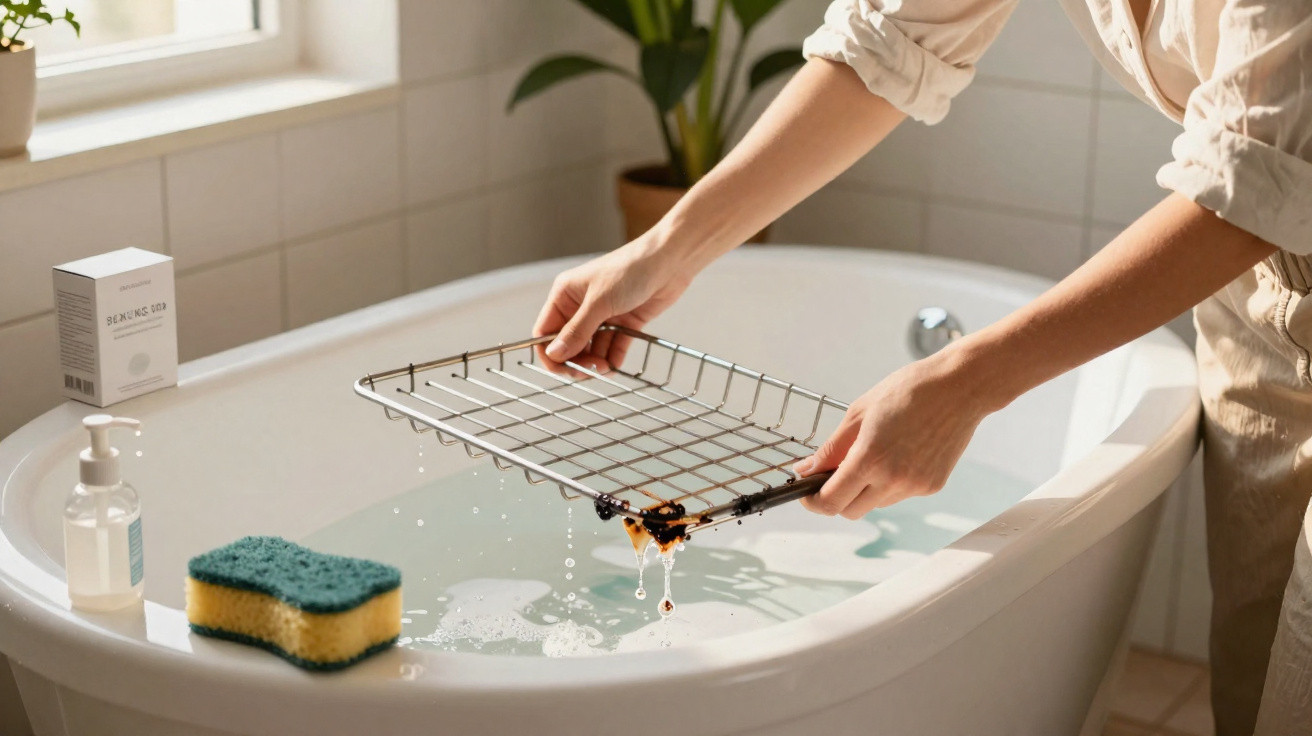
While the oven door glass and baking trays are scrubbed regularly, warped, grease-encrusted oven racks are often left untouched. They do not fit properly in the sink, are difficult to soak and can be sensitive to harsh cleaners. A straightforward household method shows how residues from fat, marinade and baked-on cheese can be removed without hours of scrubbing.
Why oven racks become so stubbornly dirty
Oven racks catch everything that goes wrong in the oven: fat dripping from a roast, cheese from pizza and sauce from a bake. Each use adds another layer, which becomes increasingly baked on under intense heat.
- Many racks are chrome-plated or enamelled, so abrasive steel wool can damage their finish.
- Their long bars and corners are almost impossible to reach fully in a standard kitchen sink.
- A quick surface wipe removes only fresh dirt, not the older layers underneath.
When people finally decide to tackle them, they soon face a dilemma: either use very strong chemicals that irritate the eyes and airways, or scrub endlessly with limited results. Many give up in frustration after the first attempt, and the uncleaned rack goes straight back into the oven.
The unexpected place: why the bath is the ideal cleaning helper
The answer is in a room few people would consider: the bathroom. More specifically, the bath. Even large oven racks fit comfortably inside it and can be fully covered with water, which is a key advantage for tackling baked-on deposits.
To avoid scratching the bath enamel, use this simple protective measure:
- Place a thick old terry towel or blanket on the bottom of the bath.
- Lay the oven racks flat on top.
- Leave some space between the racks so that the water can reach every area.
“The bath replaces the tiny kitchen sink: only complete soaking allows baked-on dirt to loosen by itself.”
The towel padding does more than protect the bath: it also muffles the noise when heavy metal racks are lowered into the water or turned over.
The simple mixture: what really works on baked-on residue
Rather than relying on expensive specialist cleaners, this method uses a combination of three basic household helpers:
- very hot water
- sodium bicarbonate (ordinary household baking soda or bicarbonate of soda)
- grease-cutting washing-up liquid
Each ingredient has a specific role:
| Ingredient | Function |
|---|---|
| Hot water | Softens old grease layers and opens fine cracks in the dirt |
| Soda / bicarbonate of soda | Is mildly alkaline and acts as a fine abrasive, loosening baked-on grease |
| Washing-up liquid | Breaks fats into smaller particles so they can detach from the metal |
A useful guideline is around 150 grams of soda to roughly 50 millilitres of washing-up liquid. The proportions do not need to be exact to the millilitre, but too little soda reduces the effect, while too much washing-up liquid creates excessive foam with very little extra benefit.
Step by step: how to clean oven racks
Anyone who tries this approach once will usually reach for the bath again at the next deep clean. Here is how it works in detail.
1. Place the racks in the bath
Switch off the oven, allow the racks to cool completely and wipe away loose food debris with kitchen roll. Then line the prepared bath with the towel and place the racks on it.
2. Fill with hot water
Fill the bath with the hottest possible tap water until the racks are fully submerged. The hotter the water, the more quickly the dirt will loosen. If you have an instantaneous water heater, you can set the water close to its upper temperature limit.
3. Stir in soda and washing-up liquid
Sprinkle the soda evenly across the surface of the water, then add the washing-up liquid. Briefly stir with your hand, ideally wearing household gloves, or with an old brush until everything is well combined.
“The mixture does most of the work by itself – not the person cleaning while kneeling in front of it with a brush.”
4. Soaking time: from a quick clean to an overnight treatment
How long the rack can “bathe” in the bathroom depends on how dirty it is:
- Light dirt: around 30–40 minutes of soaking
- Normal crusting that is several weeks old: 1–2 hours
- Heavy deposits baked on over months: leave overnight
The solution works its way into hardened grease layers and releases them from the metal bars. After a short time, brown streaks often become visible in the water.
5. Finish briefly, rinse and dry
After soaking, a light final clean is sufficient in many cases:
- Run a soft brush or the non-scratch side of a sponge over the bars.
- Use an old toothbrush to loosen remaining dirt in the corners.
- Then rinse the racks thoroughly with clean water.
Finally, dry everything well, for example with a tea towel. This prevents water marks and reduces the risk of rust forming.
Benefits for health, your budget and the environment
Compared with many oven-cleaning sprays, the bath method offers several advantages:
- No pungent fumes to irritate the airways or eyes
- More suitable for households with children or pets
- Low-cost ingredients that most people already keep in a cupboard
- Little physical effort, as the mixture can work for several hours
- Gentler on the protective coating of the metal
Soda and washing-up liquid are considered comparatively mild household products. When used in the right amounts, they place far less strain on wastewater and surfaces than powerful, highly alkaline oven cleaners.
How often should you clean oven racks?
Anyone who cooks daily will steadily build up new layers on their racks. A sensible general routine is:
- Soak them soon after particularly greasy meals, such as roast goose or cheese-heavy dishes.
- Schedule a thorough bath clean every few weeks.
- If the oven is rarely used, clean the racks at least every three months.
The shorter the intervals, the more quickly residues come away – and the less often an overnight treatment in the bath will be needed.
What you should avoid doing
Although it may sound tempting, some common “heavy-duty hacks” cause more harm than good. Typical mistakes include:
- Using steel wool on chrome-plated or enamelled racks
- Applying highly concentrated oven cleaner without gloves
- Repeatedly washing racks in the dishwasher on an overly hot programme
- Using hydrochloric acid-based limescale cleaners on grease crusts
In particular, repeated dishwasher cleaning can dull chrome coatings over time, leaving them looking patchy and rough.
Practical extra tips for even better results
For particularly stubborn corners, the method can easily be extended. These small tricks have proved useful:
- Apply a paste of bicarbonate of soda and a little water directly onto thick crusts.
- Keep an old toothbrush solely for soldered joints and angles.
- For very long racks, soak each side in turn if the bath is too short.
For homes without a bath, a large mortar tub or a foldable laundry basin can be used instead. The important thing is that the rack lies completely in the water bath.
Why this method also makes sense in the long term
Clean oven racks offer more than a better appearance. They help prevent burnt smells while preheating, reduce smoke and may even save energy indirectly: a clean oven free from grease layers reflects heat more evenly, so food cooks more predictably.
After using the bath method a few times, most people naturally make it part of their household routine. With a little planning, the process largely runs in the background: prepare the solution, put in the racks, go shopping or watch a film, then do a quick final clean afterwards. This makes baked-on racks suitable for everyday use again, without spending hours kneeling by the oven with a scouring sponge.



Comments
No comments yet. Be the first to comment!
Leave a Comment