
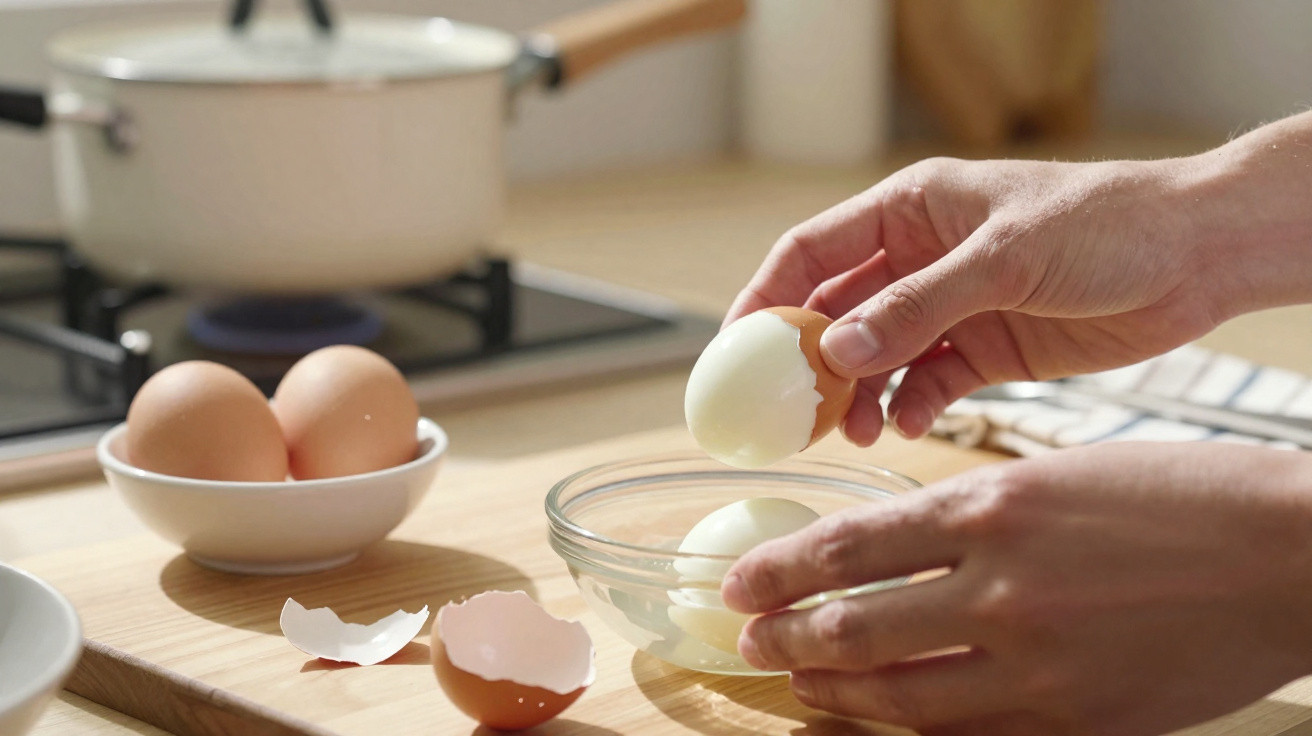
Many people enjoy an egg for breakfast, but peeling it can quickly spoil the experience. The shell cracks, bits of white tear away, and the result looks more ruined than appetising. A tip currently attracting attention on social media uses an ordinary teaspoon to loosen the troublesome shell with remarkably little effort.
Why eggs can be so difficult to peel
Anyone who boils eggs regularly will know that some shells come away easily while others seem almost fused to the egg. The key reason lies beneath the shell.
Directly underneath the hard calcium shell is an extremely thin protective layer known as the membrane. It lines the inside of the egg and helps prevent germs from entering. When peeling, however, this fine skin can become the main obstacle.
“Fresh eggs in particular have a membrane that clings very tightly – so half the egg white can easily tear away during peeling.”
As an egg ages, its membrane becomes less firmly attached to the white. That is why older eggs generally slip out of their shells much more easily. The teaspoon trick targets this membrane specifically, altering it before the egg is even boiled.
The teaspoon trick: making eggs much easier to peel
The principle is straightforward: before cooking, loosen the membrane at one point so that it does not stick as firmly to the egg white afterwards. Everything required is already available in a typical kitchen.
Step-by-step instructions for the teaspoon trick
- Hold a raw egg in one hand, ideally at its lower end: the slightly wider side containing the air pocket.
- Take a teaspoon in the other hand, with its rounded back facing the egg.
- Gently tap the bottom of the egg using the back of the spoon.
- Listen for a quiet “pop” – this sound indicates that the membrane has loosened or split.
- Repeat if necessary until the lower end feels slightly hollow.
Depending on the shell and how fresh the egg is, just a few light taps may be enough; in some cases, 10 to 20 are needed. The important thing is to work carefully so that the egg does not crack open completely. Once boiled, its shell should be far easier to remove because water and air can pass more readily between the shell and membrane.
“Once the membrane has been damaged, the shell separates from the egg white much more easily during peeling – leaving the egg smooth and intact.”
A practical tip if something goes wrong
When trying this method for the first time, it is best to hold the egg over a bowl or the sink. If it cracks too heavily by accident, it can still be put to good use – for scrambled eggs, an omelette, egg salad or as an addition to soup.
Alternatives: other ways to peel eggs more easily
The teaspoon trick is not the only reliable way to make eggs easier to peel. Several established methods can help, many of them originating in professional or large-scale kitchens where large quantities of eggs need to be prepared quickly.
Blowing, shaking and tapping: what works in practice
- Blowing method: After boiling and cooling the egg, carefully break a small hole in the shell at both the top and bottom. Then blow firmly into the upper opening – with a little practice, the egg will slide almost entirely out of its shell.
- Shaking method: Cool the boiled eggs in cold water, leave a little water in the pan, put the lid on and shake it vigorously. As the eggs knock together, their shells crack and loosen across a wide area.
- Tapping before boiling: Lightly tap the flatter end of the egg against the worktop or with a spoon until tiny fine cracks appear, or pierce it with a needle. During cooking, this allows water to move between the shell and membrane, so the shell comes away more loosely later.
Which technique suits best depends on personal preference and the situation. Anyone uncomfortable with air around food or contact with saliva is unlikely to choose blowing, and may prefer shaking the eggs or using the teaspoon trick instead.
Mistakes that make peeling eggs unnecessarily difficult
Many peeling problems begin during the cooking process itself. A few common pitfalls are easy to avoid.
| Problem | Possible cause | What helps |
|---|---|---|
| Shell sticks firmly | The egg is very fresh and the membrane is tightly attached | Use the teaspoon trick; store eggs for 7–10 days |
| Egg cracks in the water | Heat is too high or the egg touches the base of the pan directly | Lower eggs gently into water that is already simmering lightly, then reduce the heat |
| Egg white tears while peeling | The egg was not cooled enough or the shell was not cracked all over | Cool eggs in ice-cold water and crack the shell completely |
| Greenish ring around the yolk | The egg was cooked too long or at too high a temperature | Keep to the cooking time, then place the egg in cold water immediately |
How to cook eggs so they peel perfectly
To get the best possible results from the teaspoon trick, a few details during preparation also matter. Cooking time, temperature and rapid cooling all strongly affect how easily an egg can be peeled.
Steps for hard-boiled eggs that peel well
- If desired, use the teaspoon on the lower end of each egg first.
- Bring a pan of water to the boil and add a pinch of salt or a splash of vinegar; this helps if an egg does crack.
- Lower the eggs carefully into the hot water with a spoon. Do not use eggs straight from the fridge, as bringing them to room temperature reduces stress cracks.
- Cook for 9 to 11 minutes for hard-boiled eggs, depending on their size.
- As soon as the cooking time is up, transfer the eggs to ice-cold water and leave them to cool for several minutes.
- Lightly crack the shell all over against the worktop, then peel it under running water.
The cold water at the end is particularly useful because it helps the membrane separate slightly from the shell. Combined with the teaspoon used beforehand, this results in far fewer tears in the egg white.
How many eggs are considered safe – and what do they contain?
Anyone planning to eat eggs more often may soon wonder how many are suitable. Current dietary advice is far more relaxed than it once was: for healthy people, several eggs a week are generally not a problem, provided the rest of the diet remains balanced.
Eggs provide high-quality protein, vitamin D, vitamin B12, biotin and minerals including iron and zinc. For most people, their cholesterol content matters less than was once believed because the body adjusts its own cholesterol production.
“Anyone without known blood lipid problems can enjoy eggs regularly – ideally alongside plenty of vegetables, wholegrains and healthy fats.”
People with cardiovascular disease or elevated cholesterol levels should discuss the amount that is right for them with a doctor or a nutrition professional. That way, breakfast can come with peace of mind as well.
More clever uses for the teaspoon trick with eggs
The teaspoon trick is not limited to the traditional breakfast egg. It can save both time and frustration when many eggs need peeling at once. Examples include:
- large platters of devilled eggs for parties
- egg salad for barbecues or buffets
- meal preparation involving several hard-boiled eggs prepared as snacks
- protein-rich meals after exercise
Those who make dishes like these often will benefit most from shells that release quickly and cleanly. Small techniques such as the teaspoon trick can therefore make day-to-day cooking noticeably more convenient.
It remains to be seen which other kitchen hacks will stand the test of time. Many trends first circulate on social media, but only a few genuinely become part of everyday cooking. The teaspoon trick for peeling eggs is one of those ideas that delivers a clearly noticeable effect with very little effort, giving it the potential to move from a little-known tip to a regular routine in UK kitchens.



Comments
No comments yet. Be the first to comment!
Leave a Comment