
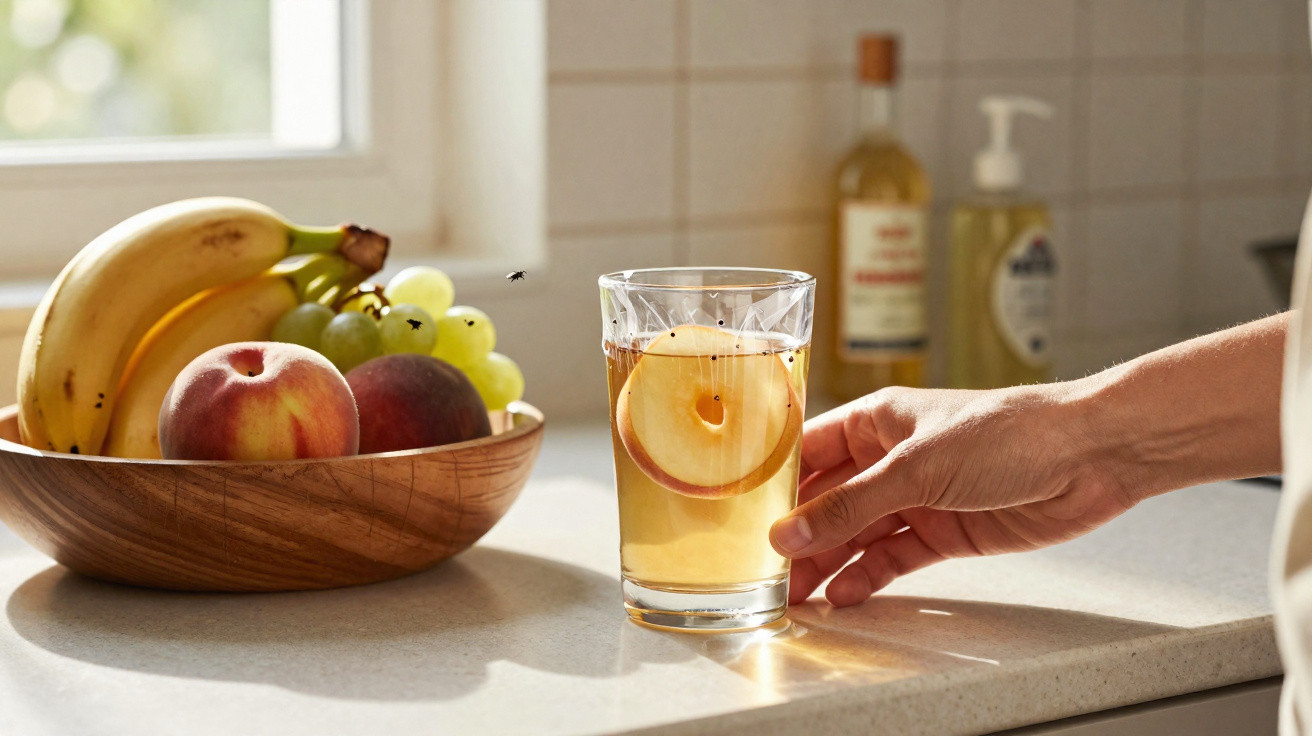
You wipe down surfaces, clean, empty the bin and rinse the sponge – yet by the following morning, they are buzzing around the worktop again. A straightforward combination of a glass, fruit and an everyday household product can noticeably reduce this persistent problem overnight.
Why fruit flies love the kitchen
Fruit flies are looking for two things: ripening fruit and moisture. Both are found in almost every kitchen, even when it appears perfectly clean.
- Ripe or overripe fruit in the fruit bowl
- Damp areas around the sink and draining board
- Bins that are not emptied every day
- Moist cloths, sponges and tea towels
A banana with brown patches or a bruised apple is enough. It may still be edible to us, but for fruit flies it is already a buffet. The same applies to a slightly damp edge around the plughole that may go entirely unnoticed.
In this situation, many people start cleaning frantically: a quick wipe with a cloth, rinse the sink, move the fruit around a little. That may feel reassuring, but it often does nothing about the actual attraction.
“What matters is not how often you wipe, but whether the hidden attractants disappear.”
There is one clear sign: if the flies make the same circuit over the worktop every day, a permanent attractant has become established there. Cleaning alone is then rarely enough – a targeted bait works far better.
The glass trick: simple bait, major effect
At the heart of this method is a makeshift funnel trap inside an ordinary glass. It takes advantage of the insects’ instincts: getting in is easy, while getting out is difficult.
What you need for the glass trick
- 1 large drinking glass
- A few thin slices of apple, or other sweet fruit
- 1 tablespoon of apple cider vinegar
- 1 sheet of paper, such as notepad or printer paper
Most households already have all these items. There is nothing toxic, no chemicals and nothing that requires a special trip to a DIY shop.
Set up in two minutes
Build the trap as follows:
- Place the apple slices in the bottom of the glass.
- Add one tablespoon of apple cider vinegar.
- Roll the sheet of paper into a cone, leaving a small hole at its tip.
- Put the cone into the glass with its point facing downwards, ensuring it does not touch the liquid.
The paper cone acts as a funnel. Inside, the smell is intensely sweet and sour, while there is very little scent outside. Fruit flies crawl or fly through the opening and down towards the bait. Finding the route back out is much harder for them.
“The trap does not force the insects – it invites them in and makes the return confusingly difficult.”
One small but important detail is the hole in the paper: it must not be too large or too small. If it is too small, the insects will not enter at all. If it is too large, they can escape more easily.
The best position and time for the glass
Where you place the glass often determines whether it succeeds or fails. Put it where the fruit flies are already flying their usual ‘patrol’.
Typical hotspots include:
- Directly beside the fruit bowl
- On the worktop near the sink
- In the corner where washing-up often piles up
- Next to the bin or food-waste caddy
The trick works best overnight. The kitchen is quiet then: nobody walks through it, there is no cooking and nothing is being moved. The trap remains the most interesting smell in the entire room.
“Set it up in the evening, and by morning you can usually see in black and white how well the glass has worked.”
If the kitchen is busy during the day, the trap can still be left out. Moving it briefly will not matter, provided it is returned to a familiar gathering point afterwards.
Why sweet and sour is so irresistible
Fruit flies rely heavily on smell for orientation. Combining natural sweetness with a touch of acidity acts like a magnet.
In the glass, the ingredients fulfil these roles:
- Apple provides the sweet element
- Apple cider vinegar adds the sour note
The glass walls keep the cloud of scent concentrated. This makes the smell inside more powerful than anything else in the kitchen that could tempt them, whether that is brown bananas, open juice or peel in the food-waste bin.
The paper funnel is the real ‘brain’ of the setup: it guides the insects deliberately downwards. At the top, the hole is narrow; below it, everything appears like a large space. To get back out, they would need to find that exact small opening. Very few manage it.
What to do after the first night
Take a close look inside the glass in the morning. If several flies are sitting in it, the trap has clearly done its job.
There are then three sensible steps:
- Dispose of or empty the glass, for example into the toilet, and flush thoroughly.
- Refill it if needed: use fresh apple slices, a new tablespoon of apple cider vinegar and a clean paper cone.
- Repeat the process in the same spot, at least for one or two nights.
If the infestation is severe, one glass will hardly be enough. In that case, use several traps at once, distributed across the kitchen’s ‘hot zones’.
“Anyone who gives every problem area its own glass quickly reduces the infestation’s numbers.”
If the number of flies remains visibly high, replace old traps completely after one or two days. The scent weakens over time, mould may develop and the trap becomes less attractive.
Without tackling the cause, the infestation returns
Effective as the glass trick may be, it only addresses the visible part of the problem. To stop the flies returning in the same numbers a week later, the kitchen’s attractants need to become less appealing.
Three areas are especially critical:
- Fruit bowl: Use ripe fruit promptly or store it somewhere cool, and remove any rotten pieces immediately.
- Drain: Flush it regularly with hot water and a little washing-up liquid, and clear residues from the strainer.
- General waste and food waste: Do not leave it to build up for days; dispose of smaller amounts more often instead.
Even apparently minor details make a difference: allow tea towels to dry properly, do not leave wet cloths crumpled up, and avoid leaving open glasses of juice standing for hours.
When other options are worthwhile – and what to avoid
Anyone who does not like the glass method can use similar household remedies. The core principle is always the same: sweet, slightly sour, easy to reach – but still a trap.
Popular alternatives include:
- Apple cider vinegar with a little washing-up liquid in a shallow bowl
- Leftover red wine with a drop of washing-up liquid
- A piece of overripe fruit in a bowl, loosely covered with cling film and pierced with small holes
Insecticide sprays may work quickly, but they create other problems in a kitchen where food is left uncovered. For most homes, the glass funnel method is entirely sufficient: it is non-toxic, inexpensive and can be repeated as often as required.
Anyone who regularly handles lots of ripe fruit, for example when preserving or baking, can make the trap part of their normal kitchen routine: on days involving plenty of fruit preparation, set out one or two glasses, leave them overnight and dispose of them in the morning.
This turns an irritating recurring problem into a manageable task: glass, fruit, vinegar, paper – and by the next day, the kitchen belongs more to people than to flies.

Comments
No comments yet. Be the first to comment!
Leave a Comment