
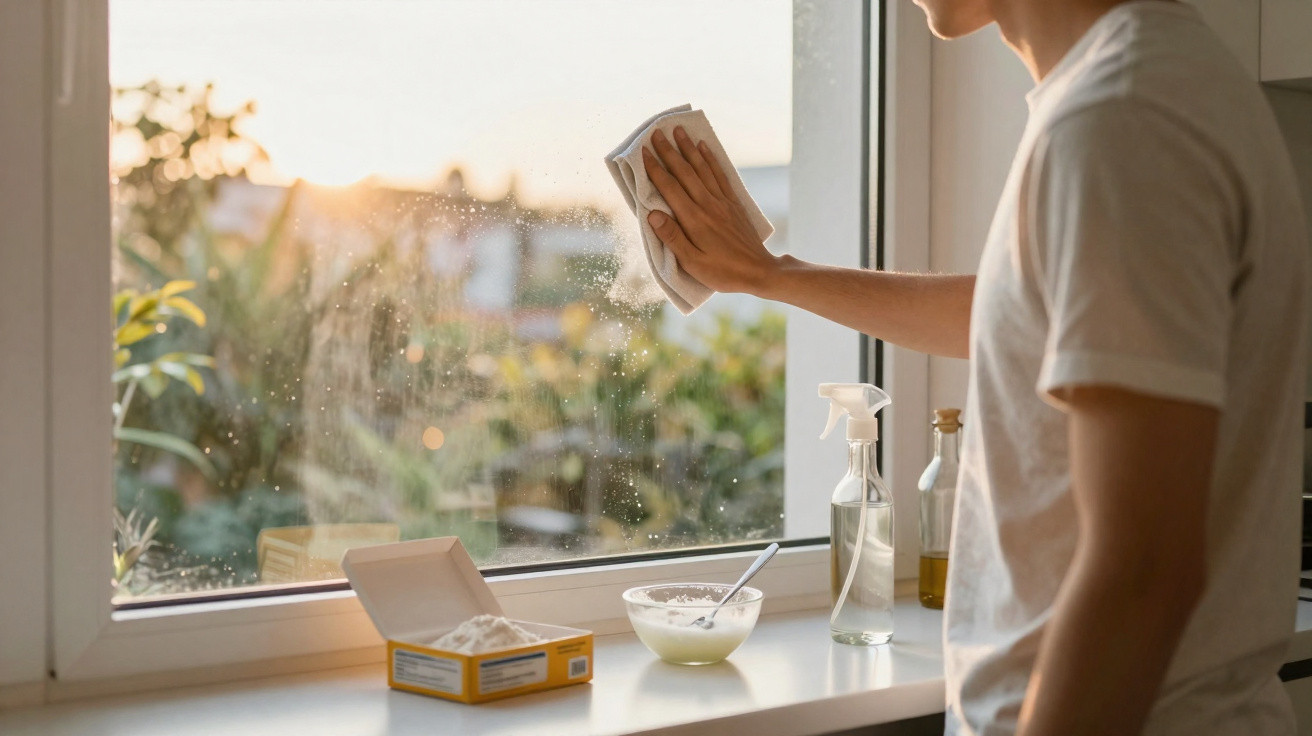
An unassuming kitchen staple can put an end to this frustrating chore.
Many people clean their windows with a mixture of vinegar and water and are initially pleased with the result. Yet as soon as the next ray of sunlight hits the glass, dull halos and streaks reappear. The idea of vinegar as a “miracle cleaner” begins to fall apart. Another powder from the cupboard performs surprisingly better, without the sharp smell and with impressively clear results.
Why vinegar often disappoints when cleaning windows
For years, vinegar has been regarded as an all-purpose household solution. It can tackle limescale, grease and soap residue. When it comes to glass, however, it has a drawback familiar to many people: the surface looks streak-free while it is being cleaned, but marks, cloudy patches and fine edges become visible as soon as the light falls at the wrong angle.
This is caused by the combination of water, acetic acid and evaporation:
- As it dries, the liquid layer contracts unevenly.
- Microscopic edges are left behind, appearing as dull halos.
- The effect is especially noticeable on large panes of glass and mirrors.
- In warm conditions or direct sunlight, the mixture evaporates too rapidly, making the streaks even more obvious.
There is also its pungent odour, which can be particularly unpleasant in small flats or poorly ventilated rooms. Many people then unknowingly use a stronger dose or add other cleaning products. The glass may look clean for a short time, but the problem of streaks remains.
Traditional vinegar cleaner does remove dirt, but it does not control how the liquid film “breaks” as it dries on the glass – and that is exactly where the kitchen powder comes in.
Corn starch: why Maizena works so well on glass
The unexpected alternative comes not from the cleaning-products aisle, but from the baking cupboard: fine corn starch, sold under brands such as Maizena. It is normally used in sauces and cakes. In a window spray, though, it has a different role: it influences how the liquid behaves on the glass.
Corn starch has several useful properties for cleaning glass:
- It alters the surface tension of water, allowing the film to spread more evenly.
- It captures fine residue and dust particles in the cleaning liquid.
- It slows the uncontrolled run-off of liquid across the glass.
- It dries clear, without leaving visible edges behind.
When combined with alcohol, it creates a window cleaner that evaporates very quickly while also drying without streaks. The alcohol disinfects and dissolves greasy marks, while the starch traps dirt particles and helps leave the surface clear.
Alcohol loosens the dirt, while corn starch stabilises the liquid film – together, they make a remarkably clear glass cleaner.
Recipe for a streak-free corn starch window spray
To make a simple, odourless glass cleaner, you need only a few ingredients that many households already have:
Ingredients for a standard bottle (approximately 500 ml)
- 250 ml water, preferably lukewarm and optionally distilled
- 250 ml household alcohol or alcohol at around 70%
- 1 level tablespoon corn starch, such as Maizena
- 1 clean spray bottle
How to mix the cleaner correctly
- Pour the water into a container and stir in the corn starch until no lumps remain visible.
- Add the alcohol and stir thoroughly again.
- Carefully transfer the mixture into the spray bottle.
- Close the bottle and shake it vigorously – it is ready to use.
The result is an almost odourless, clear cleaner that is ideal for living-room windows, mirrors, glass doors and shower screens.
| Component | Role in the cleaner |
|---|---|
| Water | Base liquid that distributes the active ingredients |
| Alcohol | Dissolves grease and dirt, and enables fast drying |
| Corn starch | Binds residue and prevents streaks and halos |
How to clean windows properly with Maizena spray
For the effect to be genuinely visible, the method matters almost as much as the recipe. A few straightforward rules can make a clear difference.
Preparing the glass surface
- Remove loose dust and cobwebs with a dry cloth or soft brush.
- Clean heavily soiled frames, such as those covered in pollen or soil, separately beforehand.
- Ideally, avoid cleaning windows in strong midday sunshine.
Using the spray correctly
- Shake the bottle firmly before every use so that the starch is evenly distributed again.
- Spray only a small amount directly onto the glass; use the product sparingly.
- Immediately buff it with a clean microfibre cloth, preferably in vertical strokes from top to bottom.
- Work in sections on large surfaces, so the mixture does not dry before it has been spread out.
A second, dry cloth can be used for additional polishing where needed. One pass is usually enough, as the alcohol and starch dry quickly and clearly together.
Less product and thorough buffing with a microfibre cloth – that is how Maizena spray shows its full potential.
Where Maizena spray performs particularly well
This homemade cleaner is suitable for more than standard windows. Its advantage over vinegar is especially apparent wherever light shines directly onto glass.
- Panoramic windows and balcony doors: large surfaces where halos are immediately noticeable.
- Bathroom mirrors: no more white streaks when sunlight comes through the bathroom window.
- Glass shower screens: water marks and soap residue can be removed with fewer streaks.
- Glass tables: greasy fingerprints and streaks disappear much more quickly.
In areas exposed to plenty of grease splashes, such as the kitchen beside the hob, the formula can be adjusted slightly. A small dash of vinegar or a little washing-up liquid can help with stubborn layers of grease. Even so, corn starch remains the key ingredient for preventing streaks.
Storage and safety points to consider
As the mixture contains alcohol, it is flammable. Keep the bottle away from naked flames and hot hobs, and store the cleaner out of the reach of children.
The starch may also cause the mixture to thicken over time or settle at the bottom of the bottle. This is normal provided that clumped powder does not remain stuck there. If the liquid becomes thick or no longer sprays properly, simply prepare a fresh, smaller batch. This keeps the cleaner fresh and easy to dispense.
If your tap water is very hard, distilled water is the best choice. It reduces limescale marks and improves the chances of achieving genuinely crystal-clear surfaces.
Why switching from vinegar to corn starch is worthwhile
Most people who change to Maizena spray mention two main reasons: no sharp vinegar smell and noticeably fewer streaks visible in sunlight. The mixture uses simple ingredients already found in many homes and can be prepared in just a few minutes.
Anyone who regularly cleans large glass surfaces, mirrors or shower cubicles can avoid a great deal of frustration with this new recipe. The view outside becomes clearer, while those persistent halos so often left by vinegar lose their sting – thanks to an inconspicuous powder more usually found in cake batter.





Comments
No comments yet. Be the first to comment!
Leave a Comment