
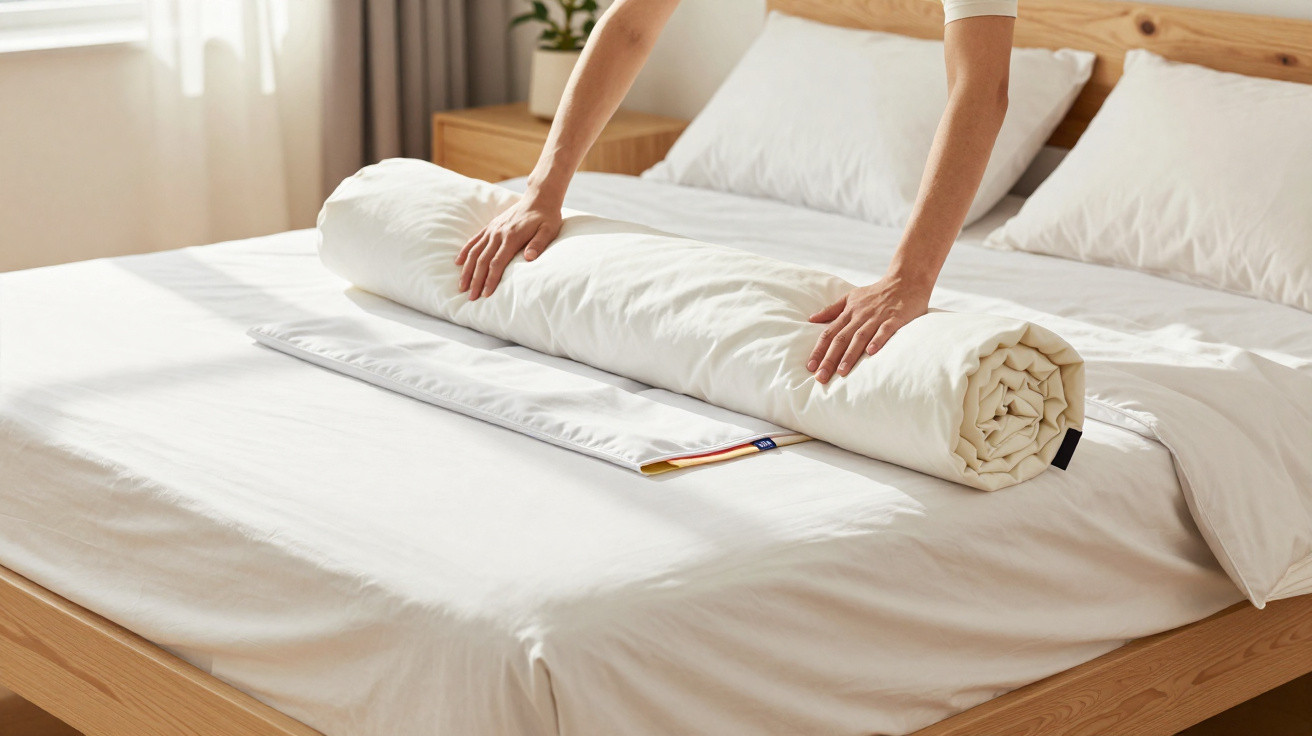
Changing bed linen is a task many people put off, as wrestling with a duvet can be irritating and leave them with an aching back. Yet one clever technique can get it done in just a few minutes – without frantic shaking, climbing across the bed or battling with oversized covers.
Why changing bed linen can test your patience
Putting a duvet into its cover may look straightforward at first. The reality is often different: you stand beside the bed, get tangled up in the corners, the cover twists around, and one corner is left sticking out awkwardly. Anyone with a large double bed or an oversized duvet will know this situation particularly well.
Fresh bed linen is about more than comfort, too. Sweat, skin flakes, pollen and sometimes dust mites build up in the fibres. Experts advise changing duvet covers roughly every one to two weeks – or more frequently if you sweat heavily or have allergies. When the process is frustrating every time, it is easy to keep postponing it.
“The Burrito method takes the stress out of putting on a duvet cover – and noticeably saves time and effort in everyday life.”
The Burrito method: make the bed without gymnastics
A tip known as the “Burrito method” has been circulating on social media for some time, taking its name from the rolled Mexican dish. Rather than wildly shaking the duvet through the air, the method involves rolling the duvet and cover tightly together. Once finished, everything is neatly aligned, with no need to twist yourself into uncomfortable positions.
Step by step: how to use the Burrito method
For this technique to work, the duvet and its cover should be approximately the same size. Then proceed as follows:
- 1. Prepare the cover: Turn the duvet cover completely inside out so that its seams face outwards. Smooth it flat across the bed, with the opening at the bottom nearest to you.
- 2. Place the duvet on top: Lay the duvet directly over the cover. Try to align the corners and edges as precisely as possible.
- 3. Roll it up like a burrito: Move to the head of the bed. Take the top edge of both the duvet and cover together, then roll them towards the foot of the bed. Work slowly and keep the roll tight so that nothing shifts.
- 4. Pull the cover over the roll: You should now have a thick roll in front of you. Take the open end of the cover and pull this strip of fabric fully over the roll, as though pulling on a sock. Fasten the zip, buttons or poppers.
- 5. Unroll it again: Unroll the “burrito” in the opposite direction. The duvet will gradually unfold inside the cover. Give the corners a quick tug and you are done.
After trying the sequence calmly once or twice, it soon becomes second nature. Many users say they can manage even a large double duvet on their own this way, without breaking into a sweat.
What makes the Burrito method so useful
Its main benefit is not simply the time it saves, but also the physical ease it offers. Everything stays at mattress height instead of having to lift and shake the duvet overhead. This is particularly kinder to your back and shoulders.
It can also help shorter people or those with limited mobility. There is no need for another person, nor do you have to run around the bed trying to catch the corners. The roll keeps everything compact until the cover is properly in place.
“Less acrobatics, less tangling and less frustration – this technique creates a hotel-bed feel at home surprisingly quickly.”
Common mistakes when making the bed – and how to avoid them
Many difficulties begin right at the start. If the cover is only partly turned inside out, or the duvet and cover are not laid neatly on top of one another, uneven edges will cause problems later. The following points can prevent this:
- Check the size: Briefly look at the label before fitting the cover. A duvet that is too small for an oversized cover will slip around more easily afterwards.
- Align the corners: Before rolling, run your hand over all four corners once. If everything is flush, the burrito will hold together better.
- Roll tightly: The firmer the roll, the more easily you can pull the cover over it and unroll it afterwards.
- Smooth out the air: As you roll, occasionally run your hands along the roll. This pushes out trapped air and prevents lumps.
Fitted sheets: how to get a genuinely crease-free fit
The duvet is not the only source of stress: fitted sheets can be just as troublesome. You turn them around, flip them over, and still one corner ends up in the wrong place. This becomes especially noticeable on large mattresses.
A simple orientation trick
Almost every fitted sheet has a small label showing its size and care instructions. Many manufacturers deliberately sew this into the same corner every time. Using that label as a guide saves you from searching for the “right” side.
A useful rule of thumb is:
- Decide whether the label should always go at the top-right or bottom-left corner.
- Stick to that routine – after a few changes, you will automatically know how to put the sheet on.
A smooth fitted sheet in four moves
- Orient the sheet: Place the sheet loosely over the mattress, positioning the label at your chosen corner.
- Secure the first corner: Pull the labelled corner over the matching mattress corner.
- Stretch the opposite corner: Move diagonally to the opposing corner and pull the next side into place.
- Tighten the remaining corners: Fit the final two corners, then pull firmly down along the sides so that the fabric sits snugly.
One useful tip is to take hold of the centre of the sheet as you go and pull the fabric outwards towards all four corners. This spreads the tension evenly and naturally smooths out creases.
How often should you change bed linen?
Once you have mastered the Burrito method, changing bed linen soon feels far less daunting. That naturally raises the question of how often it should be done.
In many homes, every one to two weeks is considered the standard schedule. If you sweat a lot at night, sleep without pyjamas during summer, or let pets onto the bed, shorter intervals are advisable. People with allergies are often sensitive to household dust and pollen in textiles, and benefit from freshly washed bedding every week.
“The easier it is to fit the bedding, the more likely you are to maintain a hygienic changing routine.”
Extra tips for a hotel-style bed
When you are changing the bed anyway, a few straightforward habits can add noticeably more comfort:
- Give the duvet a quick shake: Before putting on the fresh cover, shake out and fluff up the duvet well. This restores some of its volume.
- Start with the pillows: Change the pillowcases and plump up the pillows before covering the duvet. This gives you better access to everything.
- Air the mattress: If time allows, leave the mattress uncovered for a few minutes. Moisture can escape more easily.
- Keep bed linen sets together: Store duvet and pillowcase sets together. This reduces time spent searching and speeds up the whole process.
Why the method is worthwhile in the long term
In everyday life, small routines can often be more draining than major projects. Remaking a bed may seem insignificant, but over the years it takes up many hours and a fair amount of energy. Adopting an effective approach such as the Burrito method removes this recurring source of stress for good.
Families with several beds, shared households and commuters who regularly move between two homes can particularly benefit from a clearly structured process. The method requires no tools, suits any daily routine and needs no extra equipment.
If you also use a consistent orientation system for your fitted sheet and remember to wash bed linen on a regular schedule, you can create a fresh, inviting bed with little effort – and begin or end the day feeling noticeably more relaxed.






Comments
No comments yet. Be the first to comment!
Leave a Comment