
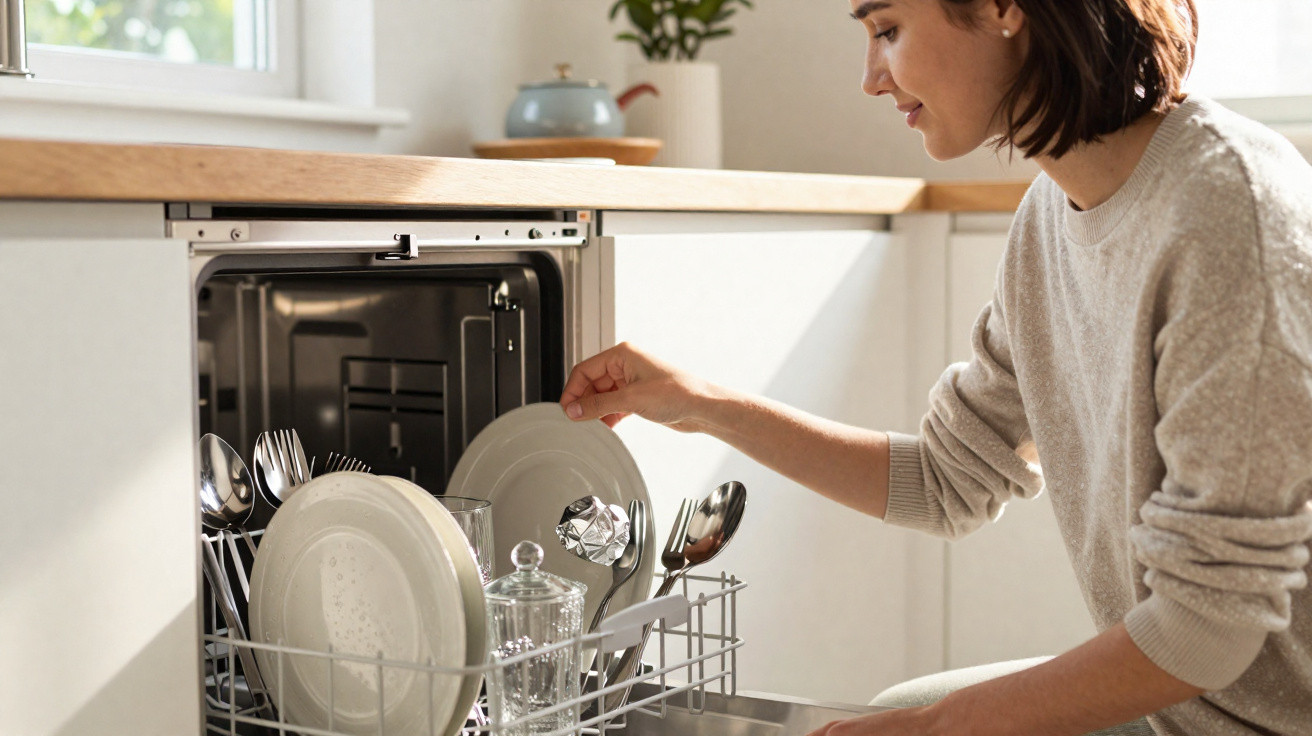
I carried out controlled dishwasher loads to find out what genuinely changes.
My routine remained identical throughout: the same programme, detergent and water. The sole variable was a loose ball of aluminium foil in the cutlery basket. Afterwards, I assessed shine, water marks, drying and limescale on glass and metal.
What the foil-ball trick is meant to do
The premise is straightforward: a crumpled foil ball stays in the dishwasher for the cycle. Supporters say it improves drying, reduces scale and makes metal surfaces brighter. The usual explanation combines two possible mechanisms: light abrasion as items shift during washing, plus a galvanic interaction near stainless-steel objects that may reduce tarnishing on silver-plated pieces.
In my tests, stainless steel cutlery looked cleaner and brighter, with fewer water spots. Glass saw a small improvement. Aluminum cookware did not benefit.
How I tested it
I completed four consecutive loads in a five-year-old, mid-range dishwasher:
- Eco 50°C programme, hard water, with the integrated softener adjusted to the local hardness level.
- The same amount of powder detergent and rinse aid in every load.
- A mixed load of plates, glasses, stainless-steel cutlery and several pans.
- Two loads without foil and two with a tennis-ball-sized foil ball in the cutlery basket.
Changes with the foil ball
The cutlery emerged brighter and with fewer spots. Bead-shaped water marks on spoons dropped noticeably, and the dishwasher’s inner stainless-steel walls also looked fractionally improved. Metal seemed to dry faster, whereas plastic did not. The foil did not remove baked-on food by itself: detergent and heat still did most of the work.
What remained the same
The cloudy hard-water film on glasses was virtually unchanged. This haziness is often mineral etching rather than simple residue, and foil cannot reverse etching. Nor did it solve greasy pans requiring pre-soaking. Non-stick items showed no benefit and should not be exposed to abrasion.
The sweet spot: stainless steel knives, forks, and spoons. The question mark: delicate glassware and aluminum pans.
Why aluminium foil may work in a dishwasher
Two effects may be responsible. First, the foil ball creates mild points of contact inside the cutlery basket, helping water sheet away and dislodging some droplets before they dry into marks. Second, aluminium touching stainless steel in hot, alkaline water may produce a slight galvanic effect. This can slow sulphide tarnish on silver-plated pieces, in a way broadly similar to the familiar baking-soda-and-foil bath. The dishwasher effect is less powerful and not always consistent, but it was still visible with some cutlery sets.
How to use a foil ball safely
- Loosely crumple foil into a ball between the size of a table-tennis ball and a tennis ball.
- Put it in the cutlery basket rather than on the base, where it could obstruct the spray arm.
- Keep it clear of non-stick coatings and delicate crystal.
- Replace it after 8–10 cycles, once the foil begins to break down.
- Avoid washing silver with stainless steel if you have fragile silverware; hand-wash valuable pieces instead.
A foil ball is a tweak, not a substitute for rinse aid, softener salt, or proper loading.
How it compares with common fixes
| Method | Main benefit | Best for | Risks or limits |
|---|---|---|---|
| Foil ball in basket | Slightly brighter metal, fewer spots | Stainless cutlery, silver-plated in good condition | No help for etched glass; keep away from nonstick |
| Rinse aid | Better sheeting and drying | Glasses, plastics, cutlery | Overdose can leave streaks |
| Softener salt | Controls hard water minerals | Cloudy glass, limescale | Only for models with a salt reservoir |
| Citrate or dishwasher descaler | Removes scale inside the machine | Spray arms, heater, sensors | Follow dosage; run empty maintenance cycles |
Results to expect
With a typical hard-water setup, the foil ball removed some of the dullness from forks and spoons. It did not dramatically change every glass, nor did it tackle heavy grime on its own. Treat it as a minor improvement on top of the fundamentals. If your dishwasher already has the correct salt setting and dependable rinse aid, you may see a modest lift in the appearance of metal. If those basics are missing, address them first.
Loading and settings have a greater effect
Leave room between spoons so water can reach each surface. Point knives and forks upwards if that is safe in your household, or alternate their directions to prevent nesting. Choose a hotter programme for greasy loads. Clean the filter every week, and inspect spray arms for seeds or shells trapped in the jets. These measures are more effective than any dishwasher hack.
Beyond the dishwasher: other foil uses, tested cautiously
- Camping scrubber: A foil ball can remove carbonised residue from steel pans. Do not use it on non-stick surfaces or scratch-prone enamel.
- Quick knife refresh: Folding foil and cutting through it a dozen times may smooth minor burrs. It is only a temporary measure, not genuine sharpening.
- Fridge myth check: A foil ball will not make a fridge cooler. Good airflow, clean vents and avoiding an overfilled fridge are what matter. Foil may reflect light in a dark corner, but that is purely cosmetic.
Use foil as a helper, not a cure-all. Choose the right tool for delicate surfaces.
Practical ways to improve shine without new gadgets
- Match your detergent to the water hardness. Too little can leave film, while too much may cause streaks.
- Set the softener using your council’s water-hardness figure or a test strip.
- Select glass-care programmes for stemware, and avoid heated drying if etching is a concern.
- Run a hot maintenance wash with dishwasher cleaner every six to eight weeks.
- Leave roughly 13 mm gaps between plates to allow full spray coverage.
What to avoid and monitor
Do not allow loose foil to travel towards the heating-element area. After each cycle, confirm that the ball has remained in place. Keep antique silver and soft aluminium pans out of mixed stainless-steel loads. Etched glass cannot be restored, so prevent the problem by correcting water hardness and using glass-safe programmes. If your dishwasher manual advises against foreign objects in its baskets, follow the manufacturer’s instructions.
Extra context for making decisions
Water chemistry causes most dishwasher problems. The cloudy veil on glasses is frequently mineral etching, which permanently alters the surface; prevention is the only solution. If you rent in a hard-water area, a small adjustment such as raising the salt setting or changing to a detergent with a higher citrate content can produce greater improvements than any hack. If your household water is already soft, use less detergent to avoid streaks and a rainbow-like sheen.
If you prefer a numerical comparison, photograph a spoon and a glass against a dark background before and after three foil-ball cycles. Compare the sharpness of reflections and the number of spots. If metal improves while glass does not, you are seeing the same result I measured. Reserve the foil trick for cutlery, and depend on rinse aid, suitable softening and correct loading for everything else.

Comments
No comments yet. Be the first to comment!
Leave a Comment