
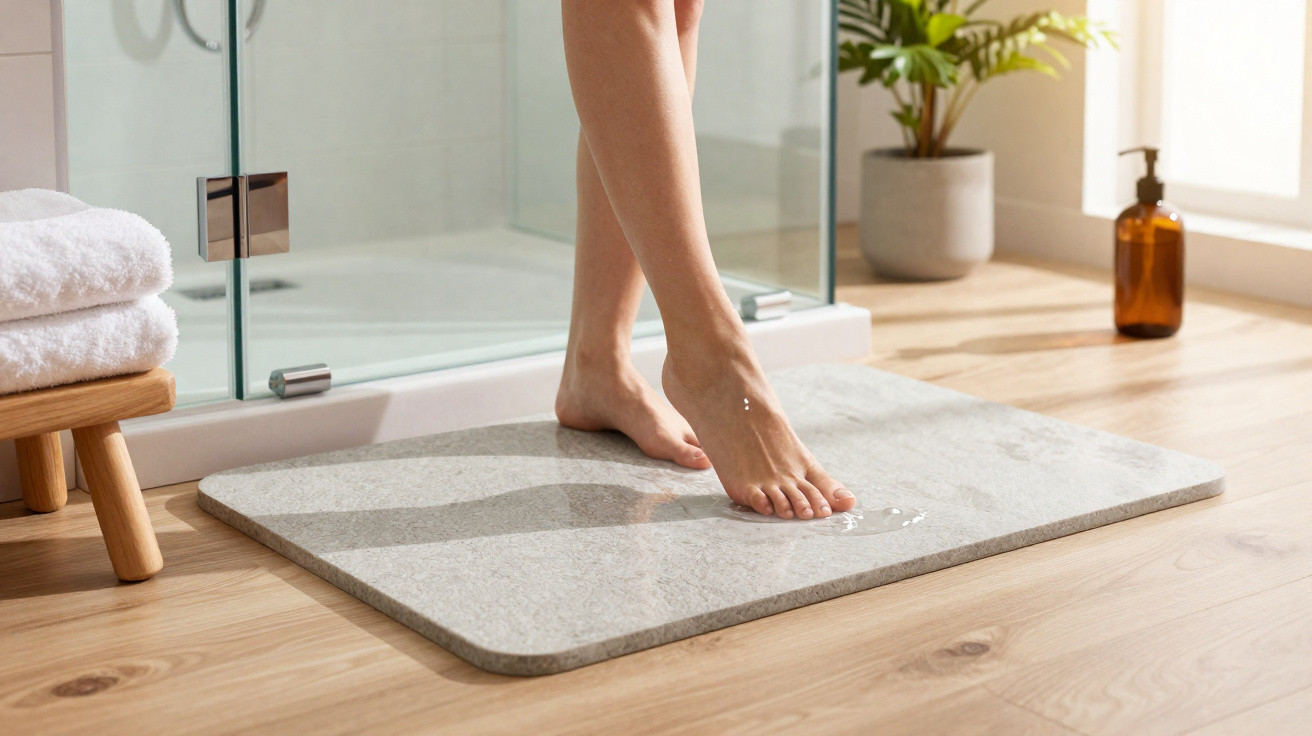
A simple bathroom accessory is now radically breaking this frustrating cycle.
More and more households are abandoning the traditional fabric bath mat in favour of placing a rigid slab outside the shower – made from stone rather than textiles. Although it may sound unusual at first, it is proving to be one of the most interesting small home trends: so-called stone bath mats made from diatomaceous earth, which absorb water within seconds and require almost no maintenance.
Why traditional bath mats become annoying in everyday life
The familiar cotton or microfibre bath mat feels cosy, but it has one fundamental flaw: it soaks up water like a sponge yet barely releases it again. After every shower, the mat remains damp, sometimes for hours.
This lingering moisture creates several problems that many people will recognise:
- The mat develops an unpleasant smell after only a few days.
- Moisture reaches the floor, which is particularly problematic with wood or laminate.
- Bacteria and mould have ideal conditions in which to thrive.
- Anyone stepping onto it barefoot in the morning ends up standing in a cold, wet puddle.
The mat therefore has to go into the washing machine regularly. That uses time, energy and detergent, while quickly wearing out the fibres. Before long, the mat looks threadbare, its edges curl up, and it ultimately ends up in the bin. At its core, this is a matter of physics: fabrics retain water rather than actively releasing it.
“Textile mats are structurally designed to hold water – not to get rid of it. This is exactly where the stone trend comes in.”
Anyone wanting to keep their bathroom permanently drier and more hygienic therefore needs a material that handles moisture very differently.
How a stone bath mat actually works
This new trend comes in the form of a flat, rigid panel, usually labelled a “stone bath mat” or a “diatomaceous earth mat”. The term refers to a particular natural material: diatomaceous earth combined with wood fibres and slaked lime.
The resulting material has a firm, slightly porous surface. Hidden inside is a network of tiny cavities that rapidly absorb water before releasing it again.
From wet to dry in one to two seconds
The everyday effect is striking. Step out of the shower and place wet feet on the stone panel, and the water marks disappear within one to two seconds. Nothing splashes around and no water remains sitting on the surface.
Water is drawn into the fine pores and spreads through the material. It then evaporates quickly into the room, especially where there is some air circulation. As a result, the surface stays virtually dry and feels ready for the next person again shortly after use.
The main benefits of this technology at a glance:
- Fast absorption: Water disappears in seconds rather than lingering in a mat for hours.
- Very rapid drying: the pore structure speeds up evaporation.
- Fewer germs: a dry surface gives micro-organisms very little room to survive.
- More secure footing: the mildly textured surface replaces a slippery puddle.
- Floor protection: the underside is designed not to scratch tiles or parquet.
“A surface that does not stay damp in the first place needs cleaning far less often – that is the essence of the hygiene benefit.”
For maintenance, a simple routine is enough in many cases: stand the mat upright against a wall once a week so that any remaining moisture can escape. If desired, wipe the surface from time to time with a slightly damp cloth. Washing machine, tumble dryer and fabric softener? None are needed.
Choosing the right stone bath mat for your bathroom
Stone bath mats are now available from numerous online retailers, large shopping platforms and higher-end homeware shops. Choices range from minimalist light-grey panels to darker versions with veining that resembles natural stone.
Size, thickness and price: what to consider
For a first purchase, a standard-sized model positioned outside the shower is often sufficient. Those with a freestanding bath or a wide vanity unit can also find larger formats that cover more floor area. A level, preferably hard surface is important: the rigid panel may wobble on uneven flooring.
The typical price range is around US$40 to US$180, depending on the brand, size and finish. Small, straightforward designs sit at the lower end, while larger or particularly design-led options cost noticeably more. Some manufacturers refine the surface with additional coatings intended to improve texture and durability.
As products differ widely, it is worth reading reviews from other buyers. They often raise questions that product descriptions tend to overlook:
- Does the mat dry quickly enough in bathrooms without windows?
- Does the surface feel hard and cool, or comfortable underfoot?
- Does the colour remain stable over time, particularly in very pale shades?
“A brief look through reviews often provides more practical knowledge than any sales brochure.”
Design: from bathroom rug to mini spa panel
Visually, a stone bath mat looks entirely different from a fluffy rug. It brings clean lines, muted colours and a calm surface to the bathroom. Many designs evoke spa areas or boutique hotels, fitting neatly into Scandinavian, minimalist or Japanese-inspired interiors.
Popular options include:
- matt, light-coloured panels with a concrete look for modern bathrooms;
- warm grey or beige tones for nature-inspired schemes;
- graphic grooves or subtle patterns as an eye-catching feature.
Anyone who previously used colourful, patterned rugs outside the shower will find that a stone alternative creates a greater sense of calm and order. In small city bathrooms especially, this can make the room appear more spacious.
Everyday practicality, risks and care tips
As practical as a stone bath mat can be, there are a few considerations to know before buying. It is considerably harder than a fabric rug, something sensitive feet will notice immediately. People with joint problems, or those who stand in one place for long periods, may still prefer a softer surface in front of the vanity unit.
There is another consideration: like any rigid object, a stone bath mat can break if it falls onto an edge or is subjected to heavy pressure in one small area. It is therefore best not to use it as a substitute for a stool or carry it when heavily loaded. In normal use on the floor, however, the risk is low.
A damp cloth is enough for cleaning, along with occasional use of very fine sandpaper if slight discolouration develops over time. Some manufacturers recommend lightly sanding the surface to reopen the pores. Harsh cleaning products are usually unnecessary.
Why switching to a stone bath mat appeals to many households
Anyone who showers every day will notice the difference within a few days: the bathroom smells more neutral, the tiles around the shower stay drier and the laundry pile becomes smaller. Families with children benefit in particular, as the area outside the shower no longer turns into a slip hazard.
There is also an environmental effect: fewer wash cycles reduce the use of water, electricity and detergent. Since stone bath mats can last for many years with proper care, there is also less waste from discarded textile bath mats.
“A small item changes routines, hygiene standards and even energy consumption – without major renovation work or tradespeople.”
Anyone already planning to refresh the look of their bathroom can use the stone bath mat as a starting point: towels in matching natural shades, a plain shower curtain and perhaps a wooden stool can often be enough to turn a purely functional space into a pleasantly calm comfort zone.
Terms such as diatomaceous earth may sound technical at first, but they simply describe extremely fine deposits of fossilised algae with a huge internal surface area. This very structure makes the material so absorbent and fast-drying. It has been used in industry for years as a filtering medium and additive – and it is now making its way into residential bathrooms.
Anyone tired of wet mats and musty odours may find that a stone bath mat is a surprisingly straightforward solution. It is not a high-tech gadget, but a well-considered piece of material science that makes daily bathroom life noticeably more pleasant.
Comments
No comments yet. Be the first to comment!
Leave a Comment