
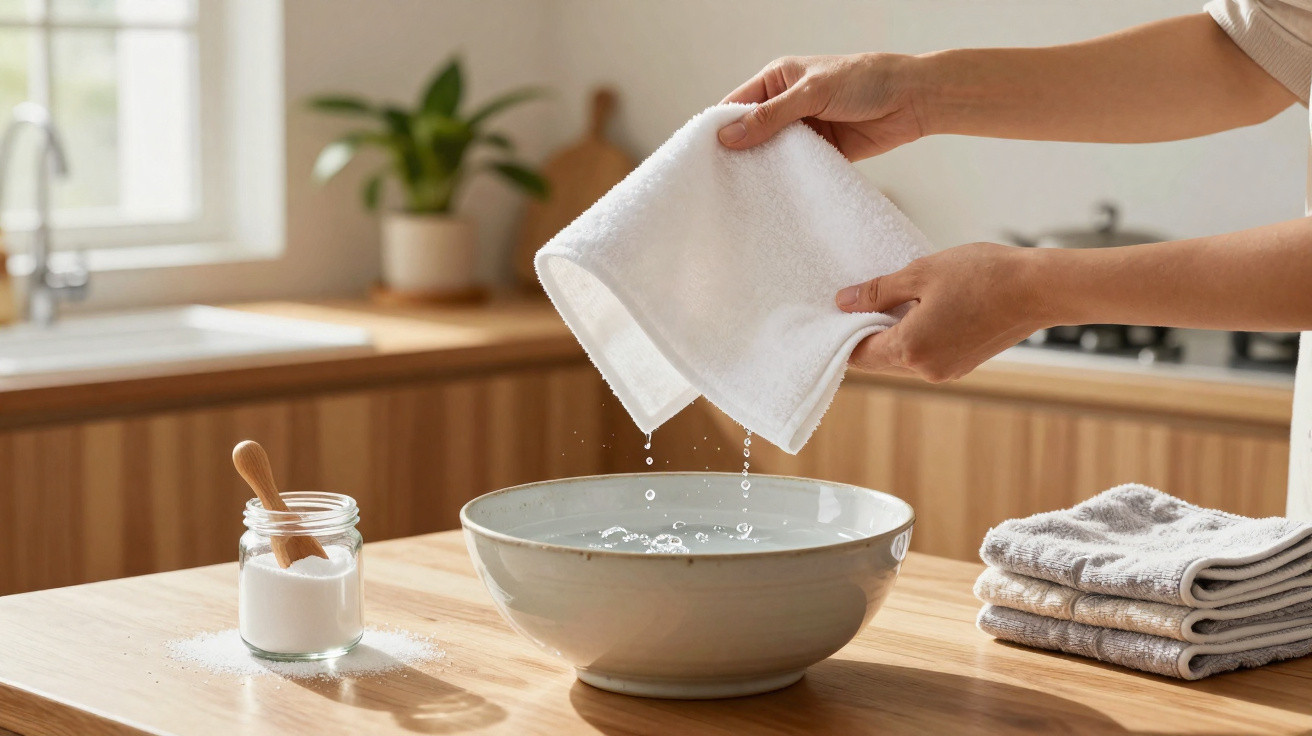
Anyone who cooks frequently will know the issue: tomato sauce, coffee, grease and tea leave marks on tea towels that ordinary detergents can barely shift. Many people then reach for harsh bleach, risking brittle fibres and yellowed fabrics. Yet an inconspicuous, often overlooked powder provides an alternative: it harnesses the power of active oxygen, is gentler on fibres and brightens greyed tea towels again.
The secret to brilliantly white tea towels again
At the heart of this method is sodium percarbonate, usually sold simply as “percarbonate” or “oxygen bleach”. It looks like ordinary white granules, but its chemistry differs greatly from traditional chlorine bleach. When dissolved in water, it breaks down into washing soda and hydrogen peroxide – essentially water, oxygen and a washing agent.
“The powder releases active oxygen directly into the wash solution – this lifts colour pigments, grease and odours from the fibres.”
This offers clear benefits, particularly for kitchen laundry:
- No yellowing: Unlike chlorine-containing bleach, percarbonate does not permanently attack cotton fibres.
- Less smell: Bacteria and odours in the towels are oxidised and substantially reduced.
- Lower chemical load: After the wash cycle, mainly water, oxygen and harmless salts remain.
The product is often confused with bicarbonate of soda or ordinary washing soda. Although these also have cleaning properties, they do not deliver the same bleaching power on stains such as red wine, coffee or tomato. Percarbonate’s particular strength lies in its controlled release of oxygen from a certain temperature onwards.
Why temperature determines success or failure
The most common mistake is adding the powder to a 30 °C wash programme and seeing virtually no result. Chemically, very little happens at that temperature. Percarbonate only starts to release a meaningful amount of oxygen at around 40 °C, and becomes truly effective at 60 °C.
“Anyone washing their towels on a lukewarm quick cycle is effectively ‘wasting’ the powder without any effect.”
This is how the cleaning process works:
- The powder dissolves in hot water and separates into washing soda and hydrogen peroxide.
- Active oxygen forms from the peroxide and penetrates the fabric.
- Organic residues, including grease, food colourings and bacteria, are oxidised and released.
As the reaction takes time, brief contact during a wash is often insufficient. Combining warm water, enough powder and soaking time produces far better results, especially with heavily soiled kitchen towels.
How to create the “miracle bath” for grey kitchen towels
For heavily stained or greyed tea towels, a proper oxygen soak before machine washing is recommended. It is less complicated than it sounds.
Step-by-step instructions for the soaking bath
| Step | What to do |
|---|---|
| 1 | Fill a large bowl or bucket with very hot water (at least 40 °C, preferably 60 °C). |
| 2 | Add 1–2 tablespoons of percarbonate per litre of water – use 2 for stubborn stains. |
| 3 | Stir thoroughly with a spoon or wooden stick until all the granules have dissolved. |
| 4 | Fully submerge the tea towels; they must be completely covered. |
| 5 | Leave them to soak for between 2 and 6 hours, or overnight for extreme staining. |
| 6 | Lightly wring out the towels, then wash them as normal in the machine. |
The oxygen reaction continues throughout the soaking period. During the following machine wash, the detergent rinses away the loosened dirt completely. Many people report that even old coffee or tomato stains almost disappear entirely.
Which fabrics are ideal for the method – and which are not
Percarbonate is not a cure-all, but it is an extremely effective specialist. It is particularly suitable for:
- white cotton tea towels
- cotton oven gloves
- linen napkins without delicate printed designs
- white bed linen and towels
Care is needed with delicate fibres. The combination of an alkaline solution and oxidising action can permanently damage certain materials.
Fabrics best avoided
Do not use percarbonate on the following textiles:
- Wool: Animal fibres may felt, break or become noticeably rougher.
- Silk: Its structure can be damaged, causing the fabric to lose its sheen and tear resistance.
- Delicate, poorly fixed dyes: Deeply coloured textiles may fade.
For coloured cotton kitchen towels, a small test can help: dip a cotton bud into a strongly diluted solution and test it on an inconspicuous corner. If the fabric releases colour or looks patchy, it is better not to use an oxygen soak.
Safe everyday use: points to remember
Although percarbonate appears considerably more environmentally friendly than many specialist cleaners, it still needs to be handled carefully. In concentrated form, the powder can irritate skin and eyes.
- It is best to wear rubber gloves when transferring or measuring out the powder.
- Avoid inhaling the dust, and close the container again afterwards.
- Keep the product dry and store it out of children’s reach.
There is another consideration: not every combination used in household cleaning is sensible. Strong acids, such as undiluted vinegar or citric acid, should not be placed in a sealed container with percarbonate at the same time. The gases produced can build up pressure and cause splashes.
“Anyone following a few basic rules can make a very effective, comparatively gentle household bleach from a simple powder.”
Why choosing oxygen bleach also makes environmental sense
Many modern heavy-duty detergents rely on optical brighteners. These coat the fibres like a thin film, creating the appearance of whiteness without actually removing the dirt. Some of these substances do not break down easily in the environment.
Percarbonate works differently: it breaks down dirt particles through oxidation, then degrades into substances that wastewater treatment plants can handle well. Used alongside a standard detergent, it can often reduce the amount of other bleaching components required. Those sensitive to fragrances can also switch to fragrance-free detergent combined with percarbonate.
Practical examples: where oxygen bleach also excels
The powder is useful beyond kitchen towels, too. Many households now use it for:
- white curtains: nicotine and dust film lift visibly.
- cotton sportswear: sweat odours disappear much faster.
- tablecloths after celebrations: red wine and sauce stains can be removed more effectively.
- cotton baby clothes: milk and carrot stains lose their yellow tinge.
The fibre is always the deciding factor: the sturdier and lighter the fabric, the more worthwhile it is to try. With delicate high-tech materials or wool, a delicate-wash detergent remains the better option.
How often kitchen towels should be treated this way
For everyday use, a standard 60 °C wash programme with the occasional addition of a small amount of percarbonate is sufficient in many households, roughly every few weeks. This helps prevent a grey film from building up in the first place.
If towels are already noticeably greyed, one or two intensive soaking baths are usually needed before their original white shade returns. Afterwards, moderate and regular use is enough to maintain the result.
Anyone who has seen old-looking tea towels appear almost new after such a treatment is less likely to adopt a throwaway approach. One simple powder extends the life of textiles – while also saving money and reducing waste.

Comments
No comments yet. Be the first to comment!
Leave a Comment