
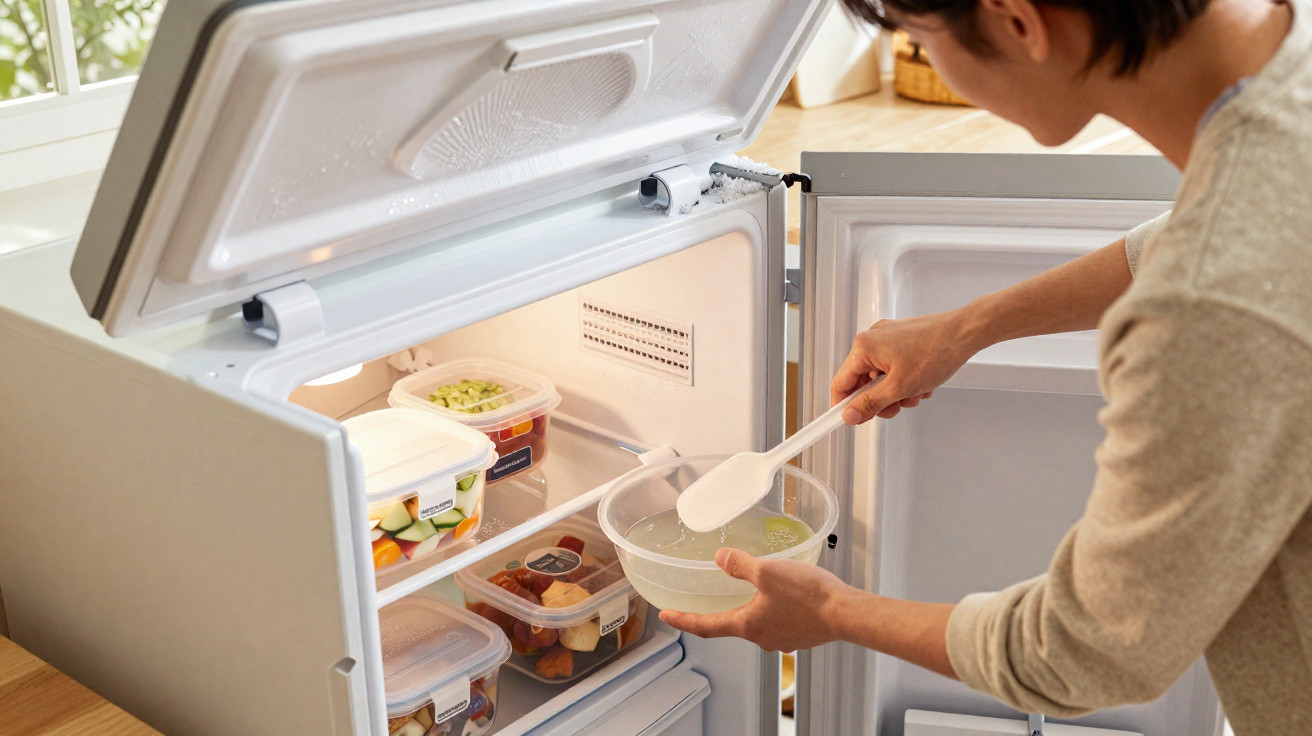
The overlooked part of a freezer shelf where frost accumulates most rapidly is not the centre.
The first time you properly inspect your freezer, rather than simply taking out the peas and shutting the door, it becomes obvious. A dense white coating has been quietly spreading in one particular corner. Ice returns there more quickly than you can remove it. It can seem almost alive as it grips the edge of a shelf you hardly ever use.
You wipe it away, scrape at it and mutter under your breath. Within a week, it has returned – thicker than before.
You may start wondering whether the freezer has developed a fault or whether you have caused the problem. Frost clings persistently beneath one particular shelf, precisely where the cold air pours out and meets the first obstruction. One tray or container always seems to end up trapped in frost as though it had been abandoned in the Arctic.
Eventually, you realise it is not happening by chance.
It is the hidden strip beside the rear wall and beneath the cold-air vent, where warmer air gets in and freezes layer upon layer. Once you have noticed it, it is impossible to ignore.
The hidden frost trap in your freezer
Open the freezer gently and notice where your gaze naturally lands. It is not the front, where the ice cream is stored. Instead, your attention goes to the misty, frosted section at the back of a shelf, often beneath a vent or along the rear edge. That narrow shelf area collects ice more quickly than any other part.
You generally only become aware of it when a drawer sticks or a bag of chips becomes fused to the metal.
Freezers do not chill every area equally. Cold air flows from the vents, strikes the first obstacle – perhaps a shelf edge, an awkwardly placed box or a raised rim – and then circulates around it. Each time the door opens, humid kitchen air enters and heads towards the coldest, most exposed surface.
As a result, that neglected shelf strip, usually directly below the airflow or pressed against the rear panel, becomes the front line where frost gathers like a snowdrift.
Think about the last time you tried to pull out a drawer and it jammed halfway, scraping against a raised line of ice. That ridge probably began in this same small corner. A bag of frozen vegetables may have been pushed against the vent, obstructing the airflow and making the cold air blast downwards. Moisture reached that spot, froze instantly and increased every time the door was opened.
There is no fuss and no warning light – only a gradual, silent accumulation until you have lost a few valuable centimetres of space.
A UK survey of kitchen habits found that, on average, people open their fridge-freezer doors more than 30 times a day. Those openings are not always lengthy, but every one allows a burst of damp air to hit that intensely cold area. Across a week, hundreds of tiny ice layers settle precisely where the temperature falls fastest.
You cannot see it from the front. It only becomes apparent when the drawer groans and will not close without a push.
There is straightforward science behind this persistent frost line. Freezers extract heat rather than producing cold. While they expel warmth and move chilled air around, the coldest air clings to the back and travels downwards. Moisture in the air condenses on the first cold surface it encounters – the underside of a shelf, a metal runner or a small ridge.
When food is packed tightly against that area, air cannot circulate. Rather than receiving an even chill, the space becomes a small cold trap in which water vapour freezes immediately.
Every door opening adds another microscopic layer of ice over time. The warmer the kitchen and the more frequently you check the freezer “just to see what’s in there”, the faster it will accumulate. The rest of the appliance may still appear perfectly fine, so there is little urgency to defrost it.
Meanwhile, that forgotten strip continues to thicken, raising containers, catching drawers and quietly taking away storage room.
How to deal with the frost-magnet shelf
The first step is almost too simple: remove everything stored near the rear wall and vents, then replace it while leaving a small gap. Create a narrow air channel between the shelf edge and any boxes or tubs, particularly below the cold-air outlet.
Even a gap the width of a finger can prevent that shelf edge from becoming an ice-making zone.
Then, when you next do a small defrost, clean this strip thoroughly. Avoid attacking it with a knife or spoon. Instead, use a bowl of warm – not boiling – water and a cloth, allowing the frost to soften before you wipe it away. Pay particular attention to the shelf underside and the rim that is usually overlooked.
That small ledge is where drips freeze again and leave the surface rough, allowing fresh frost to attach more readily.
You can also change what is stored in this high-risk area. Heavy, flat products such as pizza boxes or stacked lunch boxes are more suitable for the back than loose bags of peas. They form a smoother barrier that is less likely to trap pockets of humid air.
Keep opened bags and crumbly foods a little further forward where air can move around them, rather than hitting them like a solid wall.
For a practical approach, set yourself a discreet reminder every few months: “Check the frost strip.” Open the freezer, bend down and inspect the undersides of the shelves and the rear ridge properly. If you catch that first fine white coating, you have acted early enough.
A 10-minute wipe is much easier than spending an entire afternoon defrosting because a drawer has been frozen in place.
There is also the very human way in which freezers are used when we are tired or stressed. Shopping gets put away hurriedly, anything that fits is placed in the nearest available space, and that troublesome rear strip turns into a dumping ground. We all know that late-night “just shove it in somewhere” move.
Over several weeks, one additional bag or tub can edge closer to the vent, and frost will build more rapidly than expected.
On a cold Tuesday evening in a semi-detached house in Leeds, one homeowner told me that he finally dealt with his freezer only because the drawer containing his emergency oven chips would not move.
“I thought the whole thing was broken,” he laughed, “but it was just this thick sheet of ice right at the back of one shelf. I’d been cramming pizzas against the vent for months.”
That point, when an ordinary household task becomes a minor domestic confrontation, feels strangely familiar to many people.
Let us be honest: nobody carefully reorganises their freezer every week as though it were an appliance showroom. Life intervenes, children slam doors, and housemates stand with the door open while deciding what to have for dinner. This is why small, realistic routines are more helpful than ambitious resolutions.
- Move bulky boxes a few centimetres forwards from the rear vent.
- Inspect the underside of at least one shelf whenever you take out ice cream.
- Store an inexpensive plastic scraper in the freezer door for quick touch-ups.
- Occasionally defrost “one shelf” rather than turning it into a whole-appliance ordeal.
Living with freezer frost on your own terms
There is something unexpectedly revealing about that neglected strip of frost. It reflects how we live: rushing home from work, leaving grocery bags on the floor, holding the freezer door open with one foot while rearranging a tower of mysterious leftovers.
Frost is the physical evidence of all those small, unplanned moments.
Once you understand where ice gathers most quickly, you begin to view your freezer differently. That inconvenient rear corner is not a fault but a recurring pattern. You start leaving small gaps, wiping that shelf when you already have a cloth in hand, and moving a bag of vegetables away from the vent rather than forcing it in.
They are hardly major habits. They are more like gentle adjustments.
On a damp UK evening, when the kitchen window has steamed up and the kettle is whistling, you may pull open the freezer and look straight at that shelf. Perhaps the frost will be thinner this time. Perhaps the drawer will slide smoothly instead of crunching.
You may even point it out to somebody else, tapping that narrow section and saying, “That’s where it always starts, right there.”
| Key point | Detail | Why it matters to the reader |
|---|---|---|
| Frost hotspot | Shelf area at the back, beneath or close to the cold-air vent | Helps you identify and prevent ice in the place where it forms fastest |
| Air-gap trick | Leave a small space between food and the rear wall or vent | Reduces rapid frost accumulation and allows drawers to move freely |
| Micro-maintenance | Quickly wipe and scrape this strip every few months | Prevents lengthy full defrosts and lost freezer space |
FAQ:
- Where exactly is the “forgotten” frost zone in most freezers? It is usually the shelf strip directly against the rear wall, particularly beneath or immediately in front of the cold-air vent or fan outlet.
- Why does frost grow faster there than on the door or front shelves? This is where the coldest air arrives first, and where humid kitchen air condenses and freezes in successive layers.
- Can this frost hotspot damage my freezer? Usually not by itself, but heavy ice can put strain on drawers, distort plastic components and make the motor work harder over time.
- How often should I clean that shelf area? For most busy households, a quick monthly inspection and a light wipe every couple of months is sufficient.
- Do frost-free freezers have this problem too? To a lesser extent, yes. Even frost-free models can develop thin films of ice in cold spots when vents are blocked or the door is opened very often.






Comments
No comments yet. Be the first to comment!
Leave a Comment