
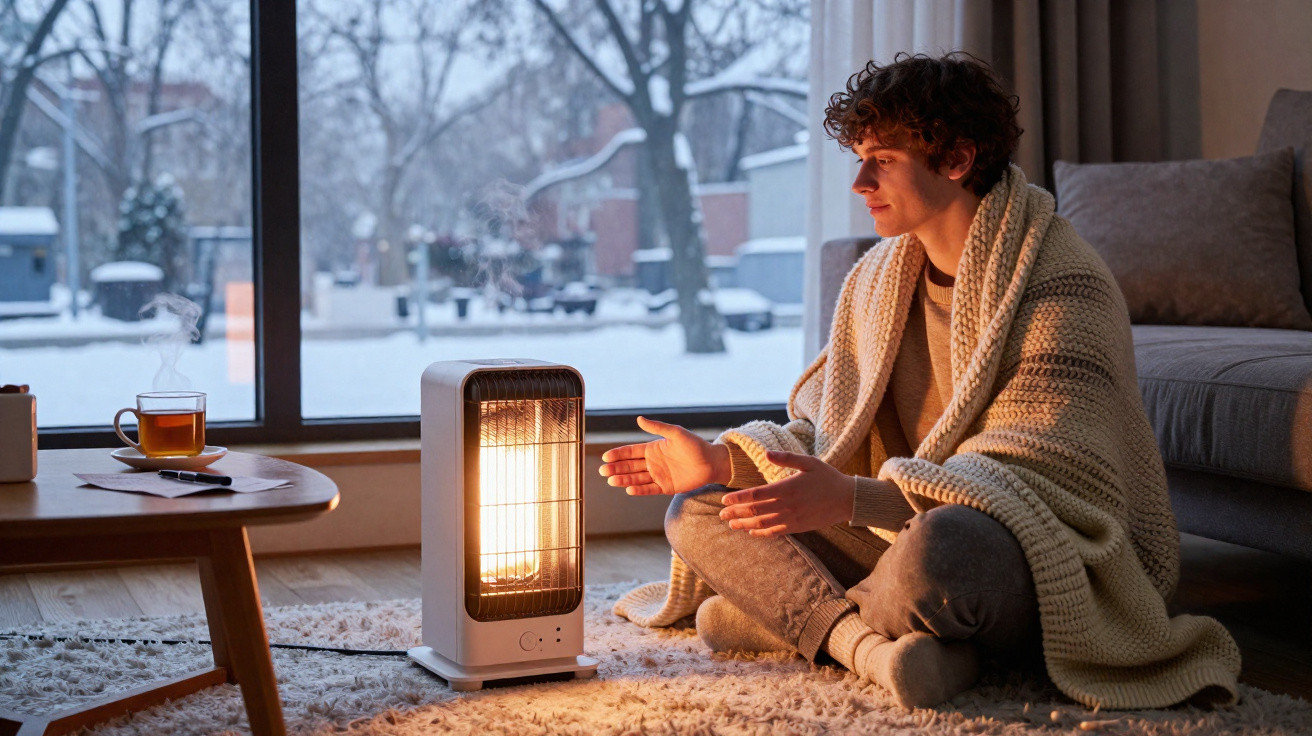
The first proper cold spell always seems to arrive on a Tuesday evening.
You know the feeling: you are on the sofa, only half following a series, when a draught suddenly starts slipping beneath the door. You tug your jumper closer, pull a blanket over yourself, yet your toes still feel like little blocks of ice. The thermostat is already set higher than you want it to be when the next energy bill arrives, but the room is taking far too long to feel warm.
So, like everyone else, you reach for your phone and search for “how to stay warm cheaply this winter”.
That is when growing numbers of people come across the same modest answer they had not realised they needed: a heater that can move around with them.
This tiny heater changes how you heat your home
On paper, a portable heater does not sound especially exciting.
But plug one in beside your desk for the first time and feel that immediate warmth against your legs, and it can feel like a small improvement to everyday life. Your central heating maintains the ‘official’ temperature, while the portable heater looks after your true comfort zone: the two square metres where you actually work and spend time.
There is no need to turn the whole house up to 22°C simply to stop your fingers going numb while typing. Heat the place where you are, rather than an unused hallway.
Imagine this.
It is 7:12 a.m., it is still dark outdoors, and your alarm has already sounded twice. The idea of putting your feet on freezing bathroom tiles is enough to make you press snooze once more.
Now picture the same morning, except you put a compact ceramic heater in the corner the night before. From bed, you press a button on a smart plug. When you eventually make your way to the bathroom, the air is already warm and soft, with an almost hotel-like feel. Instead of rushing in and straight back out, you can take your time because you are no longer standing there shivering in a towel.
That small change can make frantic winter mornings feel almost… gentle.
There is straightforward reasoning behind this extra comfort. Large central heating systems warm up volumes of air that you hardly use. A portable heater flips that approach, directing heat towards your body, your feet and the space immediately around you. After all, that is where you truly feel the cold.
Energy specialists describe this as “zone heating”: rather than heating the entire home, you create warm areas in the rooms you are using. The result is often the same comfort with fewer kilowatt-hours burned.
Naturally, not all heaters are alike. Modern options with ceramic elements, automatic safety shut-off and adjustable thermostats are the models that tend to deserve a permanent place beside your favourite chair.
How to choose and use a portable heater without losing your mind (or your money)
Begin with the simplest question: where do you feel cold most often?
At your desk, on the sofa, in the bedroom or in the bathroom? The answer will determine which portable heater is right for you. In a home office, a small ceramic fan heater can work brilliantly beneath the desk. For a bedroom, a quieter oil-filled radiator or low-noise ceramic model with a timer can feel like an everyday luxury.
Match the wattage to the room. A unit of around 1,000–1,500 W is generally sufficient for a small or medium-sized room when you are nearby.
The aim is not to heat the entire floor. You only need a warm pocket of air while you read, work or drift off to sleep.
The usual error is treating a portable heater as though it were a miniature central heating system for the whole house. Leave it running at full power in a corner, then the bill becomes a source of frustration. Instead, position it close by, direct the heat towards your body and use it for short, focused periods.
Another mistake is choosing the first cheap model available without checking for an automatic shut-off or thermostat. That is how people end up either overheating or feeling concerned about safety. A good portable heater should turn itself off if it is knocked over, while allowing you to choose a mild, comfortable level of warmth rather than only ‘arctic’ or ‘desert’ settings.
We have all had that moment of realising we have been spending money heating a room where we barely ever sit.
Sometimes comfort isn’t about adding more heat, it’s about putting warmth exactly where your day actually happens.
- Look for a built-in thermostat
This allows the heater to cycle on and off rather than operating continuously. - Prioritise safety features
Tip-over protection and overheat shut-off are essential. - Consider noise levels
Low dB levels matter more than you may expect in bedrooms and during calls. - Use smart plugs or timers
They help you avoid leaving it running ‘just in case’. - Combine it with simple habits
Warm socks, a throw and closed doors all increase its effect.
A small object that quietly changes your winter mood
Once a portable heater becomes part of your routine, winter can feel noticeably different.
You no longer dread sitting at your desk in the morning because you know warm air will reach your feet within 30 seconds. You do not put off reading in the living room because “it’s too cold in there.” Instead, you take the heater with you and create a cosy pocket of warmth within minutes.
Let us be realistic: nobody measures every watt or works out thermal heat loss day after day. What stays with us is whether we felt cold and tense, or warm and relaxed. A small, carefully chosen heater quietly shifts that balance in your favour.
Some people eventually purchase a second one for another room. It is not really a gadget to them, but a recognition that this compact box is less about technology than reclaiming comfort during the months of limited daylight and long evenings.
This winter, the difference between merely putting up with the cold and genuinely enjoying your home may fit in one hand.
| Key point | Detail | Value for the reader |
|---|---|---|
| Targeted “zone” heating | Heat concentrated in the area where you sit, work or sleep | Greater comfort without increasing the temperature throughout the home |
| The right features matter | Thermostat, safety shut-off, low noise and appropriate wattage | Safer, quieter operation and less risk of soaring bills |
| Flexible daily use | Simple to carry from desk to sofa to bedroom in seconds | One device that fits around your routine and reduces cold ‘dead zones’ |
FAQ:
Question 1: Is a portable heater really cheaper than turning up my central heating?
Often, yes, provided you use it to heat only the room you occupy and leave your main thermostat a little lower. You are paying for comfort precisely where you are, rather than warming empty rooms.Question 2: What size portable heater do I need for a bedroom or office?
For a small to medium-sized room, 1,000–1,500 W will usually be enough if the heater is close to you. Check the manufacturer’s recommended room size, and remember that you are heating a ‘zone’, not an entire house.Question 3: Are ceramic heaters safer than older fan heaters?
Ceramic models generally warm up and cool down more quickly, and many include stronger safety features. Regardless of the type, always choose one with overheat protection and tip-over shut-off.Question 4: Can I sleep with a portable heater on at night?
You can, but select a quiet model with a thermostat and safety shut-off, keep it away from bedding and curtains, and follow the manufacturer’s instructions. Some people would rather warm the room first, then turn the heater off.Question 5: Will a portable heater work in a very cold, poorly insulated room?
It will make you more comfortable, particularly when positioned near your body, but it is not magic. Combine it with straightforward measures such as draught excluders, thicker curtains and closed doors for meaningful results.

Comments
No comments yet. Be the first to comment!
Leave a Comment