
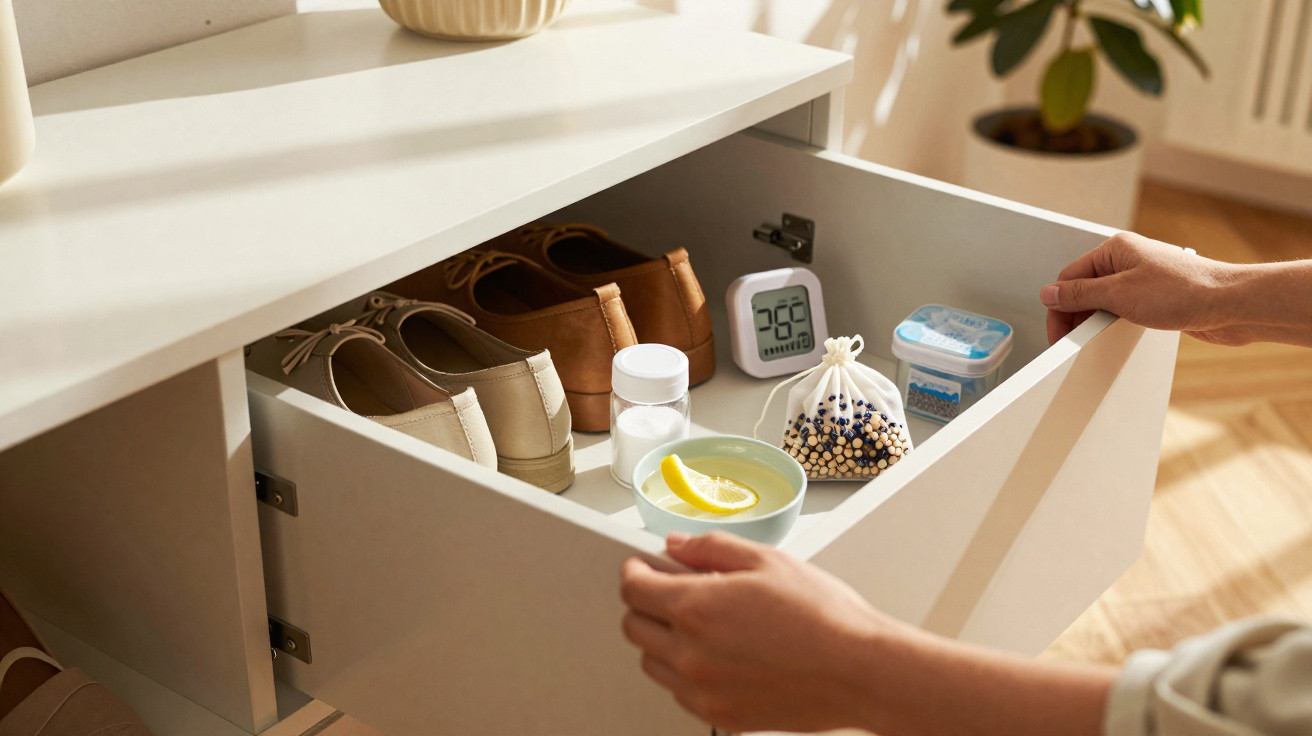
The scene is often familiar: you open the door of the shoe cabinet before rushing off to work, pull out your favourite pair of trainers and, before you have even put them on, the smell of mould rises like an invisible cloud.
It is not merely unpleasant; it is a quiet reminder of overlooked damp, rainy days and shoes put away “just for today” while still wet. The closed shoe cabinet, which ought to keep the home tidy, becomes a small chamber of stale odours. You quickly shut the door, almost as though pretending nothing happened. Yet the truth is that it will return tomorrow. And the day after. Until someone does something beyond using a scented spray. Mould is not intimidated by a pleasant fragrance. It wants space. And in this silent battle inside your home, one detail is almost always missed.
Why closed shoe cabinets become mould-smell factories
Anyone living in a damp town or a small flat will know that a closed shoe cabinet seems like the ideal solution. The clutter disappears from view, dust is kept away and everything sits neatly behind a door. Behind the wood, however, a different story unfolds. Shoes retain sweat, rainwater, splashes from the pavement and traces of wet grass. These all stay trapped in fabric, insoles and leather. Then there is the still, dark air with no circulation: precisely the combination mould loves. You may not immediately see whitish or greenish spots, but your nose notices first.
In many Brazilian homes, the shoe cabinet is placed against an external wall or tucked into a corner with no window. That is the classic recipe for damp. You get home from work after rain, take your shoes off in a hurry and put them straight inside. “I’ll dry them properly later,” you think. That “later” rarely comes. A survey by the Brazilian Association of Cleaning Companies shows that the perception of a “clean-smelling home” is much more closely linked to fragrance than to the absence of fungi. In other words, many people respond only when the odour becomes bothersome rather than when the problem begins. By then, a favourite pair may have developed stains that will not come out.
Mould in closed shoe cabinets is not merely an issue of an unpleasant smell. Fungi tend to spread, and the route is easy: from shoes to the wood, from the wood to the wall, and from the wall to the wardrobe. In poorly ventilated homes, that cycle repeats month after month. In practical terms, the smell is an alarm that colonies are multiplying, even when they cannot be seen. Let us be honest: nobody opens the shoe cabinet every day to take everything out, air it and clean each shelf. Yet the way to remove the odour depends on recognising this hidden routine of damp. Above all, it means interrupting that routine with small, practical actions.
The three-layer method: tackling odour, mould and damp
The most effective method for eliminating mould smell from closed shoe cabinets works as a layered treatment. First, make room for the process: open everything, take out every pair and empty the unit completely. For anyone who has not done this in months, the sight can be almost startling. There may be shoes you had forgotten existed, yellowed boxes and abandoned socks. The first step is then to clean the inside of the shoe cabinet with a damp cloth and a solution of water and white vinegar, wiping shelves, corners and doors. The aim is not to soak it, but to disrupt the environment in which fungi thrive.
Many people try to skip stages: they spray an air freshener and hope for a miracle. The issue is that fragrance only conceals the symptom for a few days and can sometimes make matters worse by combining smells. A method that works deals with the causes. Once cleaning is complete, the second stage is to dry the shoe cabinet thoroughly. Leave the doors open for several hours, ideally with a fan directed towards it. The wood needs to “breathe”. In damper ground-floor homes, placing a small container of diluted bleach gel inside for a short time can also help to disinfect without staining, but it must always be removed before the shoes go back in. It is almost like resetting that piece of furniture’s microclimate.
The third layer is the invisible maintenance that makes the real difference. Place containers of bicarbonate of soda or small bags of activated charcoal at the bottom of the shoe cabinet, on at least two shelves. They act as magnets for damp and odours. They are not “magic” home remedies; they rely on genuine physical and chemical reactions. A recently worn shoe needs 24 hours outside the shoe cabinet for internal perspiration to dry. This is particularly important for running trainers, closed boots and ballet flats. Anyone who gets into the habit of creating a “quick parking spot” beside the door, with a mat or small shoe rack where footwear can dry, greatly reduces the chance of mould smell returning inside.
How to keep a shoe cabinet dry without making it a daily job
One simple action can change everything: before putting shoes into a closed shoe cabinet, take 10 seconds to inspect them. Run your hand inside and check whether the fabric or insole still feels cool and damp. If it does, the shoes should not go into the shoe cabinet that day. They should stay in “waiting mode” somewhere airy. Another precise tactic is to alternate the pairs you wear. Shoes worn today should rest tomorrow. Those with shoe cabinets fitted with sliding or flap doors can also add small vents or discreet holes on the internal sides, helping air to circulate without spoiling the tidy appearance.
This is not about becoming enslaved to cleaning; it is about creating intelligent shortcuts. For example, removable shelf liners make maintenance cleaning a matter of minutes: remove the liner, wash it, dry it and put it back. Small silica-gel sachets, such as those found in electronics and handbag boxes, can be reused in corners of the shoe cabinet. There is also one common mistake: storing shoes in sealed plastic boxes with no holes or vents, inside the shoe cabinet itself. The intention is to protect them, but it turns every box into a miniature aquarium of damp. At that point, no deodoriser will cope, however expensive it may be.
A specialist in preserving damp environments whom we consulted summed it up this way: “A mould smell is always a conversation between still air and accumulated water. Where one of them is absent, mould loses strength.”
- Use bicarbonate of soda in open containers on the lower shelves, replacing it every 2 months.
- Set aside one day each month to open the shoe cabinet fully, remove everything and leave the doors wide open for at least 1 hour.
- Dry shoes outdoors, but away from strong direct sunlight, which can crack leather and soles.
- Avoid putting away fabric footwear that is still warm after the gym or a walk; always let it cool and air out first.
- Keep a dedicated cloth for the shoe cabinet, lightly scented with vinegar or alcohol, to wipe critical spots whenever you notice any sign of mould.
When the whole home breathes better, the shoe cabinet follows
Removing mould smell from a closed shoe cabinet is often the first step towards paying closer attention to damp throughout the home. That furniture does not exist in an isolated bubble. If the bedroom has little ventilation, the wall behind the shoe cabinet feels cold or the floor collects water on rainy days, the whole environment contributes to the odour. Many people only realise this when they notice the same smell in the wardrobe, stored handbags or old documents. The shoe cabinet ends up serving as a small laboratory for what is quietly happening in other rooms.
People who find a practical method that fits real life and does not require expensive products often share it with friends, neighbours and family groups. It is not about domestic pride, but genuine relief. A unit that no longer smells becomes a kind of private victory, almost invisible to visitors but very real to those who live there. It is curious how a simple shoe cabinet reveals habits we carry without noticing: putting everything away in a hurry, ignoring what is out of sight and assuming, “I’ll deal with it later.” Perhaps that is why so many people are surprised by the result when they finally tackle the root of the issue instead of simply spraying another fragrance.
Perhaps your shoe cabinet is giving off that familiar smell right now: partly sweet, partly sour and difficult to describe. Or perhaps you have managed to control the mould but remain on alert whenever a cold spell arrives. In either situation, it helps to think of the shoe cabinet as a small ecosystem. Air, water, materials and routine. The method for eliminating the odour involves carefully adjusting each of those elements. And when it works, opening the door and smelling… nothing, no strange odour at all, can feel almost liberating.
| Key point | Detail | Benefit to the reader |
|---|---|---|
| Layered cleaning | Empty the shoe cabinet, clean with water and vinegar, then dry it with the doors open | Breaks the mould cycle and prepares the unit to hold shoes without reactivating the odour |
| Damp control | Use bicarbonate of soda, activated charcoal, silica gel and structural vents | Reduces internal damp without major spending or renovation work |
| A manageable routine | A “parking spot” for damp shoes and a fixed monthly day to air everything | Turns care into a light habit that fits a busy daily routine |
FAQ:
Question 1 Does vinegar really remove mould smell from a shoe cabinet, or does it only disguise it? White vinegar helps to neutralise odours and creates an environment that is less favourable to fungi. It does not “kill” all mould on its own, but when combined with mechanical cleaning (scrubbing and drying thoroughly) and ventilation, it substantially reduces the smell and the likelihood of it returning.
Question 2 Can I use a scented essence or strong air freshener inside the shoe cabinet? You can, but only after treating the mould and damp. Air freshener in a shoe cabinet that is still damp generally only combines odours and conceals the issue. Ideally, use fragrance in removable fabric sachets rather than applying it directly to the wood.
Question 3 How long does it take for mould smell to disappear after a thorough clean? Generally, it takes 24 to 72 hours, depending on the level of damp and ventilation. If the smell remains strong after three days with the doors open and moisture absorbers in use, repeat the cleaning and check for mould on nearby walls.
Question 4 Do clear plastic boxes help prevent mould smell in shoes? Only if they have ventilation holes and the shoes are stored when genuinely dry. Fully sealed boxes with no vents usually make the situation worse inside the shoe cabinet by concentrating damp and odour.
Question 5 Is it safe to use chlorine-based products inside the shoe cabinet? Chlorine-based products can help with disinfection, but they should be diluted, applied with a well-wrung cloth and never used excessively. Too much moisture with chlorine can stain wood and metal, and may even affect rubber soles if the product drips onto the shelves.


Comments
No comments yet. Be the first to comment!
Leave a Comment