
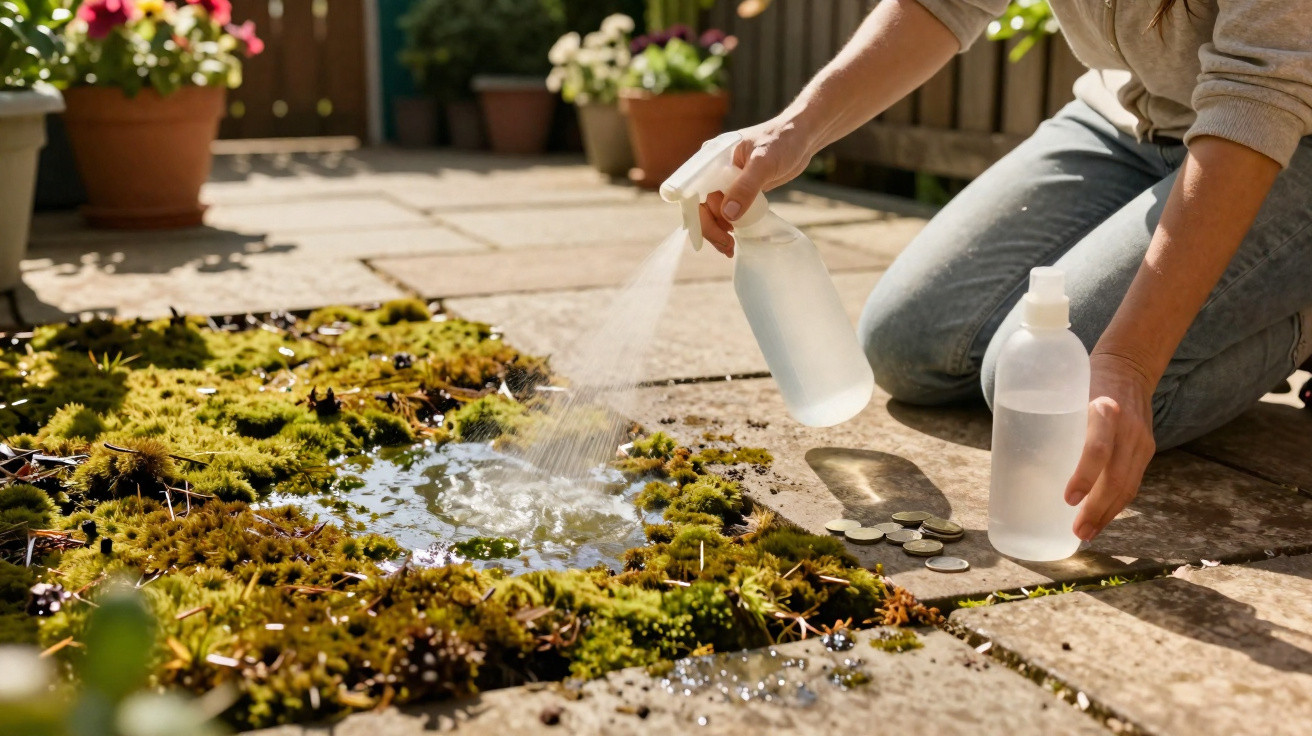
One slippery, green-covered patio, a very limited budget, and one product tucked away at the back of a kitchen cupboard.
When warmer weather arrived, an outdoor area that had once been welcoming resembled a moss-covered skating rink. Shop-bought solutions looked either expensive or unnecessarily complicated. Then one inexpensive bottle, normally used in salad dressing rather than DIY, transformed the cleaning approach.
From garden-centre prices to a 35-cent solution
Following a damp winter, patios across the UK and US can end up similarly slippery, covered in moss, algae and dark marks that make footwear slide and garden furniture unsteady. Garden centres offer rows of anti-moss jerrycans promising “instant results”, although their prices can be off-putting.
Hiring or purchasing a pressure washer is hardly a minor choice either. There is the expense, storage space, noise and the risk of harming grout or more delicate paving.
Between expensive biocides and noisy kit, a 35-cent bottle of white vinegar turned out to be the quiet third option.
The affordable alternative is an ordinary household item: plain white vinegar. In a UK supermarket, a basic bottle costs about 30 pence, or approximately €0.35. Although it is more commonly purchased to descale kettles or wash windows than to deal with a slimy patio, correct use can remove moss and algae in under an hour without specialist equipment.
The British journalist’s white vinegar patio method
The technique currently circulating on social media came from a practical article by British home and garden journalist Sophie Harris. She called white vinegar a “household essential” and set out a straightforward process for restoring a weather-worn patio.
The straightforward 1:1 vinegar mixture
Her method follows several simple steps:
- Clean while dry first: Using a stiff-bristled brush, sweep the patio well to clear away leaves, earth and loose moss.
- Prepare the mixture: Combine equal amounts of white vinegar and water in a bucket. Use cool or lukewarm water rather than hot water.
- Cover the paving: Pour or tip the solution directly across the paved surface, applying extra to the darkest and greenest areas.
- Leave it for roughly one hour: Allow around 60 minutes for the mixture to work on algae and moss roots.
- Brush gently: Go over the patio again with the stiff brush to lift remaining residue and stains.
Often, the change in colour becomes visible as brushing begins, as a cleaner and lighter surface appears beneath the green coating. The writer who tested Harris’s method used about half a bottle of vinegar on a standard-sized concrete patio and found that almost no forceful scrubbing was necessary.
A half-bottle of vinegar, an hour of contact time and 10 minutes of brushing were enough to bring the slabs back to life.
Why white vinegar removes moss and algae
White vinegar is a mild acetic acid. Cleaning varieties are usually around 8–10%, while standard cooking bottles contain roughly 5%. On exterior surfaces, this acidity can help loosen the slippery layer formed by moss and algae.
It does not work in the same way as bleach, nor does it immediately “burn” away green growth. Instead, the acid places stress on plant cells, making the growth easier to lift from the surface when brushing. It may also disrupt the small roots lodged in joints and pores, which explains why it can weaken weeds growing between paving slabs.
For people seeking to reduce their use of stronger synthetic chemicals, that is a key attraction. The odour is pungent but dissipates quickly outside, while the treatment leaves no foam or coloured residue.
Suitable patio surfaces and surfaces to avoid
Surfaces that can suit a vinegar wash
Vinegar is more appropriate for certain materials than others. Check the surface beneath your feet before soaking the entire patio.
| Surface type | Vinegar suitability | Notes |
|---|---|---|
| Concrete slabs | Generally suitable | Leave for 30–60 minutes; rinse if any residue is left. |
| Ceramic or porcelain tiles (outdoor-rated) | Usually suitable | Test an inconspicuous corner first; grout can become slightly lighter. |
| Clay pavers / bricks | Use with care | It may emphasise the colour; try it on a concealed edge first. |
| Natural stone (limestone, marble, some granites) | Not recommended | Acid may etch, dull or roughen the material. |
| Composite decking | Check manufacturer advice | Some manufacturers permit mild acids, whereas others advise against them. |
Professionals generally recommend avoiding acidic cleaners altogether on sensitive stone, including marble, limestone and certain polished granites. Etching can be permanent and expensive to repair. Specialist stone-cleaning products or low-pressure washing may be the safer choice in these instances.
Basic garden safety measures
Although vinegar may seem mild, it is sensible to take a few precautions:
- Wear simple gloves if your skin is sensitive, because repeated exposure to acid can dry it out.
- Do not let the mixture reach ornamental plants or newly laid lawn edges, as repeated splashes can inhibit growth.
- Avoid applying it in strong, hot sunshine, when the solution may evaporate before it has time to act on the moss.
- Keep pets away from the wet area until it is dry and has been lightly rinsed, particularly dogs that tend to lick puddles on the ground.
How it compares with commercial anti-moss treatments
Homeowners with very large patios, deeply shaded areas or slabs that have been neglected for years may still choose commercial anti-moss treatments supplied in 5-litre jerrycans. These may cost around €3.99 for 5 litres, equivalent to approximately €0.80 per litre, and can treat up to 50 square metres.
Such products use biocides, chemicals intended to kill living organisms including algae and lichens. They may work quickly and are frequently designed to limit regrowth for several months. However, their directions are stringent: chemical-resistant gloves and eye protection are required, children and pets must remain away until the surface is dry, and application should take place on a dry, still day.
The real trade-off is not only cost, but also how comfortable you feel spreading biocides where pets, children and rainwater circulate.
Vinegar lies at the opposite end of the range. It costs less, has a weaker effect and may need to be reapplied to heavily soiled paving, but it avoids the more aggressive compounds included in certain dedicated outdoor cleaners. Some people use both approaches, arranging a professional deep treatment every few years and using vinegar refreshes in the intervening period.
Common questions about the one-hour vinegar clean
Is it necessary to rinse the patio afterwards?
A gentle rinse from a watering can or hose normally removes loosened debris and any remaining vinegar odour. In most climates, subsequent rainfall will complete the process. Brief exposure to diluted vinegar is unlikely to damage concrete.
Will it prevent moss from returning?
No treatment can remove moss forever where conditions favour it, namely shade, dampness and porous materials. Vinegar clears visible growth and weakens it, but spores may remain. Frequent sweeping, improved drainage and cutting back nearby plants can all lessen the likelihood of a quick return.
Can vinegar be combined with bleach or other cleaning products?
No. Never mix vinegar with bleach or any chlorine-containing product, because the reaction can release toxic chlorine gas. If another chemical has already been applied to the patio, allow time, rain and thorough rinsing before using a different treatment.
Other uses for white vinegar and its limitations
This uncomplicated method can alter perceptions of the inexpensive bottle stored in the cupboard. The same white vinegar may descale kettles, clean shower screens and remove soap scum from tiles. Outdoors, it can also weaken small weeds between slabs, making them easier to pull out.
However, it has limitations. Vinegar is not a miracle treatment for black mould on walls, ingrained oil marks on driveways or structural efflorescence in brickwork. Specialist products or professional assessment are still the safer option for those problems.
It can be useful to regard it as a low-risk first attempt. If one hour and a 35-cent bottle significantly improve the patio, there is no need to buy, store and handle large quantities of harsher chemicals or transport a pressure washer home. If the outcome is disappointing, the surface will at least have been thoroughly cleaned before a stronger treatment is tried.
For households aiming to keep maintenance spending manageable, this trial has clear value. The basic comparison explains its appeal: half a bottle of vinegar for one patio clean compared with an entire 5-litre chemical container for similar coverage. Used for spring and autumn refreshes, the savings can accumulate, particularly at homes with several paved spaces.


Comments
No comments yet. Be the first to comment!
Leave a Comment