
The first properly chilly autumn evening brings a recognisable soundtrack to homes across Britain. The heating clicks and groans back into service after months off, the heavier duvet comes down from the airing cupboard, and you notice unexplained indentations in the mattress where you normally settle. You get into bed, wriggle into place, then gently slide into that familiar hollow. It feels reassuring at first - right up until you wake with a tight neck and an irritable lower back.
We can spend far too long debating tog ratings or whether the thermostat belongs at 19 or 21 degrees, while giving scarcely any thought to the surface supporting us all night. For many of us, turning the mattress happens only during a house move or after a cup of tea has been spilled on it, followed by an undeserved feeling of DIY accomplishment. Yet sleep specialists warn that this neglected routine can catch up with us once temperatures fall. The surprising question is why the colder season has such an effect.
Cold weather alters how your mattress performs
A mattress is far less fixed than it appears. Its foam, springs and filling compress, expand and move in response to your body weight, as well as changing temperatures and humidity levels. Cooler, drier air can make the materials in many mattresses marginally firmer and less supple, with memory foam particularly affected. You may not immediately notice the change, but your spine can.
That pleasant dip on the left-hand edge where you sleep every night? During summer, foam and pocket springs generally have a better chance to recover between nights. When the room cools overnight and barely warms during the day, their ability to spring back is reduced. Across weeks of long evenings and extended nights beneath a weighty duvet, a modest depression can become a proper groove. Eventually, that groove begins to dictate your shape rather than the other way round.
Some sleep researchers put it simply: cold weather “locks in” your sleeping habits. The position you naturally adopt in November is repeated night after night until late March. If you sleep slightly twisted or consistently close to one edge, the mattress gradually moulds itself to that imbalance. Regularly rotating it during winter works rather like pressing reset before the wear becomes too established.
Why winter keeps us on the same side of the bed
In principle, we know we should “use the whole mattress”. In practice, couples often sleep like determined bookends, holding fast to their allotted patches, while people sleeping alone still choose a preferred corner and guard it as though it is permanent territory. Once the weather is colder, we tend to shift around even less overnight. We try to trap heat under the duvet, our muscles tighten a little in the chill, and nighttime movement becomes less appealing.
The evidence is there in the sheets each morning: one repeatedly rumpled area and the untouched side of the bed, still cool beneath your hand. On winter nights, we draw ourselves in, hide our feet below the duvet and seldom migrate towards the middle, even when we insist we would like more room. As a result, the same mattress section supports your weight for eight, sometimes nine hours at a stretch, every night for months. It is hardly surprising that “your” side has sagged more by February.
Most of us have rolled over in winter and detected a gentle slope or raised line, like a small hill separating us from the cold side of the bed. That is the mattress revealing your habitual sleeping spot. By rotating it, you distribute the pressure and allow another area to support you for a time, rather than letting your winter routine cut into the filling like water wearing through stone.
The mattress-related back pain we rarely suspect
By the end of November, a familiar national remark tends to surface: “My back’s been a bit funny lately.” The cold gets blamed, along with commuting, an uncomfortable office chair or failing to stretch after the gym. Mattresses are rarely considered, despite the fact that the colder months often mean we spend longer in bed than at almost any other time of year. Those dark mornings when we press snooze twice soon accumulate.
Physiotherapists say a patient’s description of their first ten minutes after getting up can often reveal whether the mattress is contributing. A stiff lower back that improves through the day, painful shoulders on the side you sleep on, or a neck that abruptly seems unhappy with your pillow are all telling signs. Your spine may have spent hours in a slightly misaligned position because the mattress has become uneven, compressed or overly moulded to your body.
Mattress rotation cannot transform a poor mattress into a good one, but it may prevent a decent one from becoming a problem through the cold season. Altering the part of the bed that takes the load from your hips and shoulders changes the angles at which your spine rests overnight. Your muscles no longer have to compensate for precisely the same minor slope each night. A week after a thorough rotation, some people find that their “mysterious winter back ache” has disappeared as quietly as a long-forgotten cold.
What springs and foam do beneath your duvet
Seeing inside a mattress could change the way you look after it. Pocket sprung models contain hundreds, sometimes thousands, of small springs intended to compress and rebound separately. Sleeping in one area night after night means the same metal coils take most of your weight, sinking more often and more deeply than those around them. In time, these hard-working springs can remain slightly lower, producing the dip you notice.
Hybrid and memory foam mattresses respond differently, but winter presents a similar issue for them. Foam is affected by warmth: it becomes softer where your body has heated it and stays firmer in cooler areas, creating the embracing sensation associated with memory foam. In a cold bedroom, it takes longer for foam to soften and longer again to recover, particularly in an older mattress. Where winter rooms never properly heat up during the day, the foam gets very little chance to rebound.
Why cold bedrooms increase wear and tear
In summer, open windows and daylight can help a mattress air out. Moisture from perspiration evaporates more readily, while warmth and movement give fibres and foam a fuller opportunity to recover. During winter, however, curtains often stay drawn longer, windows remain firmly shut and heating tends to come in brief, intense bursts. The mattress effectively exists in a partly cold, partly humid cave of duvets and blankets.
That environment does it no favours. Fibres can bunch together, filling may move into little lumps, and some parts stay faintly damp from nightly sweat. Rotating the mattress, and airing it briefly where possible, lets other sections take the strain and helps limit what experts call “permanent body impressions”. It is the difference between gradually breaking in a pair of boots and repeatedly grinding your heel into one place until the sole splits.
Why experts recommend rotating your mattress more in autumn and winter
Sleep specialists and mattress manufacturers use a slightly irritating expression: “quarterly rotation”. If that brings to mind a spreadsheet or a performance review for your bed, you are certainly not the only one. In straightforward terms, it means your mattress should change as the seasons do. They are most insistent about autumn and winter because these are the periods when our sleep patterns alter most - and when the mattress materials face their greatest strain.
With many modern mattresses, particularly models that cannot be flipped, rotation matters more than turning them over. You turn the mattress 180 degrees so that the head end becomes the foot end, while keeping the same surface facing upwards. Throughout the colder months, experts often advise doing this a little more regularly, especially if the bed is shared or you strongly favour one side. This spreads the pressure of winter’s lengthy nights across a broader area before pronounced grooves develop.
Let’s be realistic: hardly anyone follows a schedule
Manufacturers may picture highly organised households with diary alerts reading “Rotate mattress today”. Everyday life is not usually like that. Most people remember only after spotting a slope, or when an unplanned deep-clean takes hold after too much coffee. Experts understand this, so many discreetly suggest tying the job to memorable seasonal events instead: rotate it the first time you switch on the heating; turn it again from the foot end on the first night you use two blankets.
This links a simple but mildly inconvenient job with a moment you are certain to recall. There is no need for tape measures, spirit levels or any of that fuss. Just follow a relaxed principle: when evenings lengthen and the bed becomes your refuge from the cold, give the mattress a different orientation before it starts remembering every movement a little too accurately.
How to rotate your mattress without making it a drama
There is a good reason so many of us put off mattress rotation: mattresses are heavy, unwieldy and seemingly determined to move by themselves. Anyone who has been caught halfway through the task while a super-king slides off the bed will recognise the situation. The key is to approach it as a minor relocation rather than a solo wrestling contest. Remove lamps and bedside clutter, strip the bed fully and make room at the foot.
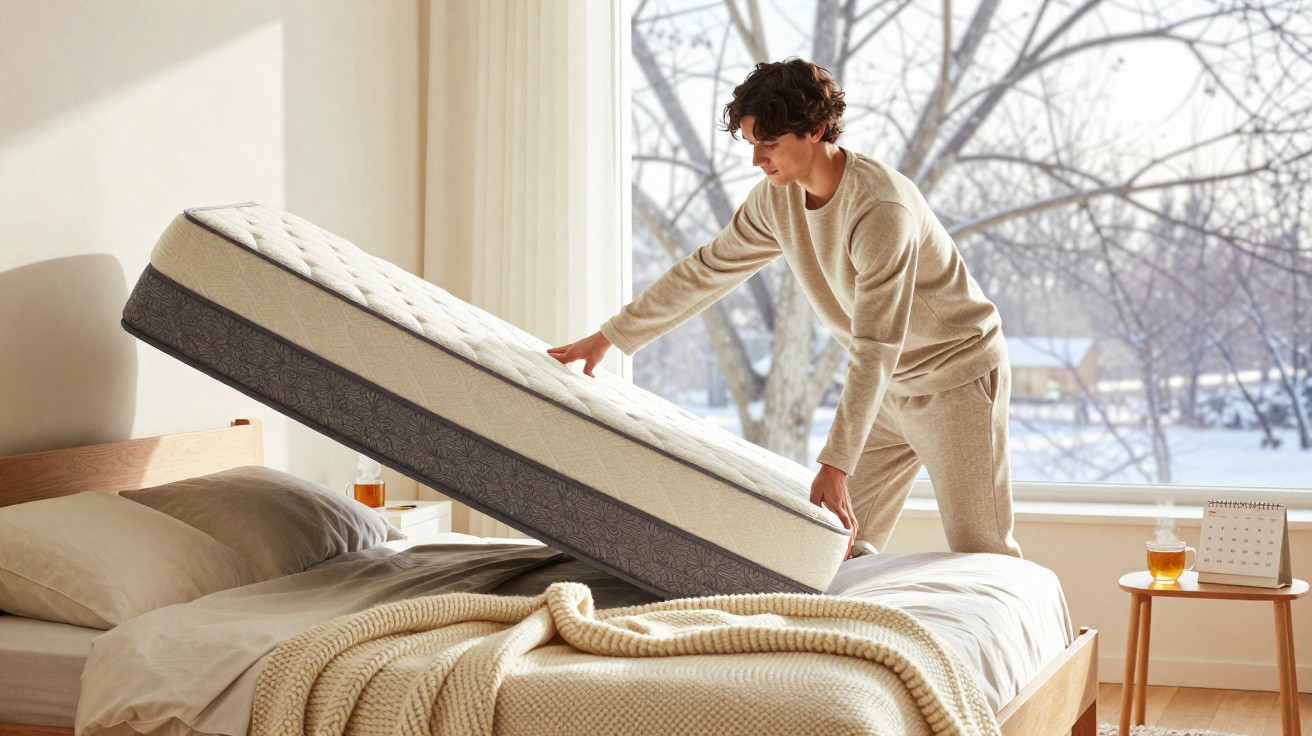
For a non-flippable mattress, all you need to do is rotate it 180 degrees along the horizontal plane. Work from one side, lifting it a little and shuffling it round instead of trying to raise the entire mattress into the air. When two people are available, make slow quarter turns: rotate halfway, stop and adjust your grip, then complete the turn. It does not have to look graceful; your spine will never watch the recording.
If your mattress has two usable sides, winter rotation can also provide an opportunity to flip it to the “warmer” side, where one exists, or simply let the underside have its turn on top. Some older mattresses feel firmer on one face, which may be preferable in winter when your body sinks less deeply into chilled padding. One sleep consultant joked that people treat mattress flipping as an Olympic event, though really, “Good enough and not dropped on your foot” is the gold standard.
The understated comfort of a freshly rotated bed
After rotating a mattress and making the bed again, there is a small moment when lying down feels subtly different in a pleasing way. Your usual hollow has vanished, the support beneath your shoulder has changed and you do not immediately roll into the familiar spot. On the first night it can seem a little odd, as if somebody rearranged the bedroom while you slept. By night two or three, though, your body begins to recognise that it is being supported more evenly.
For anyone who struggles with the colder months, this modest piece of maintenance can be unexpectedly reassuring. It is not merely about candles and fluffy socks; it is about ensuring that the place where you spend a third of your life is not quietly penalising you for habitual behaviour. There is a calm reassurance in knowing that the surface you fall onto after a long, grey day is supporting you rather than gradually pulling you out of alignment.
Practically speaking, rotating your mattress more regularly through colder weather can lengthen its lifespan. More personally, it shows how small, unglamorous routines can make a substantial difference to daily wellbeing. Sleep scientists can discuss spinal alignment and pressure distribution for hours, but most of us simply want to wake on a dark winter morning without groaning before we have even opened the weather app.
The little winter routine your future self will appreciate
If you are reading this while half-sunken into your preferred side of the bed, you are in good company. Many people first heard about rotating a mattress from an unenthusiastic salesperson years ago, then immediately forgot the advice. It probably sounded like another courteous instruction - like “wipe down your skirting boards weekly” - and was mentally filed under “Things Other People Probably Do”. But once nights grow longer and heating bills climb, that dull recommendation begins to show its slightly smug good sense.
Rotating your mattress more frequently in cold weather is not a dramatic lifestyle overhaul. It is a mildly awkward, five-minute task that your future back, shoulders and winter-weary brain may silently appreciate. Consider it upkeep for the one space in your home that sees you entirely unguarded: drowsy, hair untidy, breathing gently and trying to find the resolve for another day. If your mattress is going to support all of that, it deserves to spread the weight around a little.
The next time you wake on a frosty morning and stretch without wincing, you may remember the evening you reluctantly manoeuvred the mattress into a new position while muttering to yourself. That modest, slightly ridiculous task may have been a quiet form of winter self-protection. Your bed retains the memory of what you do to it, particularly in cold weather. What story would you like it to tell your body by spring?






Comments
No comments yet. Be the first to comment!
Leave a Comment