
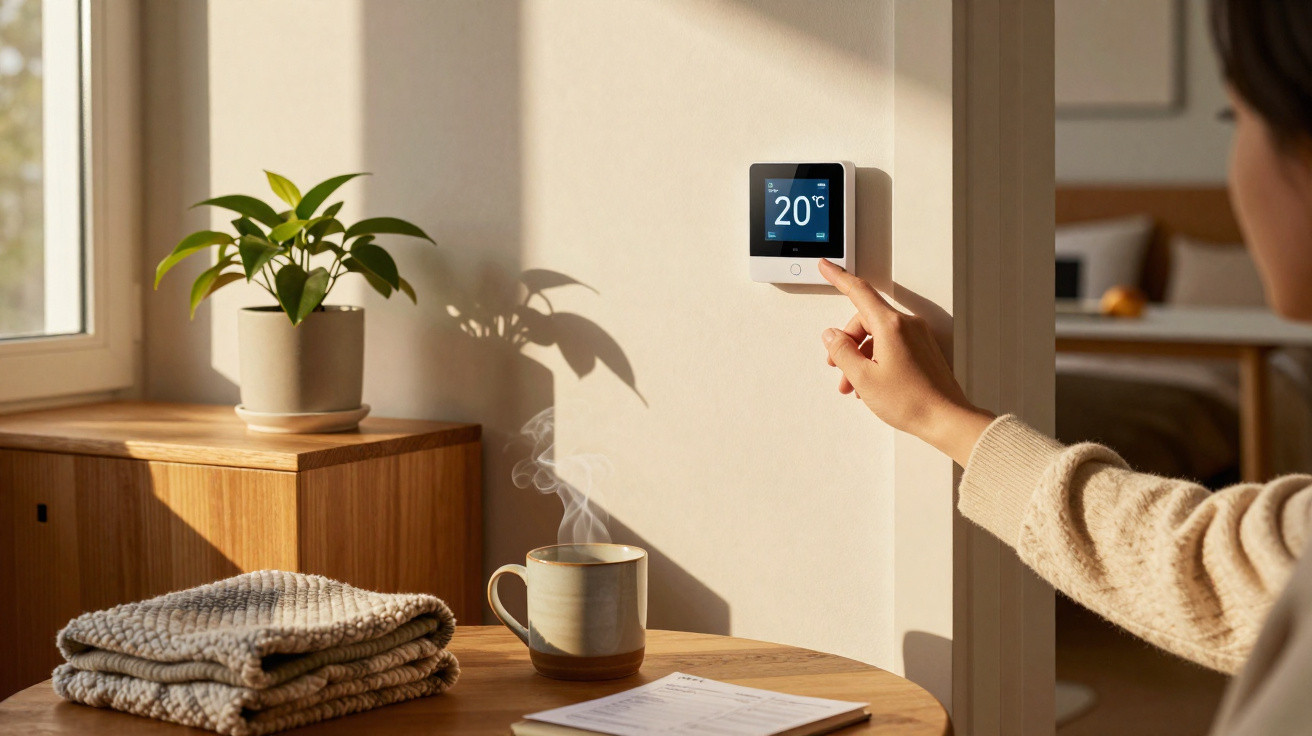
For decades, households relied on one figure to determine how warm their homes ought to be. That approach is rapidly disappearing: specialists now favour comfort, building performance and intelligent controls over an inflexible thermostat setting.
The decline of the fixed 19 °C rule
Across much of Europe, the well-known 19 °C reference emerged during the oil crises of the 1970s. At that time, heat escaped easily from homes with poorly insulated walls, single glazing and inefficient boilers. Heating rooms beyond that point could lead to excessive fuel consumption and sharply rising bills.
The situation is now very different. Insulation requirements have advanced, while modern windows retain warmth rather than allowing it to escape. Digital thermostats measure temperatures accurately instead of estimating them. Consequently, specialists no longer regard 19 °C as a universal ideal, but as a benchmark rooted in the past.
One degree of difference can shift a household’s annual energy use by around 7%, with a direct effect on gas bills and emissions.
Energy experts at organisations including ENEA and the Polytechnic University of Milan suggest a small revision: 20 °C is a more practical guideline for living spaces in refurbished or newer homes. Although the change appears slight, it represents a revised compromise between efficiency and comfort.
Why 20 °C is emerging as the new benchmark
Temperature is not the sole factor that determines human comfort. Humidity, air circulation, surface temperatures and clothing all affect whether a room feels warm or cold. Engineers and thermodynamics specialists emphasise that the body copes better with gradual variation than with abrupt temperature differences between rooms.
At 20 °C, a living room makes it easier for the body to maintain its natural 37 °C while someone is sitting down, working on a laptop or watching television. Muscles are less likely to tighten, and the body does not need to respond as strongly to cold draughts. Meanwhile, marginally warmer walls, floors and windows lessen the cold sensation that often encourages people to use supplementary heaters.
There is a benefit for the condition of the building too. At roughly 20 °C, alongside balanced humidity, surfaces remain drier. This reduces condensation on cold corners and window frames. In turn, lower condensation can mean fewer mould patches and less risk of spores spreading through the air.
Raising the setpoint by just 1 °C may prevent people from turning to electric fan heaters or constantly moving to smaller rooms, which often wastes more energy overall.
Comfort targets for each room
Rather than pursuing an identical temperature throughout the property, professionals increasingly refer to comfort ranges. European energy agencies and building engineers commonly use the following recommendations:
| Room | Suggested temperature |
|---|---|
| Living room / home office | 20 °C |
| Bedroom | 16–18 °C |
| Hallways / circulation areas | 17 °C |
| Bathroom | 22 °C (for limited periods) |
These figures should be viewed as an initial guide rather than a definitive answer. Older homes with draughts can feel colder at an identical reading, particularly where external walls and floors remain very cold. Conversely, well-insulated flats may still feel comfortable with a marginally lower thermostat setting.
Smart thermostats move beyond one-size-fits-all rules
The key development is not simply the figure displayed on the thermostat, but how it responds to everyday routines. Today’s digital thermostats, including connected smart models, enable households to heat rooms differently at different points in the day.
Regulators including ARERA in Italy state that using scheduling features correctly can reduce yearly heating costs by up to 15%. The idea is straightforward: heat occupied rooms when needed, then allow temperatures to drop gently when they are unused.
- Smart thermostats can be controlled remotely by phone, allowing users to postpone heating when they are working late.
- Presence sensors recognise when rooms are vacant, avoiding the needless maintenance of a full comfort temperature.
- Connections to heat pumps or solar thermal panels can transfer part of the heating demand to cleaner, lower-cost energy sources.
This does not require every household to buy the newest technology. Even a standard programmable thermostat can reduce waste if it is used regularly. A basic routine, with lower temperatures overnight and slightly warmer settings in the early evening, already moves away from the inflexible 19 °C approach and aligns heating more closely with actual use.
The trend moves from one fixed rule for all homes to many small, informed choices made room by room and hour by hour.
Practical examples for an ordinary week
Take a family with conventional office hours. They could set their living room to 20 °C from 6:30 to 8:30 in the morning, allow it to reduce to 17–18 °C while nobody is at home, then increase it again between 5:30 and 10:30 in the evening. Bedrooms may remain at 17 °C overnight, with a modest early-morning rise for people who are particularly sensitive to cold.
For people working remotely, the arrangement is different. During the day, the home office or principal living space becomes the main heating zone and may stay at 19–20 °C. Rooms used less frequently, including spare bedrooms, can fall to 16–17 °C without a meaningful reduction in comfort.
The changing balance between comfort and household budgets
When they are insulated properly, modern homes can maintain 20 °C with shorter boiler operating periods than was previously possible. Double or triple glazing, roof insulation and sealed window frames reduce the continual heat losses once associated with winter. However, energy costs are still unpredictable, so many households remain highly attentive to their bills.
Smart meters and digital gas meters, now fitted in millions of European homes, allow households to connect thermostat choices with real consumption. Rather than following general rules of thumb, they can monitor week by week how a 1 °C adjustment changes their usage.
Tracking consumption for two or three weeks at different setpoints often gives clearer guidance than any generic rule from decades ago.
Specialists frequently recommend making small changes gradually: alter the thermostat by half a degree, observe the result for several days, and check whether anybody notices. If comfort remains satisfactory, a further half-degree reduction may be possible. If someone feels cold when reading or working, it can be more sensible to hold the temperature steady and improve insulation or add clothing layers instead.
Useful habits for cutting waste without feeling cold
The thermostat setting is only one part of the equation. Everyday practices determine whether a heating system runs efficiently. Energy advisers regularly suggest:
- Bleeding radiators at the beginning of the heating season to ensure hot water circulates correctly.
- Positioning furniture away from radiators so it does not obstruct the flow of heat.
- Shutting blinds or curtains at night to reduce heat loss through windows.
- Airing rooms briefly with windows fully open instead of keeping them slightly open for extended periods.
Such modest measures often help households remain comfortable at 20 °C rather than turning the setting higher. They can also reduce the urge to use extra electric heaters, which generally cost more for each unit of heat and place added strain on electricity grids at peak times.
Beyond temperature: health, behaviour and building quality
Moving away from the fixed 19 °C rule also prompts a wider discussion about health and the quality of housing. Excessively cold homes can worsen respiratory conditions, particularly for children and older people. Overheated homes, meanwhile, dry the air, irritate mucous membranes and increase fossil fuel use.
Public-health guidance in several countries now describes 18–21 °C as a comfort and safety range for occupied rooms, rather than insisting on one precise target. Within this range, the best setting depends on insulation levels, the age of occupants and even cultural attitudes towards clothing indoors.
The issue also connects to the climate transition. As gas boilers are progressively replaced by heat pumps and district heating, control methods will evolve again. Heat pumps operate more effectively at stable, moderate temperatures than with large fluctuations. This may encourage households to retain 19–20 °C settings for longer, alongside substantial insulation improvements.
For the moment, experts offer a broadly clear message: the former 19 °C ceiling no longer reflects modern housing conditions. A flexible approach based on evidence is more suitable. Combining moderate temperature settings, smart controls and straightforward maintenance can help households safeguard comfort and budgets while reducing their environmental impact.






Comments
No comments yet. Be the first to comment!
Leave a Comment