
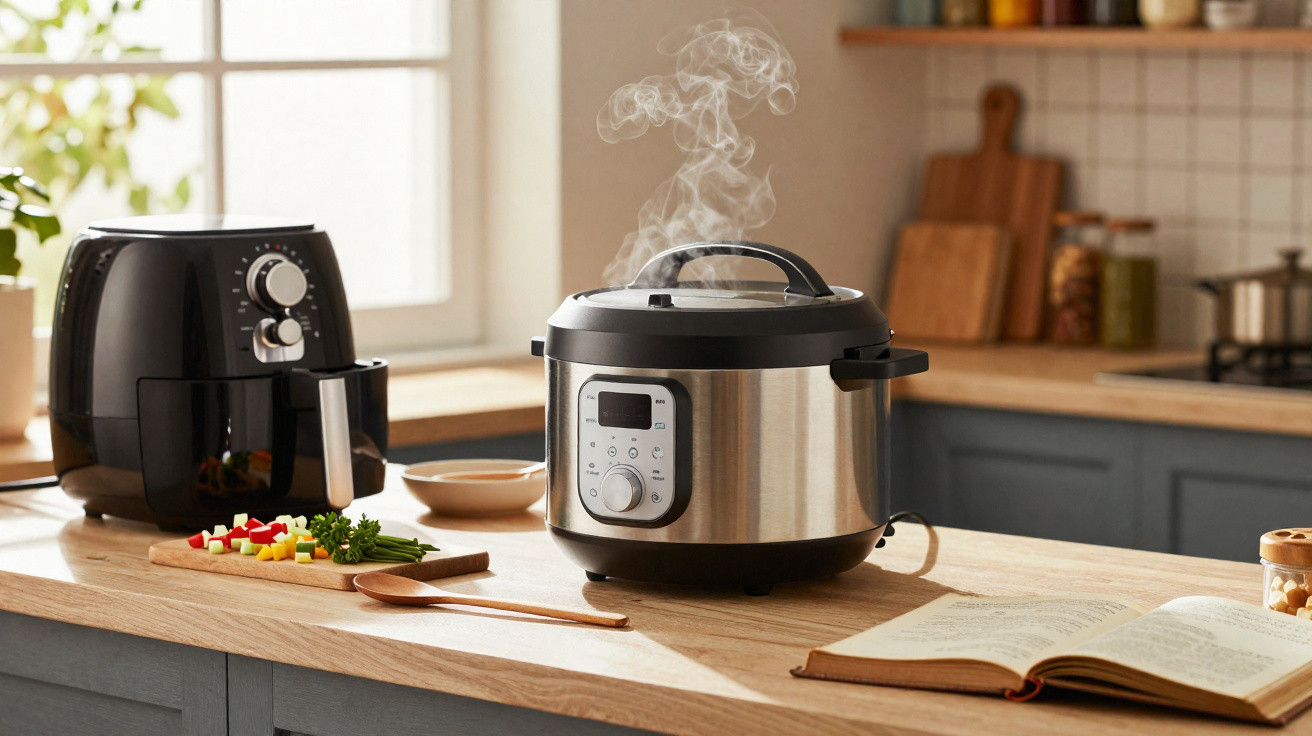
The air fryer on the worktop now seems oddly silent.
A year ago, it featured in every TikTok recipe, whirring through batches of frozen chips and “healthy” nuggets. Now, it is increasingly being nudged against the wall in kitchens, half unplugged and a little greasy, gradually becoming an overpriced bread bin. Its replacement is noisier, larger and proudly awkward, displaying nine illuminated icons: steam, bake, air fry, slow cook, sauté, grill, reheat, dehydrate, yogurt.
The adverts make a bold promise: one machine to rule them all.
Yet among hurried parents, tech-minded food lovers and appalled traditionalists gripping their cast-iron pans, this multi cooker is more than another appliance.
It is triggering an argument at the centre of the home.
From air fryer favourite to a packed worktop: a quiet kitchen takeover
Browse any food group and the same image soon appears: an overcrowded worktop.
There is an air fryer, rice cooker, slow cooker and toaster oven - plus a formidable multi cooker with more controls than an aeroplane cockpit. Its owner nearly always poses one anxious question: “Which one should I keep?”
Once the wonder gadget for midweek meals, the air fryer is gradually slipping out of the limelight.
This nine-function powerhouse says it can perform the same task, alongside eight others, from one stainless-steel unit.
Consider Maya, 34, who makes dinner every evening after work. Last year, she proudly shared “Air fryer changed my life” beneath a photo of crisp golden chicken wings.
A new post appeared last week: a hefty multi cooker bought in a sale, while the old air fryer sat pushed into the background like a forgotten former partner.
She now uses the single appliance to steam dumplings, slow-cook Bolognese and bake banana bread.
Her air fryer emerges only at weekends, when her partner maintains that wings “taste different” in the old basket.
Brands have noticed this appliance fatigue. They saw people purchase three, four or five separate gadgets, only to complain about limited space, trailing leads and the washing-up.
Their proposed solution is straightforward: one device that handles everything, replacing the air fryer, slow cooker and steamer - and, in some cases, even the oven.
For food purists, it threatens tradition: a culinary shortcut that smooths out flavour and texture.
For home cooks short on time, it represents freedom, fewer dishes and an appliance that acts like a sous-chef.
That is where the divide starts.
The nine-function multi cooker promise: clever shortcut or flavour killer?
The disputed multi cooker relies on a central idea: “stacked time”.
You might brown onions using high sauté, move to pressure mode for faster cooking, and then allow the dish to finish on low warm - all in the same pot.
For anyone arriving home late from work, that can feel like a small revolution.
Add lentils, vegetables, spices and a little stock, select a programme and leave it alone. The machine manages the changing temperatures, timings and steam release.
In effect, it changes “I have no time” into “Dinner is already done.”
But this convenience is precisely what sends more traditional cooks round the bend.
Chef friends argue that steam-led appliances soften flavours, and that no preset can replicate slow oven roasting. One baker demonstrated the bread produced by her multi cooker: soft, pale and almost excessively polite.
She then brought out a loaf baked in a battered Dutch oven. Its crust crackled, its crumb sang and the kitchen carried the scent of a bakery.
“Tell me this button can do that,” she said, tapping the multi cooker as though it were a badly behaved phone.
The machine triumphed on convenience. The oven prevailed on soul.
Beneath the debate about crispness and caramelisation lies a more basic issue: what do we expect from daily cooking?
When dinner is simply about getting through the gap between two Zoom calls, the nine-function appliance can seem almost heroic. Programme it, forget it, eat.
When the aim is pleasure, ritual and a gradual dance with heat and time, a box of presets can feel dubious.
Honestly, hardly anyone cooks that way every day.
Most of us sit somewhere in between - hoping for rich flavour on a Tuesday night while also hoping not to cry over an onion at 8:45 p.m.
Using a new multi cooker without sacrificing sanity - or flavour
The people most content with this new appliance tend to see it as an assistant rather than a dictator.
They disregard half its presets, concentrating instead on the three or four that genuinely suit their lives: pressure cooking for beans and stews, air frying for leftover food, steaming for vegetables and slow cooking for Sunday batch meals.
One simple habit helps them stay sensible.
First, they decide on the desired texture - crisp, tender, saucy or brothy - and only then select the function most likely to deliver it.
The goal always comes before the button.
A major mistake is attempting to “do it all” merely because the appliance claims it can.
People add too many ingredients, too much liquid and too many stages, before wondering why the result tastes like heavily seasoned mush.
Begin modestly.
Pick a dish you already make successfully - perhaps chilli, lentil soup or roasted vegetables. Then convert just that recipe for the multi cooker, adjusting one variable at a time.
When something goes wrong, it does not mean you are a poor cook.
It merely shows that the preset was created by somebody unfamiliar with your hob, pan, palate or midweek pressure.
“Tech won’t replace real cooking,” says Léa, a home cook who tests appliances for her blog. “It just lowers the bar for how bad a Tuesday can be.”
- Use it for what it’s best at: long-cooking dishes, grains and “set-and-forget” meals become simpler, cheaper and less stressful.
- Keep one specialist tool you genuinely enjoy: a reliable pan, a Dutch oven or your original air fryer if it still makes you happy.
- Wash it that evening: dried starch stuck inside a multi cooker is a small nightmare waiting for you the next morning.
- Do not pursue every trend: one or two dependable recipes you make repeatedly are more useful than ten you will never use again.
- Keep the simple reality in mind: the appliance is a tool, not a personality upgrade - it will not magically turn you into someone who meal-preps for the entire week.
What the “appliance war” reveals about how we want to live
Beyond the memes pitting air fryers against nine-function powerhouses is a quieter story about time, energy and what counts as “good food”.
Some feel guilty about using machines at all, as though loving cooking properly requires three pans on the hob and a sink overflowing with dishes. Others feel guilty about leaving their gadgets unused, as if they have failed a modern test of productivity.
The multi cooker is doing more than altering what we eat.
It is reshaping how we feel about the labour behind each plate.
Everyone knows the moment: staring into the fridge, phone in one hand and a delivery app in the other, while a very costly appliance appears to judge you from the worktop.
Perhaps the real change is neither abandoning the air fryer nor welcoming another all-in-one wonder.
Perhaps it is accepting that, on some evenings, we want a perfectly crisp chicken thigh from a cast-iron pan, while on others we want soup to cook while we shower.
Both belong in the same kitchen, on the same worktop, with the same slightly scratched multi cooker humming nearby.
The argument will continue online: “Real cooks don’t use presets”, “My multi cooker saved my life”, “Air fryer forever”.
Still, the most compelling discussions happen away from the screen - in untidy, half-refurbished kitchens, where a pot simmers, a multi cooker beeps and someone quietly decides what remains and what goes.
Some air fryers will end up in cupboards.
Some multi cookers will be sold second-hand.
And some households will settle into a strange but honest balance between tradition and convenience, flavour and fatigue, what we imagine cooking and what we can realistically manage on a tired Thursday night.
| Key point | Detail | Value for the reader |
|---|---|---|
| Test, don’t worship, the nine functions | Focus on 3–4 modes that match your real habits instead of chasing every preset | Reduces overwhelm and helps the appliance fit your actual life |
| Keep one “joy tool” alongside the multi cooker | Hold onto the pan, Dutch oven, or air fryer that still gives you pleasure to use | Protects flavor, texture, and your personal cooking identity |
| Use the gadget to ease weekdays, not replace cooking | Reserve it for beans, grains, stews, and batch meals that usually drain your time | Less stress, fewer dishes, and more energy for the meals that really matter to you |
FAQ:
- Question 1 Is a nine-function multi cooker really better than an air fryer?
- Answer 1 It is different rather than automatically better. You gain versatility - stews, rice, yoghurt and steaming - but may sacrifice the strong crispness and speed that people value in a dedicated air fryer.
- Question 2 Can one multi cooker safely replace several appliances?
- Answer 2 For many households, it can. It may replace a rice cooker, slow cooker, steamer and sometimes an air fryer, provided you accept certain compromises in texture and capacity.
- Question 3 Does food taste worse from a multi cooker?
- Answer 3 Not by default. Long-simmered meals, curries, beans and soups can be excellent. Its weaker areas are deep browning, crunchy crusts and delicate baking.
- Question 4 Is it worth upgrading if my air fryer still works?
- Answer 4 Probably not if you mainly reheat and crisp food. If you want assistance with complete meals, dried beans, grains or batch cooking, an upgrade could genuinely make your routine easier.
- Question 5 How do I choose between brands and models?
- Answer 5 Look beyond marketing and consider capacity, how difficult it is to clean, noise level and the 3–4 functions you will use each week. The right appliance is the one that deserves a permanent place on your worktop.



Comments
No comments yet. Be the first to comment!
Leave a Comment