
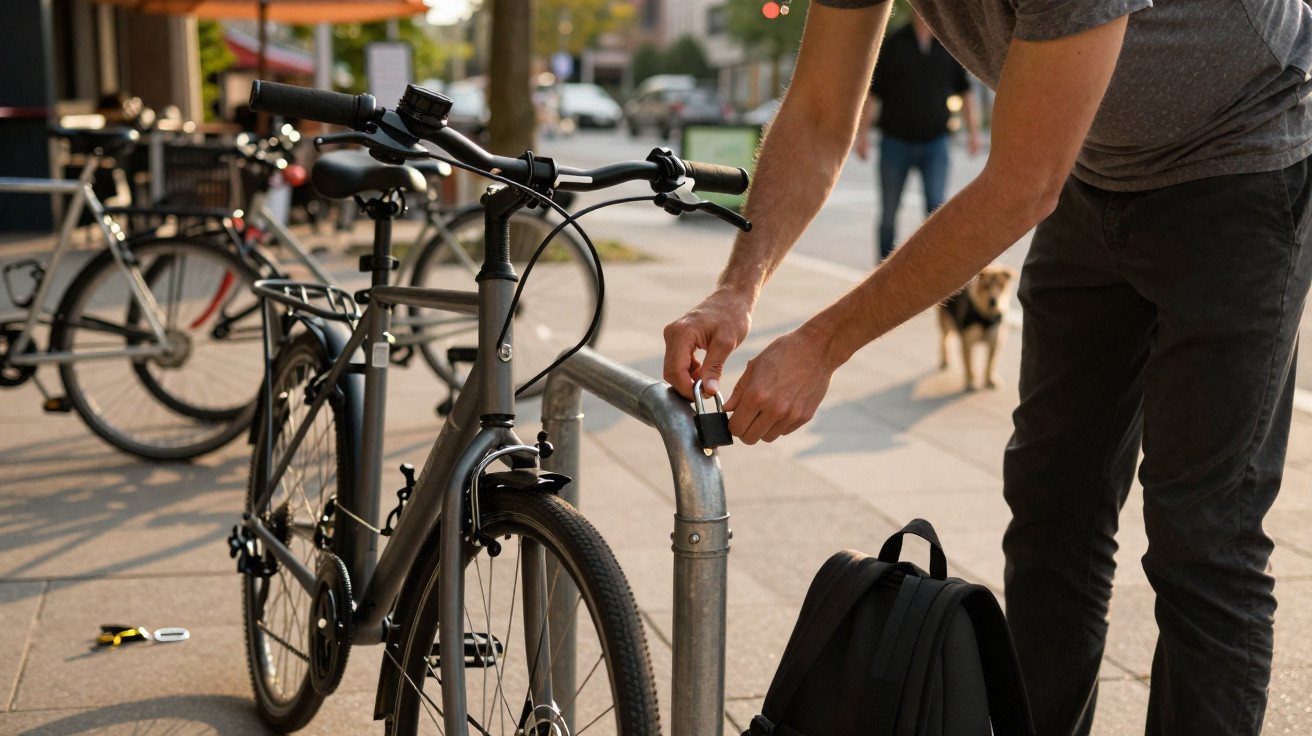
The man in the fluorescent jacket was sure he had covered every base.
A hefty U-lock. A crowded café. Broad daylight. He fastened the lock around the front wheel and glossy frame, glanced back once, then went in to order a flat white. Eight minutes later, his bicycle had vanished from the spot. There was no snapped lock, no commotion, no obvious clue - only a faint tyre mark left on the pavement.
Nearby, a woman in work clothes was looking over her own bicycle and checking the lock for a second time. She had the same style of U-lock, the same inexpensive cable around the saddle, and the same expression that said, “I hope this is enough”.
A CCTV camera opposite revealed what had happened. A thief had needed only twelve seconds to wheel the bicycle away. The lock had been present; the weakness lay elsewhere.
It began with the direction of the front wheel.
The bike-security habit most cyclists overlook
For most people, bicycle security begins and ends with equipment: a thick lock, an expensive chain and perhaps a second lock for those who are especially careful. They park up, click the lock closed and walk away believing the job is done. Yet the way you position a bicycle before locking it can make a major difference.
Think of it as a micro-habit: a two-second action that no one explains when you purchase your first bicycle. Rather than simply leaving it parallel to a rack, it involves the angle of the frame, the direction of the wheels and the side facing the road.
Thieves pay attention to those details. Most cyclists do not.
Police officers and bicycle mechanics in cities with high theft rates regularly point out something that feels rather unfair: plenty of stolen bicycles were “locked correctly” in the owner’s eyes. The lock was attached properly, but the bicycle had been parked in a position that made theft straightforward.
Researchers reviewing CCTV footage in London and Amsterdam found a recurring pattern. Stolen bicycles were commonly left straight and tidy, with wheels lined up and frames easy to grip. Although a lock was fitted, their position allowed thieves to lift, twist or force components using leverage.
Then there were the bicycles that remained untouched. They had similar locks, stood on the same streets and were parked at the same times of day. The difference was that they were difficult to shift: pinned in place, tangled up or turned at an awkward angle. A thief would walk past, assess the situation and select another target further along the rack.
We often picture thieves as unstoppable film villains. In truth, they are usually impatient, nervous and working against the clock. Anything that takes an additional ten seconds or appears troublesome can persuade them to move to the next bicycle.
The reasoning is simple. A bicycle locked in a neat position is easy to manipulate: it can be lifted directly upwards, its frame can be twisted, and force can be applied to the lock from precisely the right angle.
By contrast, a bicycle secured awkwardly - its front wheel sharply turned, frame pushed tightly against a stand and pedals wedged in place - is like trying to pull a sleeping dog through a narrow corridor. There is no useful angle, no comfortable grip and no space to swing tools.
This frequently missed habit is not about adding more metal. It is about making your bicycle irritating to handle. You are doing more than locking it; you are trapping it where it stands.
The small bike-locking ritual that deters opportunistic thieves
The habit can be summed up in one sentence: lock your bicycle so it cannot easily roll or pivot. Turn the front wheel sharply, press the frame against something solid and use the lock to hold the whole arrangement together.
Rather than stopping parallel to the rack, approach it at a slight angle. Turn the handlebars fully to one side so that the front wheel crosses the frame. Next, move the frame as close as possible to the stand or rail, almost as though the bicycle is embracing it.
Pass a U-lock or heavy chain through the rear wheel and frame, then around the stand, so that the wheel is pinned and cannot rotate. The aim is not merely for the bicycle to be “locked”, but for it to be “stuck, heavy, and awkward to move”.
On a rainy Tuesday in Berlin, I saw a courier demonstrate this exact routine to a student outside a supermarket. Her original arrangement was textbook: frame and front wheel secured, straight and tidy, with the logo clearly visible. The courier gently shook his head and unlocked it.
He repositioned the bicycle so that the rear wheel sat more tightly against the stand. He turned the handlebars until the pedal nearly touched the rack. He then locked it again through the rear triangle, wheel and stand, creating one compact bundle.
“Now,” he said, stepping back, “imagine you’re trying to steal this in 15 seconds while looking over your shoulder.” She laughed, but her perspective had visibly changed. This was not about being frightened; it was about taking control.
Cities with high theft levels often issue lists of “best locks” and “hotspot streets”, but bicycle theft figures still rise. Part of the issue is how we think about locks. We treat a lock as a magic object instead of one part of a broader system.
From a physics perspective, many attacks against bicycles depend on leverage. Thieves may pull a frame away from a rack in an attempt to break a lock, or turn the bicycle to obtain a better working angle. If your bicycle is pinned tightly, every action becomes more awkward. The thief must spend longer, exert more effort and work in more conspicuous positions.
The moment between “I can do this quickly” and “this is turning into a performance” is when passers-by begin to notice. That is precisely the attention a thief wants to avoid.
Small errors with big consequences - and discreet ways to fix them
The practical approach is straightforward: consider security in layers. Start with where you park, then consider how you position the bicycle, and only then decide how to lock it. Most cyclists go directly to the third stage and overlook the first two.
The next time you stop, physically take half a step back before securing your bicycle. Examine it as a thief might. Could it roll forwards easily if the lock were cut? Is one side of the frame left “open”, with room to twist or lift it? If the answer seems to be yes, move it.
Set it at an angle. Push it against the stand. Slot a pedal into the rack so that it catches. Your short ritual should finish only when even shifting the bicycle slightly appears inconvenient.
The first common error is locking only the front wheel. Thieves appreciate this mistake: they remove the wheel, throw it aside and take the rest of the bicycle. The second is using a high-quality lock around something flimsy - a sign that can be lifted out, a decaying fence post or a thin rail that a saw can cut through in seconds.
There is also the trap of being rushed. You are late, your hands are cold and your friends are messaging you. You attach the lock at the closest available point, while half aware that it is not ideal. On an exhausting evening, that is how bicycles disappear.
Let us be honest: nobody really does this every day. No one carries out a full security checklist for a ten-minute visit to the bakery. The aim is not perfection, but having one or two non-negotiable habits that you maintain even when tired.
“Most thieves aren’t master criminals,” says a London community officer who patrols busy commuter hubs. “They’re opportunists. They walk along a row of bikes, count the seconds in their head, and just pick the one that looks quickest to move.”
That is where an awkwardly positioned, tightly secured bicycle comes out ahead. It simply does not appear quick to take.
- Turn the handlebars fully so the wheel cannot roll in a straight line.
- Lock through the rear wheel and frame, rather than only the front wheel.
- Pin the bicycle against something solid to remove easy space for twisting or lifting.
- Keep the lock high and tight instead of letting it rest near the ground.
- Make people and lighting part of your “lock” - busy locations are better than dark corners.
How one small habit makes your bike feel safer
There is a quiet confidence in walking away from your bicycle without feeling that familiar pang of uncertainty. You have angled it, pinned it and turned it into a small metal puzzle. It is not invincible, but it suddenly feels less vulnerable than it did the previous week.
We tend to discuss urban cycling in terms of helmets, traffic and weather apps. Mundane details such as locking a bicycle rarely feature in Instagram captions. Still, this overlooked habit is among the small daily choices that accumulate over months - or over a whole year of keeping the same bicycle rather than replacing it after theft.
At a deeper level, it means changing your mindset from “I hope no one steals it” to “I’ve quietly made their job annoying.” On a street full of easy wins, your bicycle becomes the one that raises uncomfortable questions: How long are you willing to risk standing here? How much attention are you ready to draw?
| Key point | Detail | Why it matters to the reader |
|---|---|---|
| Position the bicycle before locking it | Angle it, turn the handlebars and press the frame against the stand | Reduces risk by making the thief’s movements more difficult |
| Lock the rear wheel and frame | Use a U-lock or chain through the rear triangle and stand | Protects the most expensive part and prevents the bicycle from rolling |
| Create an awkward “puzzle” | Wedge a pedal, reduce open space and keep the lock tight and high | Wastes the thief’s time, encouraging them to choose another target |
FAQ:
- Should I always lock through the rear wheel instead of the front? Yes, the rear wheel and rear triangle are both more valuable and harder to replace, so locking through them gives you more protection for the parts thieves really want.
- Is a cheap lock okay if I use this positioning trick? The awkward positioning helps, but a weak lock is still easy to cut; think of position as a multiplier, not a replacement for a solid lock.
- Does locking in a busy area really make a difference? Thieves prefer quiet, hidden spots; light, people, and movement all add social pressure that makes them more likely to skip your bike.
- How long can I leave a bike locked outside safely? No lock-up is 100% safe for long periods; the longer you leave it, the more you rely on layers: good lock, smart position, and safer location.
- Is it worth using two locks for daily commuting? If you park in the same high-risk area every day, a second lock on the front wheel or frame can turn your bike into a much less attractive target.


Comments
No comments yet. Be the first to comment!
Leave a Comment