
The delivery team had hardly walked out before Emma threw herself face-down onto her new mattress.
It had that weighty, indulgent “hotel mattress” feel and seemed to promise thousands of flawless nights’ sleep. She posted a photograph on Instagram, joked that she was “entering her soft girl era”, then stopped thinking about it as soon as she put on the sheets.
Two years on, a shallow dip had formed where she slept. Her side had sunk while her partner’s remained firm, and her lower back made a wordless protest each morning. The mattress was still covered by its warranty and, technically, was still “good”… but it no longer felt good.
The change came not from an expensive sleep app, but from a friend quietly asking over coffee: “You ever tried rotating it?”
That straightforward, rather unexciting action can make all the difference.
Why rotating your mattress quietly saves it from an early death
The gradual decline is easy to miss at first: a few centimetres of sagging in one place, a hollow that gets a little deeper elsewhere, or the sense that your hip sits lower than it did last month. Then, on an otherwise ordinary morning, you realise the mattress is moulding your body rather than supporting it.
Mattresses deteriorate in the places where our bodies tell the same story each night: the same position, the same shoulder and the same curve of the spine. Foam becomes compressed, springs lose strength and fabric stretches. When a mattress stays in one orientation, all that strain remains concentrated in the same area.
Rotating it effectively gives the bed a new body map. It does not repair existing damage; it distributes the stress before that damage becomes obvious.
Most of us have experienced drifting towards the centre of the bed without intending to. That is more than an irritation: it is information. It reveals where your weight has gradually worn a track into the mattress over months and years.
When people rotate a mattress that has been neglected for a long time, their response can be almost comical. A couple from Manchester told me they had “an entirely new bed overnight” simply by turning it 180 degrees. There was no replacement topper or clever gadget involved, just a new orientation.
Some manufacturers monitor this effect quietly. Their internal testing often indicates up to 30% longer usable life for owners who rotate regularly, particularly with foam and hybrid mattresses. The mattress does not somehow wear out more slowly, but the wear is spread out instead of being focused beneath one hip or shoulder.
It is much like rotating a car’s tyres. You can travel thousands of miles without doing it, and the car will still run. However, the tyres will wear unevenly, the ride will become less smooth and they will need replacing earlier than necessary.
Your mattress encounters comparable forces every night. Bodies are not evenly weighted sandbags: shoulders weigh more than calves, while the pelvis carries more load than the feet. When your heaviest area lands in precisely the same place night after night, that part loses its resilience sooner.
Rotation alters that pressure pattern. The area that used to take your hips becomes the shoulder area at the opposite end. Springs and foam that received little use begin to share the burden. Rather than creating one deep crater, the entire sleeping surface wears more gently and evenly.
That is what genuinely extends a mattress’s lifespan: no magic, simply a fairer distribution of unavoidable wear.
How to rotate your mattress so it actually works (and you don’t hate doing it)
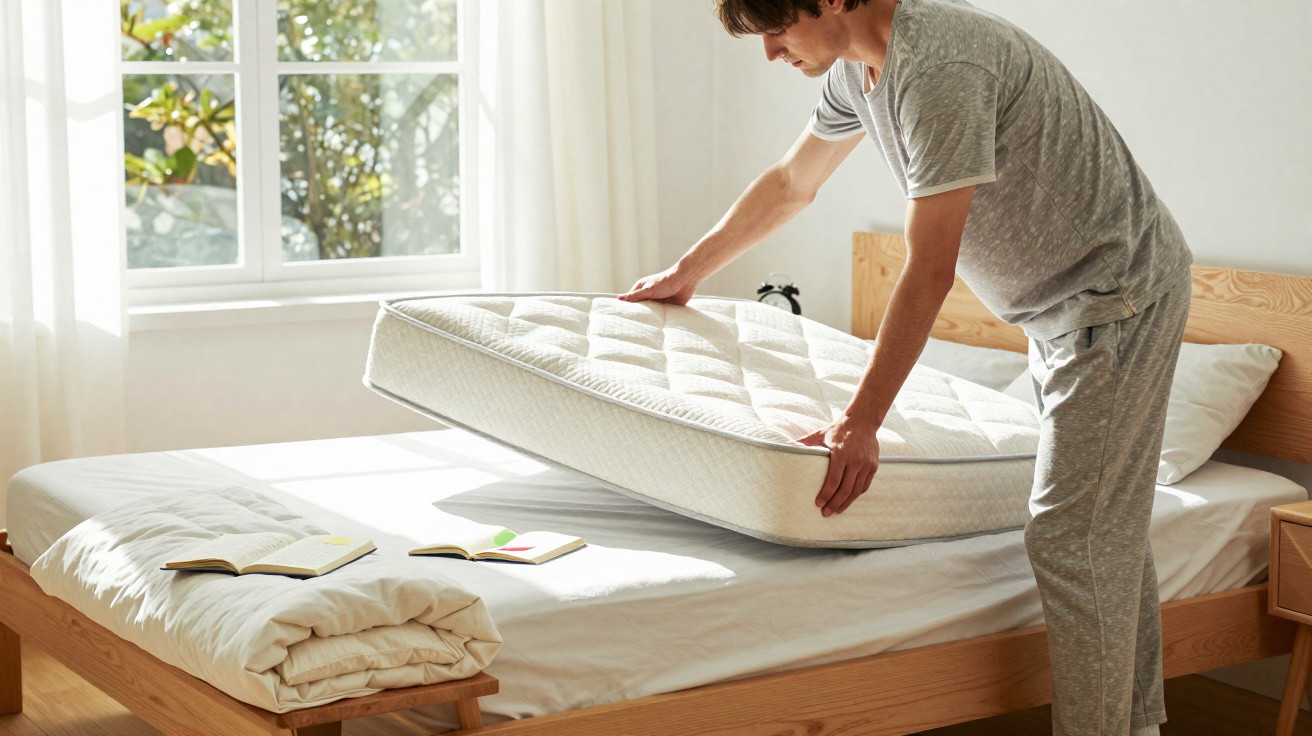
The easiest approach is to turn the mattress 180 degrees every three to six months, so the head end becomes the foot end. There is no need to flip it or perform mattress origami; simply pivot it slowly.
If it seems like an unwelcome job, attach it to something you already do, such as the change of seasons or swapping between your summer and winter duvet. Some couples tie it to birthdays or the beginning of school terms. It does not have to be perfectly timed, only consistent.
Most contemporary mattresses are single-sided, meaning they should not be flipped upside down. Rotation, however, is discreetly recommended in the small print by almost every brand. This is where their laboratory testing matters, since those tests assume that you move the mattress occasionally.
Let’s be honest: nobody really does this every day.
The main reason people avoid rotating is very simple: mattresses are bulky and cumbersome. If you live alone, or have a king-size bed with a deep base, wrestling with it can sound like a dreadful way to spend a Sunday.
The key is to see it as moving furniture by sliding rather than as heavy lifting. Remove the bedding, position yourself at one corner and gently “walk” the mattress around the frame, corner by corner. With a partner, take a side each and turn it gradually instead of lifting it.
Trouble usually starts when people rush. They pull the mattress sharply, scrape the walls, damage the springs or strain their backs. A careful quarterly rotation is far better than an annual, chaotic whole-body workout that makes everyone swear never to do it again.
“The first time we rotated ours, we realised just how much we’d been asking of that one spot under my right hip,” laughed James, 41. “We’d been complaining about the mattress, but really, the mattress should have been complaining about us.”
There is a quiet emotional dimension beneath this small household task. Spending ten minutes rotating your mattress is a modest way of saying that this room matters, your sleep matters and your body matters.
- Every 3 months – Best for heavy use, side sleepers or couples with different body weights.
- Every 6 months – Suitable for most people with a good-quality mattress.
- After the first month – Useful for helping new mattresses settle beneath new weight.
- Skip rotation only if the manufacturer specifically advises against it for your model.
The small ritual that quietly changes how you sleep
Once people begin rotating their mattress, their view of sleep subtly changes. Instead of being “this thing I collapse onto at night”, the mattress becomes long-term equipment worth maintaining, rather like polished shoes or pruned plants.
It is not only about saving money, though that benefit is genuine. A mattress that may have seemed finished after six or seven years can often remain comfortable until nine or ten when wear is shared. That means years without researching models, debating choices in showrooms or wondering whether back pain is “just age”.
There is another understated advantage: you notice faults earlier. Stripping the bed and rotating the mattress lets you spot damp marks, potential mould, broken slats or loose screws. You can deal with a squeaky base before it turns into a mysterious 3 a.m. sound that prevents sleep.
On a more personal level, this tiny task acknowledges the memories a bed carries. The side where your child slept after a nightmare may become the side you now use. The hollow slowly shaped by your body can turn into a gentler area for your partner’s shoulders.
A rotated mattress remains the same object, but your relationship with it changes just enough for you to notice.
Perhaps that is the understated point behind the whole subject: looking after the surface on which you spend a third of your life is not an indulgence reserved for “sleep geeks”. It is simply everyday kindness towards the future version of yourself who will wake there tomorrow.
| Key point | Detail | Benefit for the reader |
|---|---|---|
| Regular rotation | Turn the mattress 180° every 3 to 6 months | Extends its lifespan and delays costly sagging |
| Pressure distribution | Shares wear between the head and foot ends and different support zones | More comfortable sleep and more even support over the years |
| Practical ritual | Link rotation to seasonal changes or changing bedding | Turns a chore into a simple habit that is easy to sustain over time |
FAQ:
- How often should I really rotate my mattress? Most people benefit from rotating every 3 to 6 months. If you are heavier, sleep on one side or share the bed, aim for every 3 months.
- Can I flip my mattress as well as rotate it? Only if it is a genuinely double-sided mattress. Many modern foam and hybrid models are single-sided and should be rotated only, not flipped.
- What if my mattress is too heavy for me to rotate alone? Wait until somebody can help, or move it gradually by sliding rather than lifting. You can also rotate it in smaller stages over several days instead of doing the full 180° at once.
- Will rotation fix a mattress that already sags badly? Rotation may redistribute pressure and offer temporary relief, but deep, permanent sagging generally means the mattress has reached the end of its usable life.
- Does rotating a mattress void the warranty? Usually, the opposite is true: many warranties expect regular rotation and may ask about it when you make a claim. Always check the care label or the brand’s website.






Comments
No comments yet. Be the first to comment!
Leave a Comment