
Some scratches on a car seem like evidence of a life well lived.
There are scuffs from the school run, smudges left by a dog’s nose, and a little constellation of stone chips that only appears when you stop at the lights. Hard water marks on glass are different, though: they do not feel deserved, only persistent. After a week of April rain and one careless parking spot beneath a sprinkler, my windows were covered in chalky circles that would not budge. The wipers dragged hopelessly across them. I worked at them with the usual blue spray until my wrists hurt. Still nothing. Then, one Sunday morning, while the kettle was fizzing with limescale and Radio 2 floated over from somebody’s shed, I tested an old-fashioned remedy that seemed almost laughably straightforward. It not only worked; it altered how I think about car windows, and perhaps about small household jobs altogether.
The haze you only spot when the sun catches it
Everyone knows the moment: low sunshine strikes the windscreen at an unforgiving angle and suddenly you realise you have been looking through a film. It is not visibly filthy, merely muted - a faint mineral residue left by rainwater and spray from a hosepipe. Rain is not really to blame; it is the calcium, magnesium and traces of local geology dissolved within it, deposited on the glass and baked on by the next reluctant patch of sun. Welcome to Britain’s hard water country, where even the tea tastes of limestone. The annoying part is that the residue remains after every wash, including a careful one, because water evaporates while minerals stay put.
That morning, the marks looked as though they had been pressed into the glass. I passed a fingertip over one and could not feel a thing - the surface was smooth - yet the pale circle lingered like a ghost. You can keep spraying until you feel thoroughly responsible, and it will still seem to mock you. Honestly, nobody keeps on top of this daily. That is why the marks creep up on people with packed schedules and good intentions, making a mild, speedy solution worth having in your back pocket.
What causes those ghostly marks
As hard-water droplets dry, they leave minute rings of minerals behind. Caught early, they remain on top of the glass, rather like dust stuck down by sunlight. Ignore them for longer and they may etch the outer surface, meaning the task becomes a light polishing job. On windscreens, heat from the demisters can bake the edges of a spot more firmly than its centre. The answer is to soften the deposits before trying to remove them, just as you would soak a baked-on dish rather than tackle it with a dry sponge.
The five-minute white vinegar towel trick for car windows
This was the stage that appeared far too simple to make a difference: a warm, wet towel and a splash of white vinegar. I put hot tap water into a washing-up bowl, then added a generous glug of the vinegar I normally use to sort out the kettle. Its sharp, fresh smell woke me up - like chips eaten on a bench by the seaside. I soaked a clean microfibre cloth until it was fully saturated, squeezed it enough to stop it dripping, then spread it over the worst section of the driver’s window. No rubbing required. The minerals simply needed five minutes to reconsider their position.
While it sat there, I wiped a dry cloth along the window seals to prevent vinegar from creeping underneath and lingering. Next, I lifted the warm microfibre, turned it to a clean section and wiped the pane. The deposits disappeared beneath the cloth as though they had only been acting permanent. A fast rinse with plain water, followed by a second dry microfibre, removed the slight vinegar residue. The returning squeak of clean glass felt like one of those modest victories that lifts your mood for no logical reason.
If drips concern you, place a tea towel along the lower edge to shield the paintwork. Vinegar is friendly to glass, but it is not intended to sit on bodywork for ages. Keep it on the pane and you will be fine. I tackled one window at a time, allowing five minutes for each, and the car looked transformed before the kettle had boiled again.
Tougher marks: toothpaste, bicarbonate of soda and patience
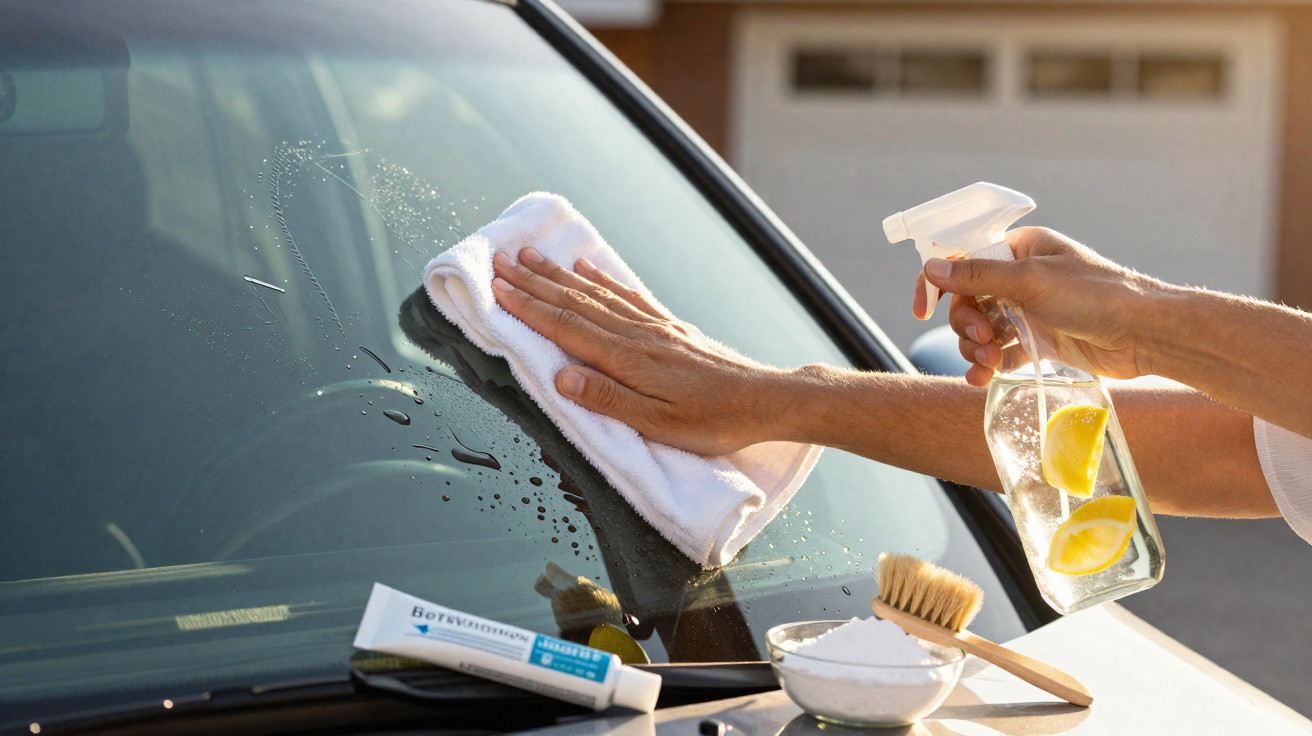
The soak dealt with most of my spots. A handful required a little persuasion. For those, the unexpected saviour came from the bathroom: a pea-sized amount of non-gel toothpaste, worked into the mark using a finger wrapped in damp microfibre. It acts as a mild abrasive, much like an exceptionally gentle polish, with sufficient grip to remove mineral halos without scratching. Use light pressure in small circles for thirty seconds, then rinse with water and dry. Finished.
For a kitchen-based option, combine bicarbonate of soda with a little water to make a paste, then apply it with the same circular action. There is something almost clinical about it; first the paste slides, then catches, then slides once more. For the most determined patches on my rear window - probably baked on after a week of reversing into afternoon sunshine - I used a square of 0000-grade steel wool, saturated in glass cleaner, and skimmed it across the surface. This ultra-fine grade is used by window fitters and detailers; when used wet and with a light touch, it is safe on exterior glass. Never use it on tinted glass or plastic, and try it in an unobtrusive corner first if the car has aftermarket film.
There is a modest pleasure in the rhythm. You feel the resistance fade and watch a flat-looking patch turn clear. It calls for patience rather than brute force, and that is unusual for car cleaning because the reward arrives so quickly.
The overlooked step: rinse properly
After loosening and removing the minerals, the greatest kindness you can show your future self is a proper rinse. Not a token splash from a bottle, but a deliberate wash with clean water, followed by drying with an absorbent cloth so nothing remains to become tomorrow’s problem. If your tap water carries plenty of limescale - as it does in many British homes - you can take a shortcut by saving a jug of cooled boiled water for the final rinse. It sounds overly particular until you see how cleanly the glass dries without spots.
For my last rinse, I used a trick recommended by a detailer friend: distilled water in a cheap spray bottle from the pound shop. A light mist, a soft wipe and the glass settled into a rich, uncomplicated shine. There were no arcs, halos or streaks that reveal themselves only when you are halfway to the school gates. It is the distinction between simply clean and visually quiet. Your eyes no longer have to work as hard.
I also wiped along the wiper blades. Minerals and dust settle there as well, and the first rainfall can transfer them straight back to the place you least want them. A quick pinch-and-pull down each rubber blade does the job. That small additional task stops the next shower from reversing all your effort.
Make the result last with a sealant
Once the glass is genuinely clean - with no residue or sleight of hand - you can help it stay that way for longer. This does not need to become a showroom-level routine. Apply a thin coat of glass sealant, or a small amount of liquid car wax, to the dry window and buff it away after a minute. The layer encourages water to bead and run off, leaving fewer droplets sitting long enough to deposit minerals. It can also make wipers glide quietly rather than chatter; I had not noticed how irritating that sound was until it disappeared.
Anyone who has used rain repellent on a windscreen before a motorway journey will know the effect. It will not turn you into a rally driver, and it cannot deal with greasy film inside the car, but it gives you extra time. The next heavy shower works as a rinse instead of laying down another coating of dust and chalk. It also stops you reaching for the blue spray every other day like a glass-obsessed meerkat.
A driveway trial, a neighbour’s Fiesta and a small cheer
A useful test for any trick is trying it on another car. My neighbour’s Fiesta lives beneath an upstairs bathroom vent that drips with metronomic regularity. Its rear screen had become a pattern of pale speckles, built up over a year. We began with the warm vinegar towel, and the marks almost seemed to exhale. The worst ones took a dab of toothpaste and a careful minute of circular rubbing. Then came the rinse, the drying and the calm gleam.
Small successes have a way of spreading. Two people walking past asked what we had used, drawn by the admittedly silly picture of two adults smelling a microfibre cloth that reeked of chips. The Fiesta owner repeatedly stepped back, moved closer, then stepped back again, as if the clarity might disappear the moment he looked away. I didn’t expect a tea towel and a bottle from the condiments shelf to show off like that. It was like passing on a secret, but without any smugness.
Simple mistakes to avoid
It is easy to make this task more difficult than necessary. Direct sunlight is the chief offender: it heats the glass, dries the liquid too rapidly and leaves you chasing streaks while the mineral deposits remain fixed. Work in shade or leave it until early evening. Do not allow vinegar or paste to trail across paintwork or plastic trim; if anything drips, wipe it off immediately. Keep the treatment on the glass and the outcome will be gentler.
Another mistake is combining products and tasks. Bleach and vinegar are not compatible, so leave bathroom cleaning habits indoors. Use fresh cloths too, as fabric-softener residue on towels causes smears that can make you question your eyesight. Do not begin with harsh abrasives, either. Most marks need softening rather than a battle. Reserve polishing for the occasional spot that demands it, and even then use it only on exterior glass, well away from tints and sensors.
If the hard water spots still will not shift
Occasionally, an apparent stain is actually a shallow etch. Older deposits can bite into the glass’s outer layer. When vinegar, paste and patience still leave a faint trace, it is time for light polishing. A proper glass polish or a cerium-oxide-based product, used sparingly with a felt pad, can work out the remaining mark. It is essentially the more serious version of the toothpaste method, best approached slowly, one panel at a time, with frequent wipe-downs to inspect the result.
If you are uneasy about doing this - or your windscreen has chips, sensors or heated elements you would rather not interfere with - there is no embarrassment in stopping there. A valeter or detailer can carry out a targeted polish in an hour, often for less than you might expect. The basic rule is straightforward: if you cannot feel it with a fingertip but can still see it, it can probably be removed. If you can feel a dip, you are managing the issue rather than erasing it. Either way, you will have a cleaner, clearer view, which is the aim.
A short ritual that improves every drive
Driving later that day felt unexpectedly calm. The world seemed crisper around the edges, as though somebody had adjusted a camera’s focus ring. Cyclists become visible sooner. You meet the gleam of rain with less squinting. Glass is not meant to be thrilling, but clarity creates a feeling of its own and it affects you. The cabin feels brighter when your eyes are not constantly straining.
This is not a job reserved for weekends, nor is it a bucket-and-hours marathon. It is a five-minute rescue whenever sunshine exposes the state of your windows: a warm cloth, a splash of vinegar, a patient wipe and a thorough rinse. Add a quick sealant if you feel inclined. There is no badge of honour and no need to boast, only the quiet satisfaction of seeing your own street as though it has been returned to you.
Here is the small lesson I wish I had picked up earlier: the best cleaning hacks do not create more work; they remove friction. They make a chore into a little routine you can do almost automatically. The vinegar towel trick achieves precisely that for hard water spots on car windows. It makes something that appears stubborn feel easy. It is almost like cheating, which may be exactly why it is so satisfying.




Comments
No comments yet. Be the first to comment!
Leave a Comment