
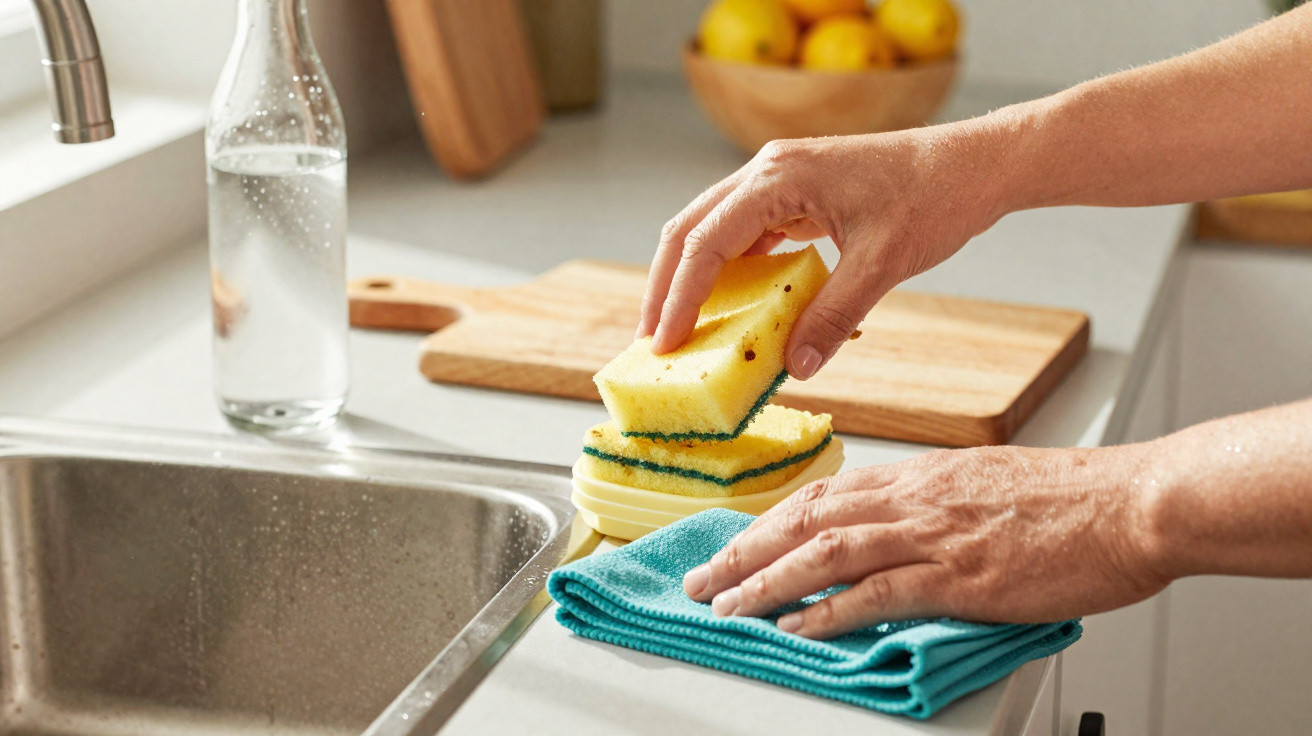
Laboratory testing, however, presents a much less reassuring reality.
Throughout Europe, microbiology laboratories have been taking a closer look at the items we touch, wash and wipe each day. Their results indicate that one of the kitchen’s most familiar “cleaning” items may function less like a hygiene aid and more like a bacterial tower block.
The filthiest item in an apparently clean home
An ideal environment for microbial growth
Recent European research indicates that an ordinary kitchen sponge may contain as many as 50 billion bacteria per cubic centimetre. This is not an error. The item used to scour dishes and clean worktops holds moisture, food debris and heat in abundance - precisely the conditions microbes favour.
Its porous structure retains water and food fragments, making it slow to dry and converting each small opening into a potential breeding site. Within this damp labyrinth, bacteria multiply rapidly and create communities that are not removed by a quick rinse under the tap.
In 1 cm³ of a used kitchen sponge, labs have measured bacterial counts comparable to those found in sewage sludge.
Figures published by a national food safety centre found that over 70% of the household sponges examined contained pathogenic bacteria, including Escherichia coli and Staphylococcus aureus. Such microbes are strongly associated with digestive illnesses, skin conditions and, among vulnerable people, potentially more severe complications.
The danger lies in what experts describe as cross-contamination. After cleaning a chopping board used for raw chicken, the same sponge may then be used on the worktop, sink, table and even a baby’s high chair. Each wipe can transfer unseen colonies between surfaces.
A neglected issue in household routines
The risk is greater in homes with small children, pregnant women or older people, whose immune systems may respond less strongly. Even so, daily habits rarely reflect this. A single sponge is commonly used for nearly everything: washing up, the hob, sink, fridge seals and even liquid spills on the floor.
Hygiene professionals emphasise that replacement frequency is as important as cleaning method. After several weeks of use, a sponge gradually becomes a microbial storehouse that detergent alone cannot properly address.
A simple weekly replacement of the kitchen sponge can drastically cut the average bacterial load that circulates around the sink area.
Experts commonly advise several small but targeted steps:
- Change the kitchen sponge at least every 7 days.
- Rinse it straight after use and run very hot water through it.
- Do not use it directly on surfaces that have touched raw meat or fish.
- Do not leave it sitting in water; allow it to dry rapidly, ideally in an upright position.
Although these actions may appear insignificant, they disrupt the bacterial “supply chain” running from the sink to the rest of the kitchen.
The growing use of washable microfibre as a safer alternative
Lower microbial levels and a longer working life
Over the past decade, numerous households have moved away from traditional yellow-and-green sponges towards microfibre cloths. Made with extremely fine synthetic fibres, these textiles capture dust and residue through electrostatic attraction rather than absorption alone.
Microfibre offers one key microbiological benefit: it can withstand high temperatures. Unlike a standard sponge, which can lose its shape or melt in very hot water, a microfibre cloth can be laundered at 60°C or higher, greatly limiting microbial survival.
Hygiene laboratory comparisons point to a reduction of up to 99% in residual microbial load following suitable washing, compared with conventional synthetic sponges that are never put through a washing machine.
| Material | Average residual bacteria (units/cm³) | Thermal disinfection possible? |
|---|---|---|
| Standard synthetic sponge | 50,000,000,000 | No |
| Cotton dishcloth | 5,000,000,000 | Yes (hot wash) |
| Microfibre cloth | 500,000,000 | Yes (≥60°C) |
Microfibre generally dries more quickly than thick sponges too, interrupting bacterial multiplication between uses. For hygiene specialist Christophe Mercier-Thellier and other professionals, this change represents a quiet shift in the way cleaning equipment is viewed.
When a cloth goes into the washing machine at 60°C every day, it behaves more like a washable garment than a permanent bacterial nest.
Nevertheless, microfibre is not a fail-safe solution. Colonies can still develop when a cloth is left damp and scrunched at the bottom of the sink. Regular laundering, complete drying and clear task separation - one cloth for washing up and another for surfaces - are still central to a safer routine.
Everyday habits that genuinely improve home hygiene
Hand hygiene remains the foundation
Although sponges and cloths receive plenty of attention, hands are still the main means by which microbes travel around the home. Health authorities continue to recommend regular handwashing before eating, after using the toilet, after handling raw food, and after touching bins or pet-related items.
There is an important qualification, though. Dermatologists caution against overusing aggressive soaps, as these can remove the skin’s protective microbiome. This population of “good” bacteria forms a natural defensive layer; if it is disrupted, irritation and infections may occur more often.
Public health guidance generally favours lukewarm water, gentle soap, a careful 20-second wash and thorough drying with a clean towel. Antibacterial products are useful in clinical environments, but in the typical home they can be reserved for particular circumstances, including caring for someone who is ill.
Shared soap and public toilets
The position is different in communal settings. Traditional soap bars handled by dozens of people in schools, gyms or workplaces can accumulate microorganisms from successive users. Dampness, soap residue and repeated contact create a small yet genuine reservoir.
This is why many infection-control experts prefer wall-mounted liquid-soap dispensers or single-use gel portions in public toilets. Push-button and touch-free systems reduce contact points and limit microbial “traffic” from one user to another.
A clean, well-stocked soap dispenser and a functioning hand dryer often do more for public health than complicated disinfection rituals.
The subtle evolution of home hygiene habits
Greater awareness since the pandemic period has altered how many families manage day-to-day cleaning. In Italian kitchens, and increasingly across the UK and US, traditional plastic sponges now sit alongside washable alternatives, including microfibre cloths, cellulose pads, compostable wipes and reusable silicone scrubbers.
Manufacturers increasingly promote dishcloths assessed against standards such as ISO 20743 for antibacterial performance, as well as products made without synthetic plastics to reduce environmental effects. This movement brings hygiene worries together with climate anxiety, both of which now influence household purchasing decisions.
Some households use colour-coding: one cloth for areas used for raw meat, another for everyday surfaces and a separate one for the bathroom. Others arrange weekly “tool resets”, laundering every cloth at high temperature, replacing damaged items and disinfecting brushes or sink caddies.
Beyond the sponge: other concealed kitchen reservoirs
Water bottles, boards and fridge seals
The sponge is by no means the only unexpected source. Reusable water bottles, particularly those taken to the gym or workplace, frequently have high microbial counts on their caps, straws and rubber seals. If bottles are repeatedly refilled without being washed correctly, traces of saliva provide bacteria with a steady source of moisture and nutrients.
Chopping boards can also become sites of cross-contamination, especially when the same one is used for raw meat and vegetables. Deep cuts from knives retain juices beyond the reach of ordinary rinsing. Specialists normally advise keeping separate boards for raw animal products and ready-to-eat food, alongside regular hot washing or dishwasher cleaning where possible.
Fridge-door seals are missed in many cleaning schedules, yet they collect crumbs, spills and condensation. Their narrow grooves remain damp and protected from light, following a familiar rule: microbes flourish where organic residue and moisture remain.
Straightforward ways to lower daily risk
Hygiene researchers often frame the home as a network of “high-touch points”. Rather than attempting to sterilise every item - an unrealistic and unnecessary aim - they recommend concentrating on a short list of crucial areas:
- Items that remain damp, such as sponges, cloths, bottle caps and bathroom mats
- Surfaces exposed to raw food, including boards, knives, the sink and the worktop around the hob
- Handles and switches touched regularly by several people, such as fridge handles, taps and light switches
By dealing with these clusters using hotter water, more regular replacement and a firm division between “dirty” and “clean” equipment, households can reduce the risk of infection without making the home feel like a laboratory.
For people who prefer tangible figures, some public-health teams suggest a simple exercise: count how often the kitchen sponge touches a food-related surface in a day. Multiply this by seven, then compare the result with how often the sponge is replaced or properly disinfected. The difference between these figures can say more than any laboratory report.

Comments
Деревянные сувениры — шкатулки, футляры, рамки для фотографий https://flok-upakovka.ru/
Флокирование — это модно, стильно и необычно https://flok-upakovka.ru/privacy/
Не знаете где заказать услугу? Обращайтесь к нам https://flok-upakovka.ru/privacy/
2 https://flok-upakovka.ru/privacy/
Тканевые ложементы
Работаем в несколько этапов:
При флокировании применяются различные технологии, благодаря чему можно получить флокированные ложементы, обладающие текстурой густого бархата, нежной замши, шелковистого велюра или мягкого текстиля https://flok-upakovka.ru/privacy/
Применение флокированных ложементов существенно повышает привлекательность упаковки и выделяет товар среди прочих изделий https://flok-upakovka.ru/
Флокирование: что это такое?
Снижение временных затрат на упаковку товара;
Защита изделий от механической деформации;
Наносим флок https://flok-upakovka.ru/
Используем флокатор, который создает электростатическое поле https://flok-upakovka.ru/
В результате этого текстильные волокна материала подвергаются химической активации — так улучшается качество соединения https://flok-upakovka.ru/
Часто бархатные ложементы используют для коробок под медали и наборы монет https://flok-upakovka.ru/privacy/
Благодаря тому, что бархат немного тянется, при изготовлении под него можно положить поролон для дополнительной мягкости https://flok-upakovka.ru/
Leave a Comment