
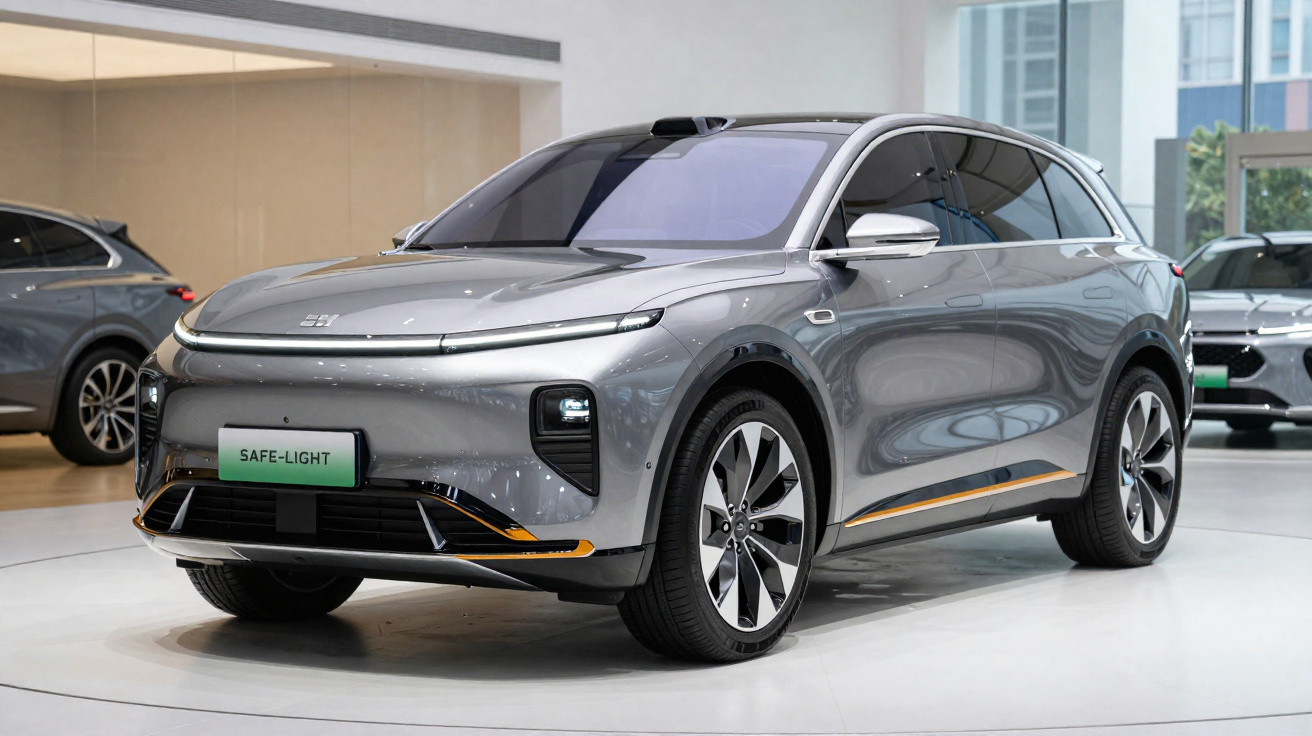
Passing lorries cast sharp, fleeting bursts of light through the car’s interior before darkness closed in again, broken only by the muted illumination of the dashboard. The driver has pulled onto the hard shoulder, hazard lights flashing faintly, with their pulse beating slightly quicker than the cooling fan. Their phone is at 5%. There are no street lamps, no nearby junction, only the unsettling sense of being tiny and isolated at the roadside.
They search the glove compartment and find receipts, an out-of-date map and an old pair of sunglasses. There is no proper light. The silence that follows feels weighty. It is often then that people recognise a frustrating truth: even a modern car filled with screens and sensors can leave you almost unable to see when something goes wrong.
One small item can transform that situation entirely.
Why a simple car flashlight quietly beats much of your “safety” equipment
In theory, your car may already seem prepared for almost anything. It has airbags, ABS, a phone with a bright display and perhaps a roadside assistance number saved somewhere. That can feel comforting, even impressively modern. But a flat battery, a broken fan belt after dark or a snowstorm is all it takes to reveal the distance between technology and reality.
A straightforward flashlight is the unglamorous hero here. It has no alerts and no apps; it simply provides a beam of light whether or not the car still has power. It does not require a signal, a password or reliable 4G coverage. It enables you to see, and being able to see is the first step towards remaining calm when everything else seems to be going wrong.
At a dark roadside, that dependable simplicity is worth more than any polished list of features.
Roadside assistance incident reports reveal a familiar pattern. Breakdowns frequently occur at night or in poor visibility, whether on winter evenings, early mornings or during heavy rain. A battery dies, a tyre bursts, or someone drives over debris on an unlit road. Drivers who handle these events most effectively tend to share three things: a calm manner, basic equipment and a light source that is not their phone.
Emergency responders often note that people spend the first ten minutes fumbling about. This is when poor choices start to appear: walking along an unlit hard shoulder, standing too near passing traffic, or remaining in a car that is partly in the carriageway because they cannot clearly identify a safe place to move. It may not sound dramatic until you consider that many fatal night-time accidents involve people who are already outside their vehicle.
Picture the same situation with a strong beam cutting through the darkness. The edge of the shoulder, the ditch, reflective marker posts and tools in the boot suddenly become visible again. Such a small difference can have major consequences.
The principle behind a car flashlight is surprisingly straightforward. An emergency is not solely defined by what has happened, but by what you can see during its first minute. What you can see influences every decision. Without light, your surroundings contract into a small, indistinct bubble, while fear fills the space where information ought to be. With light, that bubble expands: you can identify options, hazards and tools you had forgotten were there.
A flashlight also preserves precious time. Your phone can be reserved for communication rather than drained by its torch function. That alone could mean the difference between reaching a recovery vehicle and watching a “1% remaining” message while still searching for the jack beneath your seat. Light is not merely useful in practical terms; it also helps psychologically, giving your mind something certain to work with rather than leaving it to guesswork.
This is why many experienced drivers discreetly regard a flashlight as part of the car itself, rather than an optional accessory.
Choosing, storing and using a car flashlight without overthinking it
The right car flashlight is the one you can take hold of within three seconds, with your eyes shut, in darkness. That is the test that matters. Impressive lumen figures and tactical-looking designs are irrelevant if it is hidden beneath shopping bags and takeaway napkins in the boot. For most motorists, a compact LED flashlight with fresh batteries will do the job. Avoid both the tiny keyring novelty and the oversized camping lantern; choose something between those extremes.
Choose one that feels robust in the hand and has one obvious button. It should be waterproof, or at least water-resistant. It need not withstand a war, only a British winter. Magnetic bases appeal to many people because they allow the light to attach to the bodywork while they change a tyre. A basic wrist strap is useful too: dropping your light into a snowy ditch at 2 a.m. is the sort of minor mishap that quickly becomes legendary.
The next stage is the one most drivers overlook: choosing its exact home.
On a quiet afternoon, get into your car and set yourself a small challenge. Close your eyes, count to three and reach for the place where the flashlight will be kept. The centre console, door pocket or glove compartment are all possibilities. Select one location and do not alter it. It may sound a little childish, but stress makes everyone clumsier. In this situation, muscle memory is invaluable.
We have all seen “perfect” car emergency kits that look excellent on Instagram: immaculately packed, colour-coordinated, with every item labelled and folded. In reality, those kits commonly end up in the boot and are never used again. Let’s be honest: nobody genuinely does that every day. One dedicated flashlight positioned where your hand naturally reaches is much more valuable than a premium kit you have forgotten exists.
A simple ritual can help. Every few months, when you stop for fuel or clean the windscreen, switch the flashlight on for two seconds. If it flickers or seems dim, replace the batteries that week. There is no need for fuss or a special occasion; it is simply a small habit built into the car’s life.
Consider the usual failures. Some people depend on their phone light, which dazzles at close range, rapidly uses battery power and leaves one greasy hand trying to manage both a phone and wheel brace. Others put a large flashlight in the boot, only to discover that they cannot see well enough to find it. Some buy a rechargeable model, charge it once and then forget it until the night when everything is flat and quiet.
Here is the sympathetic reality: nobody wakes up thinking, “Tonight I’ll have a breakdown on a rural exit ramp.” Preparation therefore needs to be easy enough to become real, rather than merely something pinned to a board called “someday”. A brief checklist in your notes app, containing just “Flashlight checked?”, can sit quietly alongside reminders for oil changes and tyre rotations.
If other people use the car, tell them about it. Show your partner, a teenager learning to drive or a friend borrowing the vehicle where the light is stored. Point it out and have them pick it up once. That small moment of “Oh, okay, here it is” creates a memory. When a difficult night actually arrives, their mind can reach for that map automatically.
“The most useful tool you’ll ever own is the one you can find in the dark and use with cold hands,” a veteran roadside mechanic told me. “Half the battle is not feeling helpless on that shoulder.”
Treating the flashlight as a component of the car rather than an accessory brings a subtle change in mindset. It belongs beside your seatbelt, spare tyre and vehicle registration: quiet, ordinary and always present. That is real preparation-not spectacular, but consistent.
To make this more tangible, keep a short mental framework for your light and its purpose:
- See: Illuminate the ground, traffic, tools and people.
- Signal: Wave it or position it so other drivers can see you.
- Stay: Use it to remain safely where you are until help has genuinely arrived.
That small triangle-see, signal, stay-makes one modest item into a complete safety system that requires very little thought.
The overlooked reassurance of a car flashlight in your door pocket
There is a quiet confidence in knowing that darkness does not have complete control over you. It is subtle, almost like background noise, yet you notice it on long journeys, late trips home or when a storm crosses the motorway and turns the sky charcoal at 4 p.m. If something occurs-a strange sound, a warning light or a tyre making a flapping noise-you know you will not simply be looking into an empty void.
For families, this matters even more. Children immediately sense panic. When an adult calmly takes out a flashlight, gets out and moves with purpose, the atmosphere in the car changes. The view beyond the window becomes less threatening and more understandable. Teenagers who witness this once often carry the habit through life. This is how quiet habits spread.
At a deeper level, that modest beam is a reminder that safety is not one grand, dramatic action. It is a collection of small, nearly invisible decisions: keeping the fuel level above a quarter of a tank, carrying water, putting an old blanket in the boot and leaving a flashlight in the same place year after year. None of these actions will become social-media trends, but they can change the course of a bad night in meaningful ways.
Given enough time, every driver acquires a story: a winter breakdown, a flat tyre on an empty lane or an engine that stops on a bank holiday night when every recovery vehicle appears busy. The issue is not whether such moments will arise, but how they will feel when they do. A small, reliable light in your hand will not solve every problem by magic. It does, however, restore one essential thing: the feeling that you can act rather than merely endure.
The next time you enter your car after dark, take three seconds to look around. Check the glove compartment, door pockets and centre console. Imagine the lights off, the engine silent and the outside world unfamiliar. Then picture your hand wrapping around that cold, uncomplicated cylinder of metal or plastic. That is the difference between being lost in the dark and being temporarily delayed.
| Key point | Detail | Benefit for the reader |
|---|---|---|
| Choose a simple, dependable flashlight | LED, medium size, single button and rain-resistant | Ensures you have a light that genuinely works when everything else fails |
| Give it a fixed place in the car | Centre console, glove compartment or door pocket, always in the same location | Saves valuable seconds under stress, without searching in the dark |
| Maintain a small routine | Test the flashlight every few months and replace batteries as soon as the beam weakens | Maintains quiet reassurance without major effort or complicated equipment |
FAQ
- What type of flashlight is best to keep in a car? An LED flashlight with good brightness, a single on/off button and standard AA or AAA batteries is ideal. It should be durable, water-resistant and small enough that you will not be tempted to store it in the boot.
- Where should I keep a flashlight in my car? Choose one place you can reach from the driver’s seat, such as the centre console, the driver’s door pocket or the glove compartment. Consistency is essential, so your hand finds it automatically in the dark.
- Isn’t my phone flashlight sufficient in an emergency? A phone light can help in a pinch, but it drains the battery quickly and is awkward to hold while working. A dedicated flashlight keeps your phone available for calls, navigation and emergency services.
- How often should I inspect or replace the batteries? Briefly switch it on every few months, for example when you refuel or have the car serviced. If the beam is dim or flickers, change the batteries that week rather than waiting for an emergency.
- Are rechargeable flashlights suitable for a car? They can be, provided you regularly recharge them. If that is unlikely, a flashlight using ordinary batteries may be the safer choice, as fresh replacements are available from most shops or a spare pack.




Comments
No comments yet. Be the first to comment!
Leave a Comment